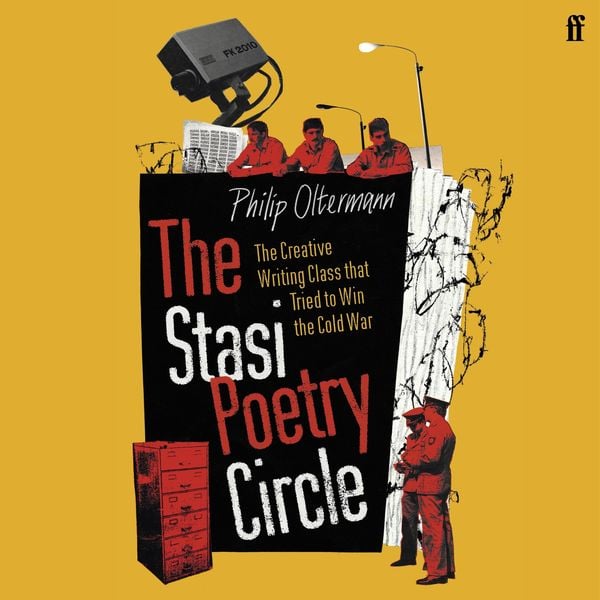

Philip Oltermann
1. The Stasi Poetry Circle
The Stasi Poetry Circle The Creative Writing Class that Tried to Win the Cold War
Gesprochen von
-
- Taschenbuch
- eBook
- Hörbuch ausgewählt
-
Form:Osiander Hörbuch-Abo
-
Sprache:Englisch
0,00 € *
inkl. gesetzl. MwSt.
* im Probemonat gratis danach 7,95 €/Monat
* im Probemonat gratis danach 7,95 €/Monat
Im Hörbuch-Abo laden
- Monatlich einen Titel wählen & behalten
- Jederzeit pausieren oder kündigen
- Weitere Hörbücher im Abo für max. 7,95 €
Beschreibung
Produktdetails
Family Sharing
Ja
Gesprochen von
Leighton PughSpieldauer
6 Stunden und 1 Minute
Abo-Fähigkeit
Ja
Erscheinungsdatum
24.02.2022
Hörtyp
Lesung
Fassung
ungekürzt
Medium
MP3
Anzahl Dateien
13
Verlag
Faber & FaberSprache
Englisch
EAN
9780571377114
The extraordinary true story of the Stasi's poetry club: Stasiland and The Lives of Others crossed with Dead Poets Society.
'A magnificent book . . . at once touching, exquisite, devastating and extraordinary.'
PHILIPPE SANDS, author of East West Street and The Ratline
'A vivid, funny, and imperturbable portrait of Soviet Russia's most loyal satellite.'
NELL ZINK
Berlin, 1982. Morale is at rock bottom in East Germany as the spectre of an all-out nuclear war looms. The Ministry for State Security is hunting for creative new weapons in the war against the class enemy - and their solution is stranger than fiction. Rather than guns, tanks, or bombs, the Stasi develop a programme to fight capitalism through rhyme and verse, winning the culture war through poetry - and the result is the most bizarre book club in history.
Consisting of a small group of spies, soldiers and border guards - some WW2 veterans, others schoolboy recruits - the 'Working Group of Writing Chekists' met monthly until the Wall fell. In a classroom adorned with portraits of Lenin, they wrote their own poetry and were taught verse, metre, and rhetoric by East German poet Uwe Berger. The regime hoped that poetry would sharpen the Stasi's 'party sword' by affirming the spies' belief in the words of Marx and Lenin, as well as strengthening the socialist faith of their comrades. But as the agents became steeped in poetry, revelling in its imaginative ambiguity, the result was the opposite. Rather than entrenching State ideology, they began to question it - and following a radical role reversal, the GDR's secret weapon dramatically backfired.
Weaving unseen archival material and exclusive interviews with surviving members, Philip Oltermann reveals the incredible hidden story of a unique experiment: weaponising poetry for politics. Both a gripping true story and a parable about creativity in a surveillance state, this is history writing at its finest.
'A magnificent book . . . at once touching, exquisite, devastating and extraordinary.'
PHILIPPE SANDS, author of East West Street and The Ratline
'A vivid, funny, and imperturbable portrait of Soviet Russia's most loyal satellite.'
NELL ZINK
Berlin, 1982. Morale is at rock bottom in East Germany as the spectre of an all-out nuclear war looms. The Ministry for State Security is hunting for creative new weapons in the war against the class enemy - and their solution is stranger than fiction. Rather than guns, tanks, or bombs, the Stasi develop a programme to fight capitalism through rhyme and verse, winning the culture war through poetry - and the result is the most bizarre book club in history.
Consisting of a small group of spies, soldiers and border guards - some WW2 veterans, others schoolboy recruits - the 'Working Group of Writing Chekists' met monthly until the Wall fell. In a classroom adorned with portraits of Lenin, they wrote their own poetry and were taught verse, metre, and rhetoric by East German poet Uwe Berger. The regime hoped that poetry would sharpen the Stasi's 'party sword' by affirming the spies' belief in the words of Marx and Lenin, as well as strengthening the socialist faith of their comrades. But as the agents became steeped in poetry, revelling in its imaginative ambiguity, the result was the opposite. Rather than entrenching State ideology, they began to question it - and following a radical role reversal, the GDR's secret weapon dramatically backfired.
Weaving unseen archival material and exclusive interviews with surviving members, Philip Oltermann reveals the incredible hidden story of a unique experiment: weaponising poetry for politics. Both a gripping true story and a parable about creativity in a surveillance state, this is history writing at its finest.
Noch keine Bewertungen vorhanden
Verfassen Sie die erste Bewertung zu diesem Artikel
Helfen Sie anderen Kundinnen und Kunden durch Ihre Meinung.
Kurze Frage zu unserer Seite
Vielen Dank für Ihr Feedback
Wir nutzen Ihr Feedback, um unsere Produktseiten zu verbessern. Bitte haben Sie Verständnis, dass wir Ihnen keine Rückmeldung geben können. Falls Sie Kontakt mit uns aufnehmen möchten, können Sie sich aber gerne an unseren Kund*innenservice wenden.
zum Kundenservice