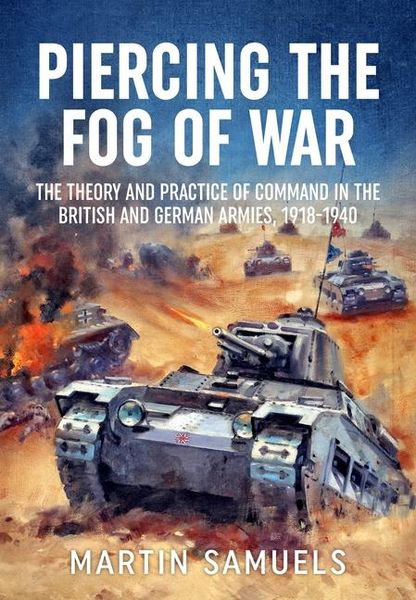
Piercing the Fog of War The Theory and Practice of Command in the British and German Armies, 1918-1940
-
- Englisch ausgewählt
37,99 €
inkl. gesetzl. MwSt.,
Beschreibung
Produktdetails
Einband
Taschenbuch
Erscheinungsdatum
31.03.2024
Verlag
Helion & CompanySeitenzahl
332
Maße (L/B/H)
15,5/23,3/2 cm
Gewicht
722 g
Sprache
Englisch
ISBN
978-1-80451-478-8
Since the late 1970s, anglophone and German military literature has been fascinated by the Wehrmacht's command system, especially the practice of Auftragstaktik. There have been many descriptions of the doctrine, and examinations of its historical origins, as well as unflattering comparisons with the approaches of the British and American armies prior to their adoption of Mission Command in the late 1980s. Almost none of these, however, have sought to understand the different approaches to command in the context of a fundamental characteristic of warfare - friction. This would be like trying to understand flight, without any reference to aerodynamics. Inherently flawed, yet this is the norm in the military literature.
This book seeks to address that gap. First, the nature of friction, and the potential command responses to it, are considered. This allows the development of a typology of eight command approaches; each approach then being tested to identify its relative effectiveness and requirements for success. Second, the British and German armies' doctrines of command during the period are examined, in order to reveal similarities and differences in relation to their perspective on the nature of warfare and the most appropriate responses. The experience of Erwin Rommel, both as a young subaltern fighting the Italians in 1917, and then as a newly-appointed divisional commander against the French in 1940, is used to test the expression of the German doctrine in practice. Third, the interaction of these different command doctrines is explored in case studies of two key armored battles, Amiens in August 1918 and Arras in May 1940, allowing the strengths and weaknesses of each to be highlighted and the typology to be tested. The result is intended to offer a new and deeper understanding of both the nature of command as a response to friction, and the factors that need to be in place in order to allow a given command approach to achieve success. The book therefore in two ways represents a sequel to the author's earlier work, Command or Control? Command, Training and Tactics in the British and German Armies, 1888-1918 (London: Cass, 1995), in that it both takes the conceptual model of command developed there to a deeper level, and also takes the story from the climax of 1918 up to the end of the first phase of the Second World War.
Noch keine Bewertungen vorhanden
Verfassen Sie die erste Bewertung zu diesem Artikel
Helfen Sie anderen Kundinnen und Kunden durch Ihre Meinung.
Kurze Frage zu unserer Seite
Vielen Dank für Ihr Feedback
Wir nutzen Ihr Feedback, um unsere Produktseiten zu verbessern. Bitte haben Sie Verständnis, dass wir Ihnen keine Rückmeldung geben können. Falls Sie Kontakt mit uns aufnehmen möchten, können Sie sich aber gerne an unseren Kund*innenservice wenden.
zum Kundenservice