Statistical Methods for Handling Incomplete Data
-
- Hardcover
- Taschenbuch ausgewählt
- eBook
-
Sprache:Englisch
77,99 €
inkl. gesetzl. MwSt.,
Beschreibung
Produktdetails
Einband
Taschenbuch
Erscheinungsdatum
29.01.2024
Abbildungen
6 SW-Abb., 6 SW-Zeichn., 28 Tabellen
Verlag
Taylor & FrancisSeitenzahl
382
Maße (L/B/H)
23,4/15,6/2,1 cm
Gewicht
579 g
Auflage
2. Auflage
Sprache
Englisch
ISBN
978-1-03-211813-0
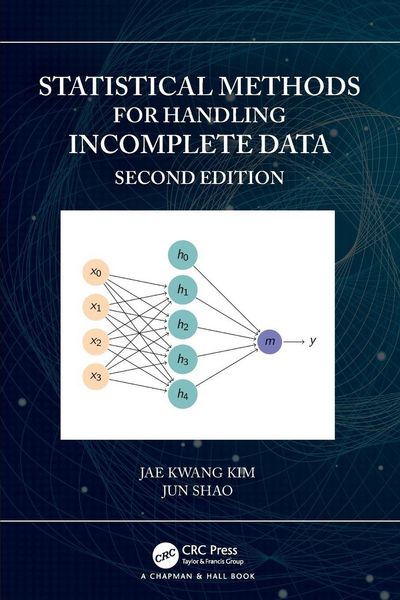
Due to recent theoretical findings and advances in statistical computing, there has been a rapid development of techniques and applications in the area of missing data analysis. Statistical Methods for Handling Incomplete Data covers the most up-to-date statistical theories and computational methods for analyzing incomplete data.
Features
- Uses the mean score equation as a building block for developing the theory for missing data analysis
- Provides comprehensive coverage of computational techniques for missing data analysis
- Presents a rigorous treatment of imputation techniques, including multiple imputation fractional imputation
- Explores the most recent advances of the propensity score method and estimation techniques for nonignorable missing data
- Describes a survey sampling application
- Updated with a new chapter on Data Integration
- Now includes a chapter on Advanced Topics, including kernel ridge regression imputation and neural network model imputation
The book is primarily aimed at researchers and graduate students from statistics, and could be used as a reference by applied researchers with a good quantitative background. It includes many real data examples and simulated examples to help readers understand the methodologies.
Noch keine Bewertungen vorhanden
Verfassen Sie die erste Bewertung zu diesem Artikel
Helfen Sie anderen Kundinnen und Kunden durch Ihre Meinung.
Kurze Frage zu unserer Seite
Vielen Dank für Ihr Feedback
Wir nutzen Ihr Feedback, um unsere Produktseiten zu verbessern. Bitte haben Sie Verständnis, dass wir Ihnen keine Rückmeldung geben können. Falls Sie Kontakt mit uns aufnehmen möchten, können Sie sich aber gerne an unseren Kund*innenservice wenden.
zum Kundenservice