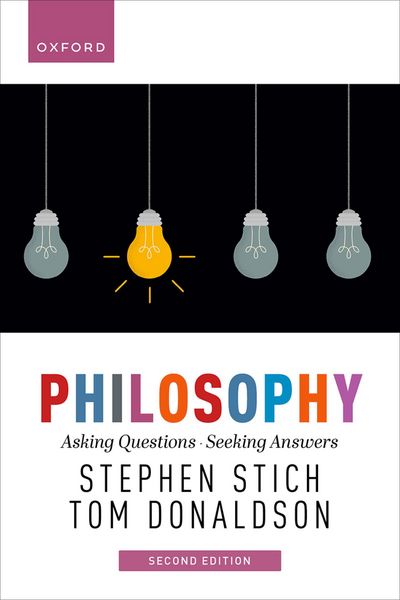
Produktbild: Philosophy, 2e

Philosophy, 2e Asking Questions, Seeking Answers

77,99 €

inkl. gesetzl. MwSt., Versandkostenfrei


Beschreibung

Produktdetails

Einband

Taschenbuch

Erscheinungsdatum

17.10.2024

Verlag

Oxford Academic

Seitenzahl

456

Maße (L/B/H)

20,9/14,1/2,5 cm

Gewicht

499 g

Auflage

2 Revised edition

Sprache

Englisch

ISBN

978-0-19-776801-3

Beschreibung

Produktdetails

Einband

Taschenbuch

Erscheinungsdatum

17.10.2024

Verlag

Oxford Academic

Seitenzahl

456

Maße (L/B/H)

20,9/14,1/2,5 cm

Gewicht

499 g

Auflage

2 Revised edition

Sprache

Englisch

ISBN

978-0-19-776801-3

Herstelleradresse

Libri GmbH
Europaallee 1
36244 Bad Hersfeld
DE

Email: gpsr@libri.de

Noch keine Bewertungen vorhanden

Verfassen Sie die erste Bewertung zu diesem Artikel

Helfen Sie anderen Kundinnen und Kunden durch Ihre Meinung.

Kundinnen und Kunden meinen

Bewertungen (0)

  • Produktbild: Philosophy, 2e
    • Preface?

    • CHAPTER 1 What Is Philosophy?

    • 1.1 Philosophy Is Everywhere

    • 1.2 What Is a Philosophical Question?

    • 1.3 The Philosophical Method

    • 1.4 Philosophy and Science

    • 1.5 Why Bother?

    • Discussion Question

    • Notes

    • CHAPTER 2 What Are Arguments, and How Should We Evaluate Them?

    • Introduction

    • 2.1 Premises and Conclusions

    • 2.2 Evaluating Arguments

    • 2.3 Deductive Validity

    • 2.4 Induction and Abduction

    • 2.5 Multistep Arguments

    • 2.6 Evaluating Multistep Arguments

    • 2.7 Some Arguments to Evaluate

    • 2.8 Answers to Problems

    • What to Look at Next

    • Glossary

    • Notes

    • CHAPTER 3 Does God Exist?

    • Introduction

    • 3.1 The First Cause Argument

    • 3.2 Some Questions about the First Cause Argument

    • 3.3 Leibniz's Cosmological Argument

    • 3.4 The Design Argument

    • 3.5 Criticisms of the Design Argument

    • 3.6 Anselm's Ontological Argument

    • 3.7 What, If Anything, Is Wrong with Anselm's Ontological Argument?

    • 3.8 A Pragmatic Case for Theism?

    • Conclusion

    • Glossary

    • Comprehension Questions

    • Discussion Questions

    • What to Look at Next

    • Notes

    • CHAPTER 4 Why Does God Leave Us to Suffer?

    • Introduction

    • 4.1 Three Logical Puzzles for Theists

    • 4.2 Introducing the Problem of Evil

    • 4.3 Three Inadequate Responses

    • 4.4 Rethinking the Nature of God

    • 4.5 Theodicy

    • 4.6 Skeptical Theism

    • Conclusion

    • Glossary

    • Comprehension Questions

    • Discussion Questions

    • What to Look at Next

    • Notes

    • CHAPTER 5 Can We Be Completely Certain of Anything?

    • Introduction

    • 5.1 Descartes's Project

    • 5.2 Certainty Is Hard to Find

    • 5.3 Achieving Certainty

    • 5.4 Clear and Distinct Perception

    • 5.5 Descartes's Theism, and His Solution to the Evil Demon Problem

    • 5.6 The Cartesian Circle

    • 5.7 Descartes's Legacy

    • Conclusion

    • Glossary

    • Comprehension Questions

    • Discussion Questions

    • What to Look at Next

    • Notes

    • CHAPTER 6 Can We Trust Our Senses?

    • 6.1 Rationalism and Empiricism

    • 6.2 Indirect Realism

    • 6.3 Primary and Secondary Qualities

    • 6.4 Do Material Objects Really Exist?

    • 6.5 Berkeley's Idealism

    • 6.6 Direct Realism

    • Conclusion

    • Glossary

    • Comprehension Questions

    • Discussion Questions

    • What to Look at Next

    • Notes

    • CHAPTER 7 Will the Sun Rise Tomorrow?

    • Introduction

    • 7.1 Making Predictions

    • 7.2 Hume's Problem

    • 7.3 Karl Popper

    • 7.4 Peter Strawson

    • 7.5 Epistemically Basic Beliefs

    • 7.6 Beyond Enumerative Induction

    • Glossary

    • Comprehension Questions

    • Discussion Questions

    • What to Look at Next

    • Notes

    • CHAPTER 8 What Is Knowledge?

    • Introduction

    • 8.1 Three Kinds of Knowledge

    • 8.2 Analyzing Propositional Knowledge: The Easy Part-Belief and Truth

    • 8.3 Analyzing Propositional Knowledge: The Hard Part-Justification

    • 8.4 Foundationalism

    • 8.5 Coherentism

    • 8.6 Internalism and Externalism

    • 8.7 Fallibilism and Skepticism

    • 8.8 Gettier Cases-A Challenge to the Justified True Belief Account of Knowledge

    • Glossary

    • Comprehension Questions

    • Discussion Questions

    • What to Look at Next

    • Notes

    • CHAPTER 9 Do We Have Free Will?

    • 9.1 What Is Determinism?

    • 9.2 Incompatibilism

    • 9.3 Compatibilism

    • 9.4 Libertarianism

    • Glossary

    • Comprehension Questions

    • Discussion Questions

    • What to Look at Next

    • Notes

    • CHAPTER 10 Race

    • Introduction

    • 10.1 Racialism XX

    • 10.2 Non-Racialist Meanings of 'Race'

    • Summary XX

    • Glossary

    • Comprehension Questions

    • Discussion Questions

    • What to Look at Next

    • Notes

    • CHAPTER 11 How Is Your Mind Related to Your Body?

    • Introduction

    • 11.1 Cartesian Dualism

    • 11.2 Philosophical Behaviorism

    • 11.3 The Mind-Brain Identity Theory

    • 11.4 Functionalism

    • 11.5 Physicalism, Zombies and a Revival of Dualism

    • Glossary

    • Comprehension Questions

    • Discussion Questions

    • What to Look at Next

    • Notes

    • CHAPTER 12 Will You Be the Same Person in Ten Years? Could You Survive Death?

    • 12.1 The Philosophical Issue and Its Practical Importance

    • 12.2 The Soul Theory

    • 12.3 Problems for Soul Theory

    • 12.4 Memory Theories

    • 12.5 Personal Identity and the Brain

    • Glossary

    • Comprehension Questions

    • Discussion Questions

    • What to Look at Next

    • Notes

    • CHAPTER 13 Are There Objective Truths about Right and Wrong?

    • Introduction

    • 13.1 Objective Truth

    • 13.2 The Divine Command Theory

    • 13.3 Cultural Relativism

    • 13.4 Subjectivism and Expressivism

    • 13.5 The Qualified Attitude Theory

    • Conclusion

    • Glossary

    • Comprehension Questions

    • Discussion Questions

    • What to Look at Next

    • Notes

    • CHAPTER 14 What Really Matters?

    • Introduction

    • 14.1 Hedonism

    • 14.2 Sartre

    • 14.3 Susan Wolf on Meaningfulness

    • Conclusion

    • Glossary

    • Comprehension Questions

    • Discussion Questions

    • What to Look at Next

    • Notes

    • CHAPTER 15 What Should We Do? (Part I)

    • 15.1 Act Consequentialism and Act Utilitarianism

    • 15.2 Objections to Act Utilitarianism

    • 15.3 Rule Consequentialism and Rule Utilitarianism

    • 15.4 Kant's Universalization Test

    • 15.5 Kant's Humanity Formula

    • 15.6 Comparing Kantianism and Consequentialism

    • Glossary

    • Comprehension Questions

    • Discussion Questions

    • What to Look at Next

    • Notes

    • CHAPTER 16 What Should We Do? (Part II)

    • Introduction

    • 16.1 Is It Morally Wrong to Go to the Opera While People Are Starving?

    • 16.2 Vegetarianism

    • 16.3 Is Abortion Morally Wrong?

    • Glossary

    • Comprehension Questions

    • Discussion Questions

    • What to Look at Next

    • Notes

    • CHAPTER 17 Why Democracy?

    • 17.1 What is Democracy?

    • 17.2 The Basic Argument Against Democracy

    • 17.3 A Modest Defence of Democracy

    • 17.4 Are Democratic Countries Well Run?

    • 17.5 Non-Instrumental Defenses of Democracy

    • Conclusion

    • Glossary

    • Comprehension Questions

    • Discussion Questions

    • What to Look at Next

    • Appendix: A General Knowledge Quiz

    • Appendix A: Reading and Writing Tips

    • Seven Tips on Reading Philosophy

    • Eighteen Tips for Writing Philosophy Papers

    • Appendix B: The Truth about Philosophy Majors

    • Careers

    • Salaries

    • Meaning

    • Resources

    • Notes

    • Glossary

    • Credits

    • Index