Gutscheinbedingungen

Gültig bis 19.08.2026 | Gültig für Spielzeug, Filme, Musik, Software, Games, Elektronik, Geschenke & Trends, Schreibwaren, Hörbücher und Hörbuch-Downloads (außer Abo & Shelfies), gebrauchte Bücher, nicht preisgebundene Bücher und Kalender | Einlösbar unter osiander.de und in der Osiander App | Click & Collect nur mit Online-Zahlung (Paypal/Kreditkarte) vorab | Einzelne Artikel können ausgeschlossen sein | Nicht kombinierbar mit anderen Gutscheinen oder Preisaktionen | Nur einmal pro Einkauf einlösbar | Gutschein wird auf max. 500€ Bestellwert angerechnet | Keine Barauszahlung | Digitale Hörbücher nur für Android  | Nicht gültig für preisgebundene Artikel (aufgrund der Buchpreisbindung sind Gutscheine nicht auf Bücher, eBooks, Presse einlösbar), tolino eReader & Zubehör, Abonnements & Flatrates, Geschenkkarten, Versandkosten und Services

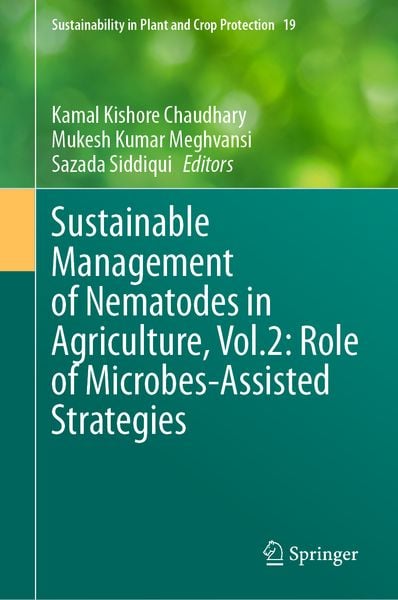
Produktbild: Sustainable Management of Nematodes in Agriculture, Vol.2: Role of Microbes-Assisted Strategies
- 12%

Sustainable Management of Nematodes in Agriculture, Vol.2: Role of Microbes-Assisted Strategies

12% sparen

187,99 € UVP 213,99 €

inkl. gesetzl. MwSt., Versandkostenfrei


Beschreibung

Produktdetails

Einband

Gebundene Ausgabe

Erscheinungsdatum

17.02.2024

Abbildungen

IX, 421 p. 24 illus., 17 illus. in color.

Herausgeber

Kamal Kishore Chaudhary + weitere

Verlag

Springer

Seitenzahl

421

Maße (L/B/H)

24,1/16/2,9 cm

Gewicht

811 g

Sprache

Englisch

ISBN

978-3-031-52556-8

Beschreibung

Portrait


Dr. Kamal Kishore Chaudhary
obtained his PhD while working on bacterial antagonist, Pasteuria penetrans against root-knot nematode Meloidogyne species at India’s premier research institute ICAR-CAZRI, Jodhpur. He served as Assistant Professor at Samara University, Samara (Ethiopia), Associate Professor, Hamelmalo Agricultural College, Keren (Eritrea) and as Associate Professor-Biotechnology at Mangalatayan University, India. He has more than 15 years of teaching and research experience. He is the member of Organization of Nematologists of Tropical America (ONTA), America. He is editor/reviewer for several international journals. He has several publications (research articles, review papers and book chapters) to his credit.

Dr Mukesh K Meghvansi
received his PhD in 2007 from MDS University, Ajmer (India) while working on biofertilizers under a multinational research project sponsored by the European Commission. He also holds an MBA degree with specialization in project management. For a stint, he served as lecturer at Bundelkhand University Jhansi (Uttar Pradesh, India) and then joined DRDO in July 2008 as a scientist 'C'. His area of research interest includes organic waste management. He has to his credit more than sixty research publications in various reputed international and national journals. He has filed three patents, three designs and one trademark in India. He is life member of several national/international professional bodies/societies including of Microbiologists Society India (MBSI), Biotech Research Society India (BRSI), The Association of Microbiologists of India (AMI), Glocal Environment & Social Association (GESA), Asian Biological Research Foundation (ABRF), Indian Botanical Society (IBS), and Assam Science Society. He is reviewer of many national/international journals. He is a Fellow of Royal Society of Biology (UK) and ABRF, India. He has authored/edited eight books including five with Springer International Publishing, Switzerland.  He is a recipient of ‘Best Innovation Award’ by MLS University Udaipur & MBSI for Advanced Biodigester as well as ‘Biotechnology Research Excellence Award-2023’ by BRSI and Society of Life Sciences, India. Currently, he is working as Scientist 'F' at Bioprocess Technology Division, Defence R&D Establishment, Gwalior (Madhya Pradesh), India.

Dr. Sazada Siddiqui,
PhD (Botany) has more than fifteen years of research/teaching experience. She obtained her PhD in 2002 from Barkatullah University, Bhopal (India) and joined subsequently as a faculty in botany department at Bundelkhand University, Jhansi (India). Currently she is serving as Associate Professor, King Khalid University, Abha (Saudi Arabia). She has more than fifty international and national publications (research articles, review articles, and book chapters) to her credit. His research interest includes phytoremediation, biological nutrient removal Cytotoxicity, and Allelopathy. She is a reviewer for many international journals. She has edited a book with Springer on Pesticide Bioremediation. Her another book entitled ‘Laboratory Techniques of Cytogenetics and Microbiology’ (ISBN 1530332222) is used in King Khalid University, Abha, Kingdom of Saudi Arabia for undergraduate and postgraduate students.

Produktdetails

Einband

Gebundene Ausgabe

Erscheinungsdatum

17.02.2024

Abbildungen

IX, 421 p. 24 illus., 17 illus. in color.

Herausgeber

Verlag

Springer

Seitenzahl

421

Maße (L/B/H)

24,1/16/2,9 cm

Gewicht

811 g

Sprache

Englisch

ISBN

978-3-031-52556-8

Herstelleradresse

Springer-Verlag KG
Sachsenplatz 4-6
1201 Wien
AT

Email: GPSR Kontakt

Noch keine Bewertungen vorhanden

Verfassen Sie die erste Bewertung zu diesem Artikel

Helfen Sie anderen Kundinnen und Kunden durch Ihre Meinung.

Kundinnen und Kunden meinen

Bewertungen (0)

  • Produktbild: Sustainable Management of Nematodes in Agriculture, Vol.2: Role of Microbes-Assisted Strategies

  • 1. Microbial-based Products and Soil Management Practices to Control Nematodes in Organic Horticultural Crops (Dawid Kozacki, Grażyna Soika, Andrzej Skwiercz and Eligio Malusà).- 2. Impact of Soil Disturbances on Soil Nematode Communities (Andrea Čerevková and Marek Renčo).- 3. Soil Microbiota and Mechanisms of Plant Parasitic Nematode Suppression (Nandni Sharma, Kanika Khanna, Ravinderjit Kaur, Shivam Jasrotia, Ripu Daman Parihar, Anjali Khajuria, Raman Tikoria, Sandeep Kour, Deepak Kumar, Renu Bhardwaj, Puja Ohri).- 4. Plant-parasitic Nematodes and Microbe Interactions: a Biological Control Perspective (Fouad Mokrini, Salah-Eddine Laasli, Said Ezrari, Zineb Belabess, Rachid Lahlali).- 5. Interactions of Free-Living Nematodes and Associated Microorganisms with Plant-Parasitic Nematodes (Ebrahim Shokoohi).- 6. Recent Advancements in the Use of Entomopathogens and Nematophagous Mites for the Management of Plant Parasitic Nematodes (Ramandeep K. Sandhi, Shabeg S. Briar and Gadi V.P. Reddy).- 7. Fungal Biocontrol Agents for Nematode Management in Organic Agriculture (Somnath Suresh Pokhare, Priyank Hanuman Mhatre, Manjunatha, N., Devata Patil, and Ruchi Agarrwal).- 8. Egg-Parasitic Fungi and Nematode Management (Mohammad Reza Moosavi).- 9. Fungal Antagonism and Effectiveness to Manage the Rice Root-knot Nematode, Meloidogyne Graminicola (Ziaul Haque, Mujeebur Rahman Khan, Seemab Zamir, Kartikey Pandey, Rajana Rakesh Naidu, Naina Gupta).- 10. Application of Bacillus Species in the Management of Meloidogyne Incognita (Oluwatoyin Adenike Fabiyi).- 11. Pasteuria Species for Nematodes Management in Organic Farms (Mahfouz Mohamed Mostafa Abd-Elgawad).- 12. Nematicidal Activity of Secondary Metabolites from Soil Microbes (Priyank Hanuman Mhatre, Yogesh E. Thorat, Manimaran B., Divya K.L., Aarti Bairwa, Satish N. Chavan, Somnath S. Pokhare, Ajinath S. Dukare, Chinnannan Karthik).- 13. Plant-Parasitic Nematode Control in Horticultural Crops of Argentina (Augusto Salas, José Matías Rusconi, Daiana Pamela Eliceche, Matías Nicolás Rosales, María Fernanda Achinelly, Eliseo Jorge Chaves, Diego Herman Sauka).- 14. Towards Innovative Strategies for Plant-parasitic Nematodes Biocontrol in Olive Tree Nurseries (Mohamed Aït Hamza, Hassan Boubaker, Odile Fossati-Gaschignard, James Nicholas Furze, El Hassan Mayad, Thierry Mateille, Abdelhamid El Mousadik).- 15. Biological Engineering and Its Relationship to Nematode Resistance (Tamer Ibrahim Abdel-Wahab, Sherif Ibrahim Abdel-Wahab, Eman Ibrahim Abdel-Wahab).- 16. Biological Control of Parasitic Nematodes and Pathogenic Fungi Damaging Black Pepper in Vietnam: a Case Study (Pham Van Toan, Tran Ngoc Khanh, Nguyen Thu Ha, Ho Hanh, Dao Huu Hien).