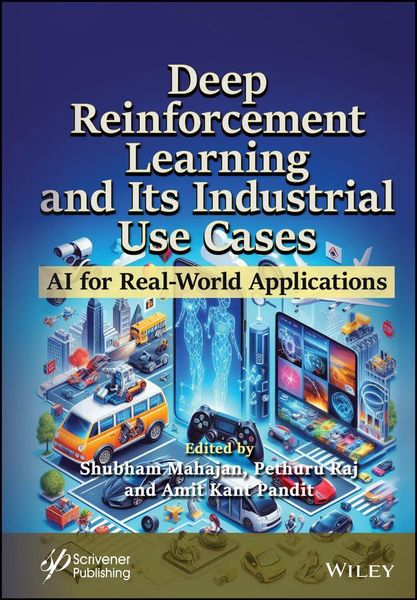
Produktbild: Deep Reinforcement Learning and Its Industrial Use Cases

Deep Reinforcement Learning and Its Industrial Use Cases AI for Real-World Applications

249,99 €

inkl. gesetzl. MwSt., Versandkostenfrei


Beschreibung

Produktdetails

Einband

Gebundene Ausgabe

Erscheinungsdatum

22.10.2024

Herausgeber

Shubham Mahajan + weitere

Verlag

Wiley

Seitenzahl

416

Maße (L/B/H)

25,7/18,3/2,8 cm

Gewicht

966 g

Sprache

Englisch

ISBN

978-1-394-27255-6

Beschreibung

Produktdetails

Einband

Gebundene Ausgabe

Erscheinungsdatum

22.10.2024

Herausgeber

Verlag

Wiley

Seitenzahl

416

Maße (L/B/H)

25,7/18,3/2,8 cm

Gewicht

966 g

Sprache

Englisch

ISBN

978-1-394-27255-6

Herstelleradresse

Libri GmbH
Europaallee 1
36244 Bad Hersfeld
DE

Email: gpsr@libri.de

Noch keine Bewertungen vorhanden

Verfassen Sie die erste Bewertung zu diesem Artikel

Helfen Sie anderen Kundinnen und Kunden durch Ihre Meinung.

Kundinnen und Kunden meinen

Bewertungen (0)

Die Leseprobe wird geladen.
  • Produktbild: Deep Reinforcement Learning and Its Industrial Use Cases
  • Preface xv

    1 Deep Reinforcement Learning Applications in Real-World Scenarios: Challenges and Opportunities 1
    Sunilkumar Ketineni and Sheela J.

    1.1 Introduction 1

    1.1.1 Problems with Real-World Implementation 2

    1.2 Application to the Real World 3

    1.2.1 Security and Robustness 3

    1.2.2 Generalization 5

    1.2.2.1 Overcoming Challenges in DRL 9

    1.3 Possibilities for Making a Difference in the Real World 11

    1.3.1 Transfer Learning and Domain Adaptation 11

    1.4 Meta-Learning 12

    1.5 Deep Reinforcement Learning (DRL) 13

    1.5.1 Hybrid Approaches 14

    1.6 Online vs. Offline Reinforcement Learning 15

    1.7 Human-in-the-Loop Systems 15

    1.8 Benchmarking and Standardization 16

    1.9 Collaborative Multi-Agent Systems 18

    1.10 Transfer Learning and Domain Adaptation 19

    1.11 Hierarchical and Multimodal Learning 21

    1.12 Imitation Learning and Human Feedback 22

    1.13 Inverse Reinforcement Learning 23

    1.14 Sim-to-Real Transfer 24

    1.15 Conclusion 25

    References 26

    2 Deep Reinforcement Learning: A Key to Unlocking the Potential of Robotics and Autonomous Systems 29
    Saksham and Chhavi Rana

    2.1 Introduction 30

    2.1.1 Significance of DRL Field 30

    2.1.2 Transformative Advantages of DRL Field 32

    2.2 Fields of Investigation 33

    2.2.1 General Methods for Investigation 34

    2.3 Background 36

    2.3.1 Fundamentals of Deep Reinforcement Learning (DRL) 38

    2.4 Deep Reinforcement Learning (DRL) in Robot Control 39

    2.4.1 Navigation and Localization 40

    2.4.2 Object Manipulation 42

    2.5 Applications and Case Studies 43

    2.6 Challenges and Future Directions 44

    2.7 Evaluation and Metrics 46

    2.8 Summary 47

    References 48

    3 Deep Reinforcement Learning Algorithms: A Comprehensive Overview 51
    Shweta V. Bondre, Bhakti Thakre, Uma Yadav and Vipin D. Bondre

    3.1 Introduction 52

    3.1.1 How Reinforcement Learning Works? 53

    3.2 Reinforcement Learning Algorithms 53

    3.2.1 Value-Based Algorithms 53

    3.2.1.1 Q-Learning 53

    3.2.1.2 Deep Q-Networks (DQN) 57

    3.2.1.3 Double DQN 58

    3.2.1.4 Dueling DQN 58

    3.3 Policy-Based 59

    3.3.1 Policy Gradient Methods 59

    3.3.2 REINFORCE (Monte Carlo Policy Gradient) 60

    3.3.3 Actor-Critic Methods 61

    3.3.4 Natural Policy Gradient Methods 62

    3.4 Model-Based Reinforcement Learning 63

    3.4.1 Probabilistic Ensembles with Trajectory Sampling (PETS) 63

    3.4.2 Probabilistic Inference for Learning Control (PILCO) 64

    3.4.3 Model Predictive Control (MPC) 65

    3.4.4 Model-Agnostic Meta-Learning (MAML) 66

    3.4.5 Soft Actor-Critic with Model Ensemble 67

    3.4.6 Deep Deterministic Policy Gradients with Model (DDPG with Model) 68

    3.5 Characteristics of Reinforcement Learning 69

    3.6 DRL Algorithms and Their Advantages and Drawbacks 71

    3.7 Conclusion 72

    References 72

    4 Deep Reinforcement Learning in Healthcare and Biomedical Applications 75
    Balakrishnan D., Aarthy C., Nandhagopal Subramani, Venkatesan R. and Logesh T. R.

    4.1 Introduction 76

    4.2 Related Works 76

    4.3 Deep Reinforcement Learning Framework 80

    4.4 Deep Reinforcement Learning Applications in Healthcare and Biomedicine 81

    4.5 Deep Reinforcement Learning Employs Efficient Algorithms 82

    4.5.1 Deep Q-Networks 82

    4.5.2 Policy Differentiation Techniques 82

    4.5.3 Hindsight Experience Replay (HER) 82

    4.5.4 Curiosity-Driven Exploration 82

    4.5.5 Long Short-Term Memory Networks and Recurring Neural Network Designs 82

    4.5.6 Multi-Agent DRL 83

    4.6 Semi-Autonomous Control Based on Deep Reinforcement Learning for Robotic Surgery 83

    4.6.1 Double Deep Q-Network (DDQN) 83

    4.6.2 Materials and Methods 84

    4.6.3 Results 86

    4.6.4 Discussion 87

    4.7 Conclusion 87

    References 88

    5 Application of Deep Reinforcement Learning in Adversarial Malware Detection 91
    Manju and Chhavi Rana

    5.1 Introduction 91

    5.1.1 Background 95

    5.1.2 Significance of Malware Detection 96

    5.1.3 Challenges with Adversarial Attacks 96

    5.2 Foundations of Deep Reinforcement Learning 97

    5.2.1 Overview of Deep Reinforcement Learning 98

    5.2.2 Core Concepts and Components 99

    5.2.3 Relevance to Malware Detection 100

    5.3 Malware Detection Landscape 101

    5.3.1 Evolution of Malware Detection Techniques 102

    5.3.2 Adversarial Attacks in Cybersecurity 103

    5.3.3 Need for Advanced Detection Strategies 104

    5.4 Deep Reinforcement Learning Techniques 104

    5.4.1 Application of Deep Learning in Malware Detection 105

    5.4.2 Reinforcement Learning Algorithms 106

    5.5 Feature Selection Strategies 107

    5.5.1 Importance of Feature Selection in Malware Detection 108

    5.5.2 Techniques for Feature Selection 108

    5.5.3 Optimization for Deep Reinforcement Learning Models 109

    5.6 Datasets and Evaluation 110

    5.7 Generating Adversarial Samples 111

    Conclusion and Future Directions 112

    Future Directions 112

    References 112

    6 Artificial Intelligence in Blockchain and Smart Contracts for Disruptive Innovation 115
    Eashwar Sivakumar, Kiran Jot Singh and Paras Chawla

    6.1 Introduction 115

    6.1.1 Smart Contract 116

    6.2 Literature Review 117

    6.2.1 Blockchain and Smart Contracts in Digital Identity 117

    6.2.2 Blockchain and Smart Contracts in Financial Security 118

    6.2.3 Blockchain and Smart Contracts in Supply Chain Management 119

    6.2.4 Blockchain and Smart Contracts in Insurance 120

    6.2.5 Blockchain and Smart Contracts in Healthcare 121

    6.2.6 Blockchain and Smart Contracts in Agriculture 121

    6.2.7 Blockchain and Smart Contracts in Real Estate 122

    6.2.8 Blockchain and Smart Contracts in Education and Research 123

    6.2.9 Blockchain and Smart Contracts in Other Sectors 124

    6.3 Critical Analysis of the Review 125

    6.4 Blockchain and Artificial Intelligence 128

    6.5 Discussion on the Reasoning for Implementation of Blockchain 129

    6.6 Conclusion 130

    References 130

    7 Clinical Intelligence: Deep Reinforcement Learning for Healthcare and Biomedical Advancements 137
    Keerthika K., Kannan M. and T. Saravanan

    7.1 Introduction 138

    7.2 Deep Reinforcement Learning Methods 138

    7.2.1 Model-Free Methods 138

    7.2.2 Policy Gradient Methods 139

    7.2.3 Model-Based Methods 139

    7.3 Applications of DRL in Healthcare 140

    7.3.1 Tailored Treatment Recommendations 140

    7.3.2 Optimization of Clinical Trials 141

    7.3.3 Disease Diagnosis Support 142

    7.3.4 Accelerated Drug Discovery and Design 142

    7.3.5 Enhanced Robotic Surgery and Assistance 142

    7.3.6 Health Management System 143

    7.4 Challenges 143

    7.5 Healthcare Data Types 144

    7.5.1 Electronic Healthcare Records (EHRs) 144

    7.5.2 Laboratory Data 145

    7.5.3 Sensor Data 145

    7.5.4 Biomedical Imaging Information 145

    7.6 Guidelines for the Application of DRL 147

    7.7 A Case Study: DRL in Healthcare and Biomedical Applications 147

    7.7.1 Optimizing Radiation Therapy Dose Distribution in Cancer Treatment 147

    7.7.2 Dose Strategy Model in Sepsis Patient Treatment 148

    References 149

    8 Cultivating Expertise in Deep and Reinforcement Learning Principles 151
    Chilakalapudi Malathi and J. Sheela

    8.1 Introduction 151

    8.1.1 Reinforcement Learning's Constituent Parts 152

    8.1.2 Process of Markov Decisions (MDP) 152

    8.1.3 Learning Reinforcement Methods 153

    8.2 Intensive Learning Foundations 164

    8.2.1 A Definition of Deep Learning 164

    8.2.2 Deep Learning Elements 164

    8.2.2.1 Different Kinds of Deep Learning Networks 165

    8.3 Integrating Deep Learning and Reinforcement Learning 172

    8.3.1 Deep Reinforcement Learning 172

    8.3.2 Deep Reinforcement Learning Complexity Problems 174

    Conclusion 175

    References 175

    9 Deep Reinforcement Learning in Healthcare and Biomedical Research 179
    Shruti Agrawal and Pralay Mitra

    9.1 Introduction 180

    9.1.1 Reinforcement Learning 180

    9.1.2 Deep Reinforcement Learning 181

    9.2 Learning Methods in Bioinformatics with Applications in Healthcare and Biomedical Research 182

    9.2.1 Protein Folding 182

    9.2.2 Protein Docking 183

    9.2.3 Protein-Ligand Binding 185

    9.2.4 Binding Peptide Generation 187

    9.2.5 Protein Design and Engineering 188

    9.2.6 Drug Discovery and Development 190

    9.3 Applications in Biological Data 192

    9.3.1 Omics Data 192

    9.3.2 Medical Imaging 192

    9.3.3 Brain/Body-Machine Interfaces 193

    9.4 Adaptive Treatment Approach in Healthcare 193

    9.5 Diagnostic Tools in Healthcare and Biomedical Research 195

    9.6 Scope of Deep Reinforcement Learning in Healthcare and Biomedical Applications 196

    9.6.1 State and Action Space 196

    9.6.2 Reward 197

    9.6.3 Policy 198

    9.6.4 Model Training 199

    9.6.5 Exploration 199

    9.6.6 Credit Assignment 200

    9.7 Conclusions 200

    References 201

    10 Deep Reinforcement Learning in Robotics and Autonomous Systems 207
    Uma Yadav, Shweta V. Bondre and Bhakti Thakre

    10.1 Introduction 208

    10.2 The Promise of Deep Reinforcement Learning (DRL) in Real-World Robotics 210

    10.3 Preliminaries 211

    10.4 Enhancing RL for Real-World Robotics 222

    10.5 Reinforcement Learning for Various Robotic Applications 224

    10.6 Problems Faced in RL for Robotics 231

    10.7 RL in Robotics: Trends and Challenges 232

    10.8 Conclusion 235

    References 236

    11 Diabetic Retinopathy Detection and Classification Using Deep Reinforcement Learning 239
    H.R. Manjunatha and P. Sathish

    11.1 Introduction 239

    11.2 Literature Survey 243

    11.3 Diabetic Retinopathy Detection and Classification 248

    11.4 Result Analysis 256

    11.5 Conclusion 260

    References 260

    12 Early Brain Stroke Detection Based on Optimized Cuckoo Search Using LSTM¿Gated Multi-Perceptron Neural Network 265
    Anita Venaik, Asha A., Dhiyanesh B., Kiruthiga G., Shakkeera L. and Vinodkumar Jacob

    12.1 Introduction 266

    12.2 Literature Survey 268

    12.2.1 Problem Statement 269

    12.3 Proposed Methodology 270

    12.3.1 Dataset Collection 270

    12.3.2 Preprocessing 271

    12.3.3 Genetic Feature Sequence Algorithm (GFSA) 275

    12.3.4 Disease-Prone Factor (DPF) 281

    12.3.5 Decision Tree-Optimized Cuckoo Search (DTOCS) 284

    12.3.6 Long Short-Term Memory Gate Multilayer Perceptron Neural Network (LSTM-MLPNN) 289

    12.4 Result and Discussion 293

    12.4.1 Performance Matrix 293

    12.5 Conclusion 296

    References 297

    13 Hybrid Approaches: Combining Deep Reinforcement Learning with Other Techniques 301
    M. T. Vasumathi, Manju Sadasivan and Aurangjeb Khan

    13.1 Introduction 302

    13.1.1 Digital Twin-Introduction 302

    13.1.2 Model of a Digital Twin 302

    13.1.2.1 Steps Involved in Building a Digital Twin Prototype 303

    13.1.3 Application Areas of Digital Twins 303

    13.1.3.1 Digital Twin in Medical Field 304

    13.1.3.2 Digital Twin in Smart City 304

    13.1.3.3 Digital Twin in Sports 304

    13.1.3.4 Digital Twin in Smart Manufacturing 305

    13.2 Digital Twin Technologies 305

    13.2.1 Data Acquisition and Sensors 306

    13.2.2 Data Analytics and Machine Learning 306

    13.2.3 Cloud Computing 307

    13.2.4 Other Technologies 307

    13.3 Integration of RL and Digital Twin 307

    13.3.1 Motivation for Combining Digital Twin and RL 309

    13.3.2 How RL Enhances Decision-Making Within Digital Twins 310

    13.4 Challenges of Using RL in Digital Twins 311

    13.5 Digital Twin Modeling with RL 312

    13.6 Technology Underlying RL-Based Digital Twins 314

    13.6.1 Integration of RL with Digital Twins in Four Stages 314

    13.6.2 Tools and Libraries for Developing RL-Based Digital Twins 314

    13.6.2.1 Simulation and Digital Twin Platforms 314

    13.6.2.2 Reinforcement Learning Libraries 315

    13.6.3 Integration with Existing Systems and IoT Devices for RL Deployment 315

    13.6.3.1 Data Collection and Sensor Integration 315

    13.6.3.2 Communication and Data Ingestion 316

    13.6.3.3 Digital Twin Integration 316

    13.6.3.4 RL Integration 316

    13.6.3.5 Control and Actuation 316

    13.6.3.6 Implementation of Feedback and Learning Process 316

    13.6.3.7 Dashboard for Alert and Visualization 316

    13.6.3.8 Ensuring the Security and Authentication 317

    13.7 Industry-Specific Applications: A Case Study of DT in a Car Manufacturing Unit 317

    13.7.1 IoT Components Required for Creating Digital Twin for the Manufacturing Unit 318

    13.7.2 Architecture of the Proposed Digital Twin for Car Manufacturing Unit 318

    13.7.3 Challenges and Opportunities in the Implementation of DTs for Car Manufacturing 320

    13.8 Conclusion 321

    References 322

    14 Predictive Modeling of Rheumatoid Arthritis Symptoms: A High-Performance Approach Using HSFO-SVM and UNET-CNN 325
    Anusuya V., Baseera A., Dhiyanesh B., Parveen Begam Abdul Kareem and Shanmugaraja P.

    14.1 Introduction 326

    14.1.1 Novelty of the Research 327

    14.2 Related Work 328

    14.2.1 Challenges and Problem Identification Factor 331

    14.3 HSFO-SVM Based on LSTM-Gated Convolution Neural Network (lstmg-cnn) 332

    14.3.1 C-Score and Cross-Fold Validation 332

    14.3.2 Honey Scout Forager Optimization 335

    14.3.3 Feature Selection Using SVM 336

    14.3.4 UNET-CNN Classification 338

    14.4 Result and Discussion 341

    14.5 Conclusion 345

    References 346

    15 Using Reinforcement Learning in Unity Environments for Training AI Agent 349
    Geetika Munjal and Monika Lamba

    15.1 Introduction 349

    15.2 Literature Review 351

    15.3 Machine Learning 352

    15.3.1 Categorization of Machine Learning 352

    15.3.1.1 Supervised Learning 352

    15.3.1.2 Unsupervised Learning 353

    15.3.1.3 Reinforcement Learning 353

    15.3.2 Classifying on the Basis of Envisioned Output 353

    15.3.2.1 Classification 354

    15.3.2.2 Regression 354

    15.3.2.3 Clustering 354

    15.3.3 Artificial Intelligence 354

    15.4 Unity 354

    15.4.1 Unity Hub 355

    15.4.2 Unity Editor 355

    15.4.3 Inspector 355

    15.4.4 Game View 355

    15.4.5 Scene View 355

    15.4.6 Hierarchy 355

    15.4.7 Project Window 356

    15.5 Reinforcement Learning and Supervised Learning 356

    15.5.1 Positive Reinforcement 357

    15.5.2 Negative Reinforcement 357

    15.5.3 Model-Free and Model-Based RL 357

    15.6 Proposed Model 359

    15.6.1 Setting Up a Virtual Environment 359

    15.6.2 Setting Up of the Environment 360

    15.6.2.1 Creating and Allocating Scripts for the Environment 361

    15.6.2.2 Creating a Goal for the Agent 361

    15.6.2.3 Reward-Driven Behavior 361

    15.7 Markov Decision Process 362

    15.8 Model-Based RL 362

    15.9 Experimental Results 363

    15.9.1 Machine Learning Models Used for the Environments 363

    15.9.2 PushBlock 363

    15.9.3 Hallway 365

    15.9.4 Screenshots of the PushBlock Environment 368

    15.9.5 Screenshots of the Hallway Environment 369

    15.10 Conclusion 372

    References 372

    16 Emerging Technologies in Healthcare Systems 375
    Ravi Kumar Sachdeva, Priyanka Bathla, Samriti Vij, Dishika, Madhur Jain, Lokesh Kumar, G. S. Pradeep Ghantasala and Rakesh Ahuja

    16.1 Introduction 375

    16.2 Personalized Medicine 376

    16.3 AI and ML in Healthcare Sector 377

    16.3.1 AI in Medical Diagnosis 378

    16.3.2 Drug Discovery 378

    16.3.3 Personalized Treatment Plans 379

    16.3.4 Pattern Matching or Trend Detection 380

    16.4 Immunotherapy 380

    16.4.1 Monoclonal Antibodies 381

    16.4.2 Checkpoint Inhibitors 381

    16.4.3 CAR-T Cell Therapy 381

    16.5 Regenerative Medicine 381

    16.6 Digital Health (Use of Technology in Healthcare) 383

    16.6.1 Wearable Devices 383

    16.6.2 Telemedicine 384

    16.6.3 Electronic Health Records 384

    16.7 Health Inequity 385

    16.7.1 Health Disparity 385

    16.7.2 Health Equity 385

    16.8 Future Directions in Healthcare Research 385

    16.9 Challenges and Recommendations for Advanced Level of Modern Healthcare Technologies 386

    16.9.1 Challenges 387

    16.9.2 Recommendations 388

    16.10 Healthcare Sector in Developing and Underdeveloped Countries 388

    16.10.1 Healthcare Sector in Developing Countries 388

    16.10.2 Healthcare Sector in Underdeveloped Countries 389

    16.11 Comparison of Recent Progress and Future Mentoring in Healthcare Using Technology 389

    16.12 Conclusion 391

    References 392

    Index 395