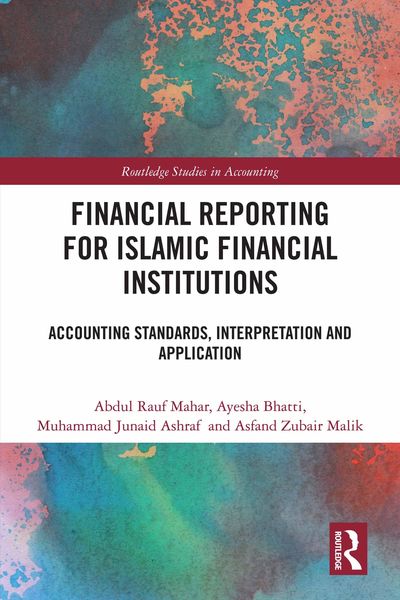
Financial Reporting for Islamic Financial Institutions Accounting Standards, Interpretation and Application
-
- Hardcover
- Taschenbuch
- eBook ausgewählt
-
Form:Einzelkauf Download
-
Sprache:Englisch
-
eBook Format:ePUB 3
- ePUB 3 60,99 € ausgewählt
- PDF 60,99 €
60,99 €
inkl. gesetzl. MwSt.Beschreibung
Produktdetails
Format
ePUB 3
Kopierschutz
Ja
Family Sharing
Nein
Text-to-Speech
Ja
Erscheinungsdatum
19.01.2024
Verlag
Taylor & Francis eBooksSeitenzahl
352 (Printausgabe)
Auflage
1. Auflage
Sprache
Englisch
EAN
9781003837725
Mainstream accounting rules, namely International Financial Reporting Standards (IFRS), used in conventional banking, employ financial logics and principles which are at odds with Shariah and therefore unsuitable for reporting the results of Islamic banks. The book is an effort to explain the Islamic accounting principles and practices for Islamic Financial institutions and to juxtapose them to mainstream accounting principles in a simple and practical manner.
The book begins with an overview of the Islamic Finance environment, the rationale for Islamic accounting and a brief introduction of AAOIFI (Accounting and Auditing Organization for Islamic Financial Institutions), the professional body responsible for the issuance of Islamic accounting standards. The main features of the AAOIFI Conceptual Framework and its comparison with IFRS framework are covered in Chapter 2. Chapters 3-9 cover the accounting treatment of the major Islamic finance products including trade-based (Murabaha, Salam and Istisna'a), rental-based (Ijarah) and risk-sharing based products (Mudarabah and Musharakah). Given the significance and complexity of Islamic bonds (Sukuk) for the Islamic finance industry, Chapter 10 discusses the basic accounting and reporting issues vis-à-vis Sukuk, leaving more complex issues for advanced texts on the topic. Zakah accounting (charity) and provisions and impairments are covered in Chapters 11 and 12.
The chapters are arranged so that they start with a discussion of the product itself, followed by the AAOIFI accounting treatment and ending with the IFRS perspective. Each chapter begins with the learning objectives and a cover story and closes with a summary of the learning objectives. To facilitate the learning of readers, each chapter contains a glossary of the terms introduced as well as end of chapter multiple choice questions. In addition, each chapter includes practical insights and concept checks to enhance and test the understanding of the readers.
This will be a useful guide for students, academics and practitioners concerned with the subject of financial reporting in Islamic Institutions.
Kundinnen und Kunden meinen
Verfassen Sie die erste Bewertung zu diesem Artikel
Helfen Sie anderen Kund*innen durch Ihre Meinung
Kurze Frage zu unserer Seite
Vielen Dank für Ihr Feedback
Wir nutzen Ihr Feedback, um unsere Produktseiten zu verbessern. Bitte haben Sie Verständnis, dass wir Ihnen keine Rückmeldung geben können. Falls Sie Kontakt mit uns aufnehmen möchten, können Sie sich aber gerne an unseren Kund*innenservice wenden.
zum Kundenservice