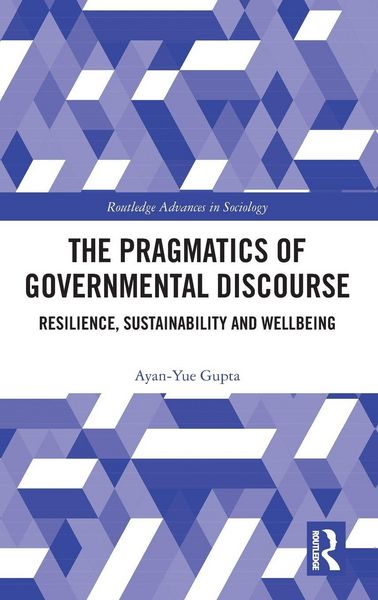

The Pragmatics of Governmental Discourse Resilience, Sustainability and Wellbeing
-
- Hardcover ausgewählt
- Taschenbuch
- eBook
-
Sprache:Englisch
248,99 €
inkl. gesetzl. MwSt.,
Beschreibung
Produktdetails
Einband
Gebundene Ausgabe
Erscheinungsdatum
02.08.2024
Abbildungen
7 SW-Abb., 7 SW-Zeichn., 4 Tabellen
Verlag
Taylor & FrancisSeitenzahl
218
Maße (L/B/H)
24/16,1/1,6 cm
Gewicht
496 g
Sprache
Englisch
ISBN
978-1-03-277751-1
This book presents a novel methodological framework for analysing governmental discourse. It involves combining pragmatist perspectives on language with computational sociolinguistics and large language models (LLMs).
The first half discusses traditional critical approaches to investigating discursive practices, principally those employing Critical Discourse Analysis (CDA) and those based on methods developed by Michel Foucault. These are critiqued in terms of pragmatist views on meaning, which are rarely taken up in this area. It is argued that to understand the grounding of social structures and power relations in discourse, we must begin with a systematic account of how meaning is contextually fixed. It is proposed that a pragmatist reading of Foucault's arguments about governmentality offers a productive framework for discourse analysis. To illustrate the advantages of this framework, the book presents a case study of the British government's adoption of resilience, sustainability, and wellbeing discourses in the period 2000-2020. A dataset of 179 million tokens sampled from approximately 170,000 government documents is used to illustrate how this framework can be combined with natural language processing (NLP) to make robust inferences.
This study will be of interest to both sociologists interested in language and in the methodological potential of recent developments in NLP. Importantly, the book demonstrates how LLMs can be harnessed to bring new perspectives to long-standing sociological questions.
Noch keine Bewertungen vorhanden
Verfassen Sie die erste Bewertung zu diesem Artikel
Helfen Sie anderen Kundinnen und Kunden durch Ihre Meinung.
Kurze Frage zu unserer Seite
Vielen Dank für Ihr Feedback
Wir nutzen Ihr Feedback, um unsere Produktseiten zu verbessern. Bitte haben Sie Verständnis, dass wir Ihnen keine Rückmeldung geben können. Falls Sie Kontakt mit uns aufnehmen möchten, können Sie sich aber gerne an unseren Kund*innenservice wenden.
zum Kundenservice