• Produktbild: Everyday Silence and the Holocaust
  • Produktbild: Everyday Silence and the Holocaust

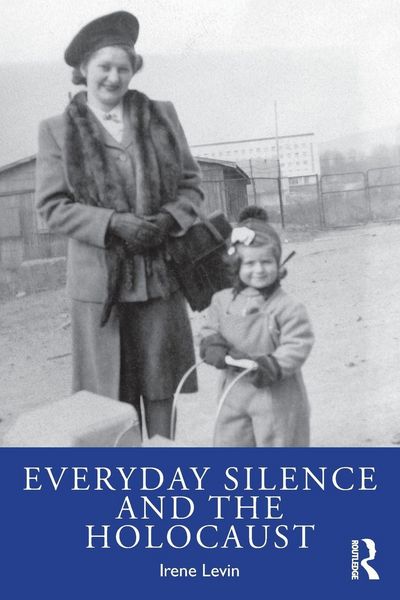
Everyday Silence and the Holocaust

53,99 €

inkl. gesetzl. MwSt., Versandkostenfrei


Beschreibung

Produktdetails

Einband

Taschenbuch

Erscheinungsdatum

31.07.2024

Abbildungen

schwarz-weiss Illustrationen, Raster, schwarz-weiss, Zeichnungen, schwarz-weiss

Verlag

Taylor & Francis

Seitenzahl

188

Maße (L/B/H)

23,3/15,5/1,4 cm

Gewicht

302 g

Sprache

Englisch

ISBN

978-1-03-261244-7

Beschreibung

Rezension

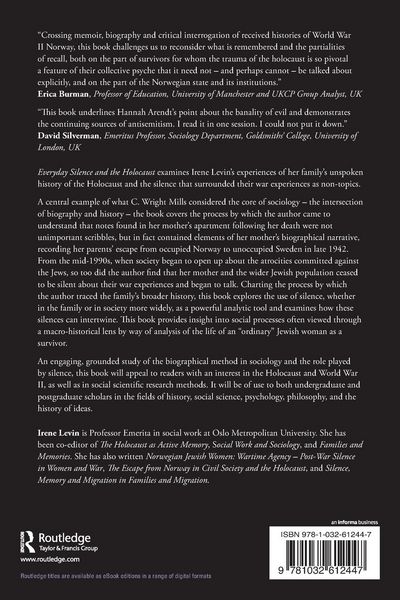
"This is such an important book, combining biography, autobiography and scholarly, meticulous documentary sourcing and analysis. Irene Levin's moving account of her mother's experience poses vital questions about silence and silencing, about agency, choices, complicities and responsibilities, and about whether, why and how these are recollected. This compelling personal story, in its rich, undeniable and specific detail, not only testifies powerfully to the history of how more than half of Norway's Jewish population came to be deported and murdered by the Nazis, it also documents the resourcefulness, creativity and courage of Jewish men and women, and some non-Jewish allies, enabling her parents to escape to Sweden. Crossing memoir, biography and critical interrogation of received histories of World War II Norway, this book challenges us to reconsider what is remembered and the partialities of recall, both on the part of survivors for whom the trauma of the holocaust is so pivotal a feature of their collective psyche that it need not - and perhaps cannot - be talked about explicitly, and on the part of the Norwegian state and its institutions. While fragments and allusions may be all that can be tolerable for those who those who lived through it, Levin shows how we who come later need to hear, learn and speak cogently and clearly about what happened and the individuals, organisations and policies that enabled, sometimes parried and ultimately claimed the authority to say how it happened. By simply recording and documenting her mother's story, Levin cleverly undoes received national and personal investments in particular historical narrations and occlusions, warding off spurious elisions between these. This book needs to be read by all who want to understand how genocides can happen and can be resisted. So relevant for our times."

Erica Burman, Professor of Education, University of Manchester and UKCP Group Analyst, UK

"Told through her mother's accounts, Irene Levin's gripping tale of what happened to a Norwegian Jewish family during and after the Second World War, has huge contemporary relevance. It underlines Hannah Arendt's point about the banality of evil and demonstrates the continuing sources of antisemitism. I read it in one session. I could not put it down."

David Silverman, Emeritus Professor, Sociology Department, Goldsmiths' College, University of London, UK

"Told retrospectively from the point of view of an adult daughter, this is the eminently readable story of the impact of Nazi occupation on the family life of a Norwegian Jewish mother and young daughter during World War II. Commonly overshadowed by accounts of the War's impact on Jews in Germany and Poland, the story on the very first page raises a vexing question applicable to all people: 'How could this happen to us?' Divided into three periods of family life before, during, and after the War, and by way of a mother's notes and notebook and a daughter's recollections, we are witness to the successful growth, adaptive silence, and subsequent ruinations of family living. Demonstrating universal truths in narrative particulars, the book will appeal both to scholars and nonscholars for its depiction of the ordinary contours of social relations in times of chaos."

Jaber F. Gubrium, Professor Emeritus of Sociology, University of Missouri, USA

"In Everyday Silence and the Holocaust Irene Levin weaves together silence and unsilencing of her mother; of herself and of the Norwegian Jewish community of the 1940s. Her project is personal, political and sociohistorical, bringing back to mind C.W. Mills' understanding of the biographical as a powerful instrument in the understanding of political processes. However, this intriguing project extends the biographical by becoming an eye opener on the normalization of institutional cruelty."

Orly Benjamin, President of the Israeli Sociological Society (ISS) and Professor, Department of Sociology and Anthropology, Bar Ilan University, Israel

Produktdetails

Einband

Taschenbuch

Erscheinungsdatum

31.07.2024

Abbildungen

schwarz-weiss Illustrationen, Raster, schwarz-weiss, Zeichnungen, schwarz-weiss

Verlag

Taylor & Francis

Seitenzahl

188

Maße (L/B/H)

23,3/15,5/1,4 cm

Gewicht

302 g

Sprache

Englisch

ISBN

978-1-03-261244-7

EU-Ansprechpartner

Taylor & Francis Verlag GmbH
Kaufingerstraße 24
80331 München
DE
GPSR@taylorandfrancis.com

Herstelleradresse

Taylor & Francis Group
5 Howick Place
SW1P 1WG London
UK
GPSR@taylorandfrancis.com

Kundinnen und Kunden meinen

0 Bewertungen

Informationen zu Bewertungen

Zur Abgabe einer Bewertung ist eine Anmeldung im Konto notwendig. Die Authentizität der Bewertungen wird von uns nicht überprüft. Wir behalten uns vor, Bewertungstexte, die unseren Richtlinien widersprechen, entsprechend zu kürzen oder zu löschen.

Die Bewertungen sind nach Format, Anzahl Sterne und Datum sortiert.

Verfassen Sie die erste Bewertung zu diesem Artikel

Helfen Sie anderen Kund*innen durch Ihre Meinung

Kundinnen und Kunden meinen

0 Bewertungen filtern

Weitere Artikel finden Sie in

Die Leseprobe wird geladen.
  • Produktbild: Everyday Silence and the Holocaust
  • Produktbild: Everyday Silence and the Holocaust
  • Preface Part I: Before the war Mother and father get married - a wedding and a shop | The application for Norwegian citizenship Part II: During the war The living would envy the dead | Three months in 1942 - the anti-Jewish policy is intensified | Rumours begin to circulate | The hunt for no. 490 and no. 301 | The "Arian" policeman | Mrs. Follestad starts organising the escape | On the doorstep of the psychiatric clinic, 6 p.m. | The arrest of Rubin Pinkowitz | Refugees in Sweden | «Oj Gott wher kommt» Part III: After the war What did they come home to? | Traces of grandfather in the archives | Getting away from the memories | Jewish voices in the public sphere | Us and the others | Self-reproach | Mother breaks the silence Part IV: The language of silence: A postscript Appendix 1: Fatalities Appendix 2: Method