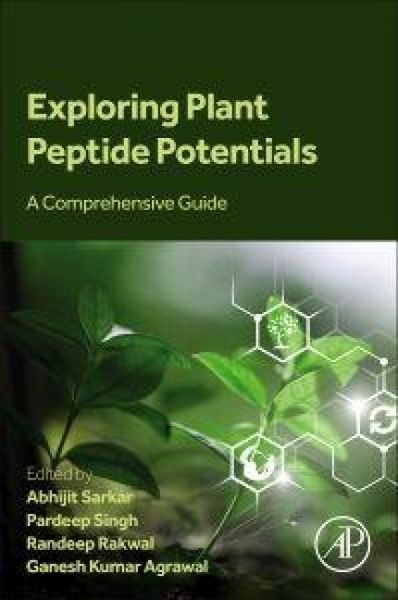
Produktbild: Exploring Plant Peptide Potentials
- 18%

Exploring Plant Peptide Potentials A Comprehensive Guide

18% sparen

151,99 € UVP 186,50 €

inkl. gesetzl. MwSt., Versandkostenfrei


Beschreibung

Produktdetails

Einband

Taschenbuch

Erscheinungsdatum

10.03.2026

Herausgeber

Sarkar Abhijit + weitere

Verlag

Elsevier Science & Technology

Seitenzahl

488

Maße (L/B/H)

22,6/15,3/2,3 cm

Gewicht

658 g

Sprache

Englisch

ISBN

978-0-443-15652-6

Beschreibung

Portrait

Dr. Abhijit Sarkar is currently an assistant professor of botany at the University of Gour Banga (India). He holds a BSc (Hons.) and an MSc in botany (with specialization in plant physiology, biochemistry, and plant molecular biology) from the University of Calcutta (India) and a PhD in Botany from Banaras Hindu University (India). Dr. Sarkar's research work encompasses air pollution and its effects on plant biology and human health, including ozone, heat, UV radiation (natural and manmade), plant pathogens, with close collaborators in Japan, South Korea, Nepal, United States, Italy, and India.
Dr. Pardeep Singh is presently working as an assistant professor at the Department of Environment Studies, PGDAV College, University of Delhi, India. He obtained his master's degree from the Department of Environmental Science at Banaras Hindu University, India in 2011 and then his PhD from the Indian Institute of Technology (Banaras Hindu University), India, in 2017. He has published more than 35 papers in international journals in the field of waste management and co-edited over 30 books with various publishers.
Professor Randeep Rakwal is a professor at the University of Tsukuba (Japan), at the Faculty of Health and Sport Sciences. His major research interests in plant environmental stress biology are jasmonic acid, ozone, heat, radiations, plant pathogens using "omics” approaches, with close collaborators in Japan, South Korea, Nepal, USA, Italy, Australia and India. He is one of the founding members of the International Plant Proteomics Organization (INPPO).
Ganesh Kumar Agrawal is the Associate Director of RLABB, a nonprofit research organization focusing on biotechnology and biochemistry in Kathmandu, Nepal. Dr. Agrawal is a multidisciplinary scientist focused on food security and human nutrition using high-throughput and targeted omics techniques. He has edited a comprehensive "Plant Proteomics: Technologies, Strategies, and Applications” book (John Wiley & Sons, NY, USA). He holds a PhD in Applied Biological Chemistry from Tokyo University of Agriculture and Technology (Japan). He is an initiator of the International Plant Proteomics Organization (InPPO).

Produktdetails

Einband

Taschenbuch

Erscheinungsdatum

10.03.2026

Herausgeber

Verlag

Elsevier Science & Technology

Seitenzahl

488

Maße (L/B/H)

22,6/15,3/2,3 cm

Gewicht

658 g

Sprache

Englisch

ISBN

978-0-443-15652-6

EU-Ansprechpartner

Zeitfracht Medien GmbH
Ferdinand-Jühlke-Straße 7
99095 Erfurt
DE
produktsicherheit@zeitfracht.de

Herstelleradresse

Elsevier Science & Technology
London Wall 125
EC2Y 5AS London
GB
tradeorders@elsevier.com

Noch keine Bewertungen vorhanden

Verfassen Sie die erste Bewertung zu diesem Artikel

Helfen Sie anderen Kundinnen und Kunden durch Ihre Meinung.

Kundinnen und Kunden meinen

Bewertungen (0)

  • Produktbild: Exploring Plant Peptide Potentials
  • 1. Peptides: fascinating, unique, and universal molecules with incredible potentials
    2. Peptides: through the looking glass of past discoveries
    3. Modern methods to isolate, characterize, and purify bioactive peptides
    4. Peptide hormones: key regulators of growth, development, and stress response in plants
    5. Plant antimicrobial peptides
    6. Plant-based antifungal peptides: novel therapeutic compounds against emerging fungal pathogens
    7. Crosstalk of peptides for communications in plants
    8. Plant-based bioactive peptides: pharmaceuticals, nutraceuticals, and herbal drugs
    9. Harnessing nanostructures for the delivery of plant antimicrobial peptides
    10. Emerging applications of nanotechnology for enhancing the efficacy of plant-based peptides
    11. Algal peptides: diversity, roles, relation to plant peptide science, and applications in crop improvement
    12. Plant-derived peptides and their emerging applications in agricultural biotechnology
    13. Plant peptides involved in reactive oxygen species signaling and biotic and abiotic stress