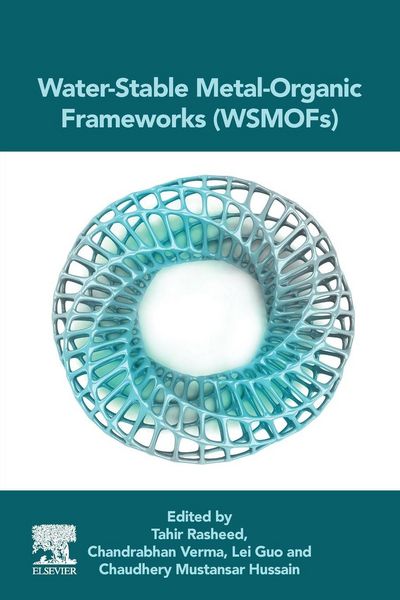
Produktbild: Water-Stable Metal-Organic Frameworks (WSMOFs)
- 20%

Water-Stable Metal-Organic Frameworks (WSMOFs)

20% sparen

161,99 € UVP 202,50 €

inkl. gesetzl. MwSt., Versandkostenfrei


Beschreibung

Produktdetails

Einband

Taschenbuch

Erscheinungsdatum

25.11.2025

Herausgeber

Lei Guo + weitere

Verlag

Elsevier Science & Technology

Seitenzahl

506

Maße (L/B/H)

22,8/15,2/2,6 cm

Gewicht

450 g

Sprache

Englisch

ISBN

978-0-443-29256-9

Beschreibung

Portrait

Lei Guo received his PhD degree in materials chemistry from the Chongqing university of china. His research is dedicated to synthesis and characterization of organic molecules and their application towards corrosion inhibition property for the protection of metals and alloys from acid corrosion. His interests also encompass theoretical and experimental research in condensed matter physics

Tahir Rasheed is a researcher at the Interdisciplinary Research Center for Advanced Materials, King Fahd University of Petroleum and Minerals, Saudi Arabia. His research interests focus on multiple disciplines including controllable synthesis, characterization and self-assembly of polymeric materials, polymer-based composites, nanomaterials and nanocomposites, and hybrid nanocomposites, with special emphasis on their potential applications in the field of sensing and biosensing, electrocatalysis, and the degradation and quantification of various emerging pollutants.

Chandrabhan Verma, PhD, works at the Interdisciplinary Research Center for Advanced Materials, King Fahd University of Petroleum and Minerals, Dhahran, Saudi Arabia. He is a member of the American Chemical Society (ACS). His research interests mainly focus on the synthesis and design of environment-friendly corrosion inhibitors used for several industrial applications. Dr. Verma received his PhD degree from the Department of Chemistry at IIT?BHU, Varanasi, India and MSc degree in organic chemistry (Gold Medalist). Dr. Verma is the author of several research and review articles in peer-reviewed international journals. He has also received several national and international awards for his academic achievements.

Prof. Chaudhery Mustansar Hussain, PhD, is an adjunct professor and director of laboratories in the Department of Chemistry & Environmental Sciences at the New Jersey Institute of Technology (NJIT), Newark, New Jersey, United States. His research focuses on sustainability, the applications of nanotechnology and advanced materials, environmental management, analytical chemistry and other various industries. Dr. Hussain is the author of numerous papers in peer-reviewed journals as well as a prolific author and editor of around 200 books, including scientific monographs and handbooks in his research areas. He has published with ELSEVIER, American Chemical Society, Royal Society of Chemistry, John Wiley & Sons, CRC Press, and Springer.

Produktdetails

Einband

Taschenbuch

Erscheinungsdatum

25.11.2025

Herausgeber

Verlag

Elsevier Science & Technology

Seitenzahl

506

Maße (L/B/H)

22,8/15,2/2,6 cm

Gewicht

450 g

Sprache

Englisch

ISBN

978-0-443-29256-9

EU-Ansprechpartner

Zeitfracht Medien GmbH
Ferdinand-Jühlke-Straße 7
99095 Erfurt
DE
produktsicherheit@zeitfracht.de

Herstelleradresse

Elsevier Science & Technology
London Wall 125
EC2Y 5AS London
GB
tradeorders@elsevier.com

Noch keine Bewertungen vorhanden

Verfassen Sie die erste Bewertung zu diesem Artikel

Helfen Sie anderen Kundinnen und Kunden durch Ihre Meinung.

Kundinnen und Kunden meinen

Bewertungen (0)

  • Produktbild: Water-Stable Metal-Organic Frameworks (WSMOFs)
  • Part 1: BASICS and FUNDAMENTALS
    1. Water-stable MOFs-based Materials: Fundamental, Properties and Applications
    2. Water-stable MOFs-based Materials: Synthesis, Design, and Characterization
    3. Theoretical Modeling to Design Water-stable MOFs-based Materials
    4. Stability (thermodynamics) of Water-stable MOFs-based Materials
    5. Selection Criteria of Water-stable MOFs-based Materials for Environmental and Sensing Applications

    Part 2: Water-stable MOFs-based Materials for Environmental Remediation
    6. Water-stable MOFs-based Materials for Remediation of Water Soluble Gases
    7. Water-stable MOFs-based Materials for Removal of Toxic Heavy Metals
    8. Water-stable MOFs-based Materials for Sequestration of Radionuclides and Toxic Ions
    9. Water-stable MOFs-based Materials for Removal of Pharmaceutical-based Pollutants
    10. Water-stable MOFs-based Materials for Removal of Organic Dyes
    11. Water-stable MOFs-based Materials for Sorption Degradation of Personal Care Products
    12. Water-stable MOFs-based Materials for Degradation of Pesticides

    Part 3: Water-stable MOFs-based Materials for Sensing Applications
    13. Water-stable MOFs-based Materials as Electrochemical Sensors
    14. Water-stable MOFs-based Materials as Optical Sensors
    15. Water-stable MOFs-based Materials as Biosensors
    16. Water-stable MOFs-based Materials as Analytical/Biosensing Applications
    17. Water-stable MOFs-based Materials for Strain Sensors
    18. Water-stable MOFs-based Materials for Other Sensing Applications
    19. Cost analysis for scaling up the MOFs-based Materials for industrial applications