
The Routledge International Handbook of Critical Disability Studies
-
- Hardcover ausgewählt
- Taschenbuch
- eBook
-
Sprache:Englisch
249,99 €
UVP
308,90 €
inkl. gesetzl. MwSt.,
Beschreibung
Produktdetails
Einband
Gebundene Ausgabe
Altersempfehlung
17 - 18 Jahr(e)
Erscheinungsdatum
26.12.2024
Abbildungen
9 SW-Abb., 9 SW-Fotos, 6 Tabellen
Herausgeber
Ellis Katie + weitereVerlag
Taylor & FrancisSeitenzahl
418
Maße (L/B/H)
25/17,5/2,7 cm
Gewicht
897 g
Sprache
Englisch
ISBN
978-0-367-33857-2
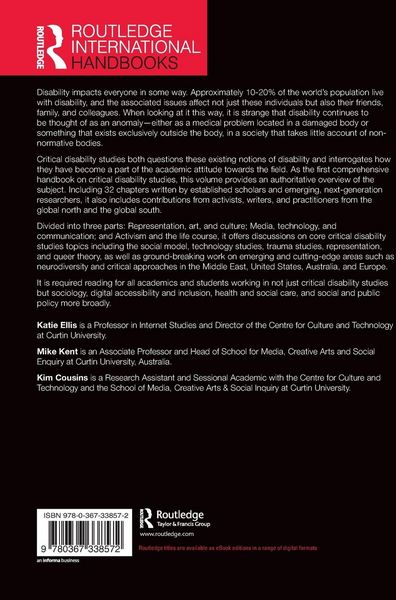
Disability impacts everyone in some way. Approximately 10-20% of the world's population live with disability, and the associated issues affect not just these individuals but also their friends, family, and colleagues. When looking at it this way, it is strange that disability continues to be thought of as an anomaly-either as a medical problem located in a damaged body or something that exists exclusively outside the body, in a society that takes little account of non-normative bodies.
Critical disability studies both questions these existing notions of disability and interrogates how they have become a part of the academic attitude towards the field. As the first comprehensive handbook on critical disability studies, this volume provides an authoritative overview of the subject. Including 32 chapters written by established scholars and emerging, next-generation researchers it also includes contributions from activists, writers, and practitioners from the global north and the global south.
Divided into three parts: Representation, art, and culture; Media, technology, and communication; and Activism and the life course, it offers discussions on core critical disability studies topics including the social model, technology studies, trauma studies, representation, and queer theory, as well as ground-breaking work on emerging and cutting-edge areas such as neurodiversity and critical approaches in the Middle East, United States, Australia, and Europe.
It is required reading for all academics and students working in not just critical disability studies but sociology, digital accessibility and inclusion, health and social care, and social and public policy more broadly.
Noch keine Bewertungen vorhanden
Verfassen Sie die erste Bewertung zu diesem Artikel
Helfen Sie anderen Kundinnen und Kunden durch Ihre Meinung.
Kurze Frage zu unserer Seite
Vielen Dank für Ihr Feedback
Wir nutzen Ihr Feedback, um unsere Produktseiten zu verbessern. Bitte haben Sie Verständnis, dass wir Ihnen keine Rückmeldung geben können. Falls Sie Kontakt mit uns aufnehmen möchten, können Sie sich aber gerne an unseren Kund*innenservice wenden.
zum Kundenservice