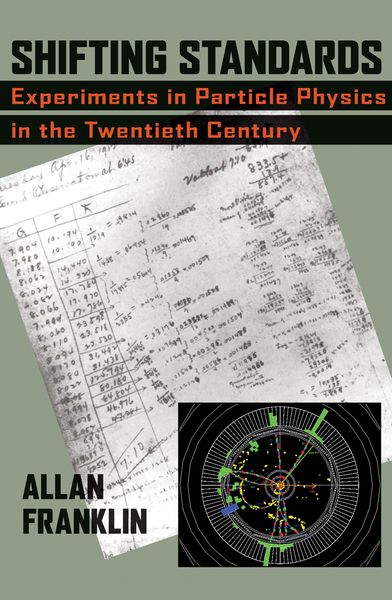
Shifting Standards Experiments in Particle Physics in the Twentieth Century
59,99 €
inkl. gesetzl. MwSt.Beschreibung
Produktdetails
Format
ePUB
Kopierschutz
Nein
Family Sharing
Nein
Text-to-Speech
Ja
Erscheinungsdatum
24.11.2018
Verlag
Manchester University PressSeitenzahl
(Printausgabe)
Sprache
Englisch
EAN
9780822979197
In Shifting Standards, Allan Franklin provides an overview of notable experiments in particle physics. Using papers published in Physical Review, the journal of the American Physical Society, as his basis, Franklin details the experiments themselves, their data collection, the events witnessed, and the interpretation of results. From these papers, he distills the dramatic changes to particle physics experimentation from 1894 through 2009.
Franklin develops a framework for his analysis, viewing each example according to exclusion and selection of data; possible experimenter bias; details of the experimental apparatus; size of the data set, apparatus, and number of authors; rates of data taking along with analysis and reduction; distinction between ideal and actual experiments; historical accounts of previous experiments; and personal comments and style.
From Millikan's tabletop oil-drop experiment to the Compact Muon Solenoid apparatus measuring approximately 4,000 cubic meters (not including accelerators) and employing over 2,000 authors, Franklin's study follows the decade-by-decade evolution of scale and standards in particle physics experimentation. As he shows, where once there were only one or two collaborators, now it literally takes a village. Similar changes are seen in data collection: in 1909 Millikan's data set took 175 oil drops, of which he used 23 to determine the value of e, the charge of the electron; in contrast, the 1988-1992 E791 experiment using the Collider Detector at Fermilab, investigating the hadroproduction of charm quarks, recorded 20 billion events. As we also see, data collection took a quantum leap in the 1950s with the use of computers. Events are now recorded at rates as of a few hundred per second, and analysis rates have progressed similarly.
Employing his epistemology of experimentation, Franklin deconstructs each example to view the arguments offered and the correctness of the results. Overall, he finds that despite the metamorphosis of the process, the role of experimentation has remained remarkably consistent through the years: to test theories and provide factual basis for scientific knowledge, to encourage new theories, and to reveal new phenomenon.
Franklin develops a framework for his analysis, viewing each example according to exclusion and selection of data; possible experimenter bias; details of the experimental apparatus; size of the data set, apparatus, and number of authors; rates of data taking along with analysis and reduction; distinction between ideal and actual experiments; historical accounts of previous experiments; and personal comments and style.
From Millikan's tabletop oil-drop experiment to the Compact Muon Solenoid apparatus measuring approximately 4,000 cubic meters (not including accelerators) and employing over 2,000 authors, Franklin's study follows the decade-by-decade evolution of scale and standards in particle physics experimentation. As he shows, where once there were only one or two collaborators, now it literally takes a village. Similar changes are seen in data collection: in 1909 Millikan's data set took 175 oil drops, of which he used 23 to determine the value of e, the charge of the electron; in contrast, the 1988-1992 E791 experiment using the Collider Detector at Fermilab, investigating the hadroproduction of charm quarks, recorded 20 billion events. As we also see, data collection took a quantum leap in the 1950s with the use of computers. Events are now recorded at rates as of a few hundred per second, and analysis rates have progressed similarly.
Employing his epistemology of experimentation, Franklin deconstructs each example to view the arguments offered and the correctness of the results. Overall, he finds that despite the metamorphosis of the process, the role of experimentation has remained remarkably consistent through the years: to test theories and provide factual basis for scientific knowledge, to encourage new theories, and to reveal new phenomenon.
Noch keine Bewertungen vorhanden
Verfassen Sie die erste Bewertung zu diesem Artikel
Helfen Sie anderen Kundinnen und Kunden durch Ihre Meinung.
Kurze Frage zu unserer Seite
Vielen Dank für Ihr Feedback
Wir nutzen Ihr Feedback, um unsere Produktseiten zu verbessern. Bitte haben Sie Verständnis, dass wir Ihnen keine Rückmeldung geben können. Falls Sie Kontakt mit uns aufnehmen möchten, können Sie sich aber gerne an unseren Kund*innenservice wenden.
zum Kundenservice