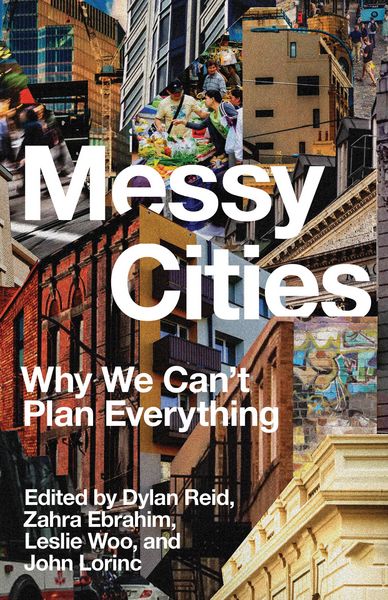
Produktbild: Messy Cities
- 10%

Messy Cities Why We Can't Plan Everything

10% sparen

16,99 € UVP 19,00 €

inkl. gesetzl. MwSt., Versandkostenfrei


Beschreibung

Produktdetails

Einband

Taschenbuch

Erscheinungsdatum

03.06.2025

Herausgeber

Zahra Ebrahim + weitere

Verlag

Coach House Books

Seitenzahl

336

Maße (L/B/H)

21,2/13,8/2 cm

Gewicht

466 g

Sprache

Englisch

ISBN

978-1-55245-503-6

Beschreibung

Portrait

Zahra Ebrahim is an urbanist, educator, and strategist. Her award-winning work focuses on building bridges between institutions and their public, working with communities to co-design towards better social outcomes and leading some of Canada’s most ambitious participatory infrastructure and policy programs. She currently co-leads Monumental, a national organization focused on projects that advance fair, just, and culturally competent citybuilding, with previous experience leading organizations across multiple sectors. She is currently an Adjunct Professor at the Daniels School of Architecture and Urbanist-in-Residence at the University of Toronto’s School of Cities. She currently lives in Toronto with her partner, and their whippet, Zada.

John Lorinc is a journalist and editor. He reports on urban affairs, politics, business, technology, and local history for a range of media, including The Globe and Mail, Toronto Star, Corporate Knights and Spacing, where he is senior editor. John is the author of five books, including No Jews Live Here: A Memoir (Coach House Books, 2024), and has co-edited eight anthologies for Coach House, including The Ward (2015), Any Other Way (2017), and Messy Cities (2025). John is the recipient of the 2019/2020 Atkinson Fellowship in Public Policy and was the winner of the Writers' Trust Balsillie Prize for Public Policy, for Dream States: Smart Cities, Technology and the Pursuit of Urban Utopias (2022). He lives in Toronto.

Dylan Reid is a co-founder and now the executive editor of Spacing magazine, an award-winning print quarterly about Toronto urbanism and public space that recently celebrated its 20th anniversary. He is the author of the Toronto Public Etiquette Guide and co-editor of other books about Toronto. He was co-chair of the city government’s Toronto Pedestrian Committee and later co-founder of the advocacy group Walk Toronto. He is also a fellow at the Centre for Renaissance and Reformation Studies at the University of Toronto, and author of several scholarly articles about the history of cities in Renaissance France.

Leslie Woo is a dynamic tri-sector athlete known for her expertise in uniting public, private, and not-for-profit leaders to co-create innovative urban policy solutions. With over 30 years of experience as an urban planner, architect, and community activator, she has been central to shaping urban development in Canada’s largest metropolis. Leslie serves on the boards of Waterfront Toronto and the Yee Hong Centre for Geriatric Care and is a trustee of the Urban Land Institute. A Senior Fellow at the University of Toronto’s Munk School of Global Affairs and Public Policy, Leslie champions women city builders on her blog.

Produktdetails

Einband

Taschenbuch

Erscheinungsdatum

03.06.2025

Herausgeber

Verlag

Coach House Books

Seitenzahl

336

Maße (L/B/H)

21,2/13,8/2 cm

Gewicht

466 g

Sprache

Englisch

ISBN

978-1-55245-503-6

Herstelleradresse

Libri GmbH
Europaallee 1
36244 Bad Hersfeld
DE

Email: gpsr@libri.de

Kundinnen und Kunden meinen

0 Bewertungen

Informationen zu Bewertungen

Zur Abgabe einer Bewertung ist eine Anmeldung im Konto notwendig. Die Authentizität der Bewertungen wird von uns nicht überprüft. Wir behalten uns vor, Bewertungstexte, die unseren Richtlinien widersprechen, entsprechend zu kürzen oder zu löschen.

Die Bewertungen sind nach Format, Anzahl Sterne und Datum sortiert.

Verfassen Sie die erste Bewertung zu diesem Artikel

Helfen Sie anderen Kund*innen durch Ihre Meinung

Kundinnen und Kunden meinen

0 Bewertungen filtern

  • Produktbild: Messy Cities
  • Contents & Contributors

    Introduction – Dylan Reid

    Dixie Road – Fadi Masoud

    These Walls, These Roads – Ameer Idreis

    Designing out Disorder – Cara Chellew

    From Loud to Lively – Leslie Woo

    Mexico City's Jumbled Apartment Buildings – Daniel Gordon

    Flexible Streets – Dylan Reid

    Satisfying Our Thirst for Agency – Colin Ellard

    The Collective Effervence of Messy Parks – Jake Tobin Garrett

    Industrial Land's Secret Sauce – Karen Chapple

    A Food Map of Toronto – Karon Lui

    A Beach Like No Other – Shari Kasman

    Sports and Spaces – Perry King

    Leave the Leaves – Lorraine Johnson

    Interruptions – Zahra Ebrahim

    The Readable City – Shawn Micallef 

    Beyond the Lawn: Meadow or Mess? – Nina-Marie Lister

    Planning for an Unplanned City – Jason Thorne

    A Farewell to El Gran Burritov – John Kamp and James Rojas

    Banquet Halls and Belonging – Sneha Mandhan

    Tokyo: The Quintessentially Messy City? – Andre Sorensen

    The Ballet of the Parking Lot – Brendan Stewart and Daniel Rotsztain

    We Can Live With That – Leslie Woo

    Tower Communities Are What We Make Them – Ajeev Bhatia

    The Case Against Controlling Infrastructure – Andrés Borthagaray

    An Argument Worth Having – Chiyi Tam

    Everything is Everything But The Details Matter – Alexandra Lambropoulos and Sami Ferwati 

    Hidden Struggles – Eileen De Villa

    Cities for Women and Girls – Elsa Marie D'Silva

    Non-humans (Heard and Unheard) – Suzanne Kite and Robbie Wing

    Cape Town's Rastafarians – Kofi Hope

    Conjay's First Walk Home – Tura Cousins Wilson and Shane Laptiste

    Another Fine Mess on Regionalism – Sabine Matheson

    The Palimpset of Heritage Streetscapes – Tatum Taylor Chaubal 

    Protecting a Queer Beach – Wesley Reibeling

    Public Health in the Post-COVID Era – Andrew Boozary

    Why Can't We Sell Stuff Anyplace? – John Lorinc

    The Messy Culture of Graffiti – Dylan Reid

    An Indigenous Take on the 15 Minute City – Carolynne Crawley

    Thinking Twice about Consultation – Lorne Cappe

    What is safety?  – Kimahli Powell

    Conclusion – Dylan Reid, Leslie Woo, Zahra Ebrahim, and John Lorinc