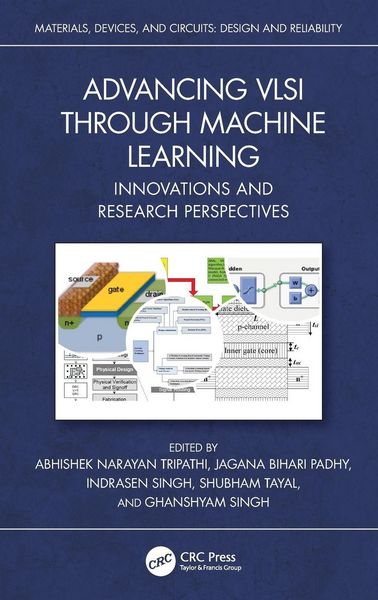
• Produktbild: Advancing VLSI through Machine Learning
  • Produktbild: Advancing VLSI through Machine Learning

Advancing VLSI through Machine Learning Innovations and Research Perspectives

209,99 €

inkl. gesetzl. MwSt., Versandkostenfrei


Beschreibung

Produktdetails

Einband

Gebundene Ausgabe

Erscheinungsdatum

30.03.2025

Abbildungen

schwarz-weiss Illustrationen, Raster, schwarz-weiss, Zeichnungen, schwarz-weiss, Tabellen, schwarz-weiss

Herausgeber

Abhishek Narayan Tripathi + weitere

Verlag

Taylor and Francis

Seitenzahl

254

Maße (L/B/H)

24/16,1/1,9 cm

Gewicht

560 g

Sprache

Englisch

ISBN

978-1-03-277428-2

Beschreibung

Produktdetails

Einband

Gebundene Ausgabe

Erscheinungsdatum

30.03.2025

Abbildungen

schwarz-weiss Illustrationen, Raster, schwarz-weiss, Zeichnungen, schwarz-weiss, Tabellen, schwarz-weiss

Herausgeber

Verlag

Taylor and Francis

Seitenzahl

254

Maße (L/B/H)

24/16,1/1,9 cm

Gewicht

560 g

Sprache

Englisch

ISBN

978-1-03-277428-2

Noch keine Bewertungen vorhanden

Verfassen Sie die erste Bewertung zu diesem Artikel

Helfen Sie anderen Kundinnen und Kunden durch Ihre Meinung.

Kundinnen und Kunden meinen

Bewertungen (0)

Die Leseprobe wird geladen.
  • Produktbild: Advancing VLSI through Machine Learning
  • Produktbild: Advancing VLSI through Machine Learning
  • Chapter 1. Optimizing Circuit Synthesis: Integrating Neural Networks and Evolutionary Algorithms for Increased Design Efficiency

    Chapter 2. Study of Physical Processes Analysis and Phenomena of Insights of Trapping in the Performance Degradation in AlGaN/GaN HEMTs

    Chapter 3. Framework for Design and Performance Evaluation of Memory using Memristor

    Chapter 4. Innovative Design and Optimization of High-Power Amplifiers: A Comparative Study with GaN HEMT and CMOS Technologies

    Chapter 5. Exploring FPGA Architecture Designs for Matrix Multiplication in Machine Learning

    Chapter 6. Silicon Chip Design and Testing

    Chapter 7. A Novel Deep Learning Approach for Early Brain Tumour Detection

    Chapter 8. TCAD Augmented Machine Learning for the Prediction of Device Behavior and Failure Analysis

    Chapter 9. Opportunities and Challenges for ML-Based FPGA Backend Flow

    Chapter 10. Role of Machine Learning Applications in VLSI Design

    Chapter 11. Application of Artificial Intelligence/Machine Learning in VLSI Design

    Chapter 12. FinFET-Based 9T SRAM for Enhanced Performance in AI/ML Applications

    Chapter 13. Power Consumption and SNM Analysis of 6T and 7T SRAM using 90nm Technology

    Chapter 14. Transforming Electronics: An Extensive Analysis of Hyper-FET Technological Developments and Utilisation

    Chapter 15. VLSI Realization of Smart Systems using Blockchain and Fog Computing