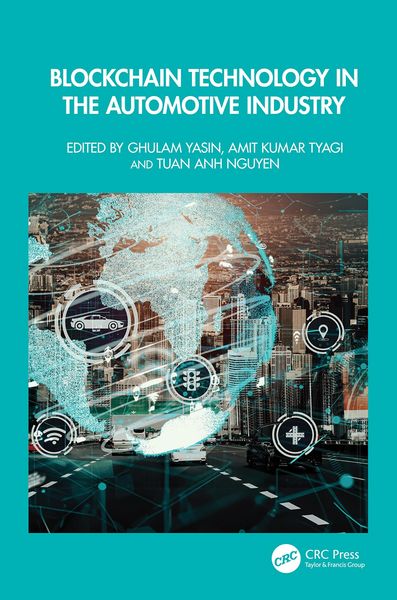
Blockchain Technology in the Automotive Industry
-
- Hardcover
- Taschenbuch
- eBook ausgewählt
-
Form:Einzelkauf Download
-
Sprache:Englisch
-
eBook Format:ePUB 3
- PDF 78,49 €
- ePUB 3 78,49 € ausgewählt
78,49 €
inkl. gesetzl. MwSt.Beschreibung
Produktdetails
Format
ePUB 3
Kopierschutz
Ja
Family Sharing
Nein
Text-to-Speech
Ja
Erscheinungsdatum
30.10.2024
Herausgeber
Ghulam Yasin + weitereVerlag
Taylor & Francis eBooksSeitenzahl
354 (Printausgabe)
Auflage
1. Auflage
Sprache
Englisch
EAN
9781040132265
Nowadays, the latest technologies can be found not only in healthcare and space application but also in hybrid supercars. Supercars and hypercars require high-performance materials with high strength, high stiffness, and light weight. For higher performance, car engines now become stronger but smaller and with lower fuel consumption (with cleaner exhaust). Currently, the automotive industry involves batch production, but in the near future, personalized and individualized automobiles with low and limited quantities can be fabricated in smart factories, which integrate all companies working in the supply chain, from manufacturing to marketing and services. In this regard, future automobiles in smart cities become more personalized (single user, limited version, personal spare parts), safer, and smarter.
Blockchain technology is the key to these future perspectives toward intelligent automobiles without any risk of safety, accident, security, theft, or traffic jam. In the current industry, blockchain technology can explore the interconnection of blockchain with other innovative technologies and trends, such as the Internet of Things (IoT) and artificial intelligence (AI), and analyzes the potential to transform business processes and whole industries if these innovations are applied jointly.
In the case of the manufacturing sector, manufacturing can provide a high return on investment. It was reported that $1 of investment in manufacturing can create ~$2.5 of economic activity. In addition, smart products should be fabricated from smart materials via the intelligent manufacturing system framework. In smart production, if the products and machines are integrated, embedded, or otherwise equipped with smart sensors and devices, the system can immediately collect the current operating parameters and predict the product quality and then communicate the optimal parameters to machines in the production line. For smart city applications, the global smart cities market size is expected to grow from USD 410.8 billion in 2020 to USD 820.7 billion by 2025 at a compound annual growth rate (CAGR) of 14.8%. For smart city applications, blockchain technology can build on decentralization, immutability, and consensus characteristics.
Additionally, intelligent wireless sensor networks can provide big information to monitor and manage the city's regular operations and services, including traffic and transportation systems, street lighting systems, power plants, water supply networks, waste management, libraries, hospitals, schools, universities, etc. A blockchain-based distributed framework can be used for automobiles in the smart city. This framework can include a novel miner node selection algorithm for the blockchain-based distributed network architecture.
This book explores how blockchain technology can be used in the automotive industry from smart manufacturing to the smart city.
Noch keine Bewertungen vorhanden
Verfassen Sie die erste Bewertung zu diesem Artikel
Helfen Sie anderen Kundinnen und Kunden durch Ihre Meinung.
Kurze Frage zu unserer Seite
Vielen Dank für Ihr Feedback
Wir nutzen Ihr Feedback, um unsere Produktseiten zu verbessern. Bitte haben Sie Verständnis, dass wir Ihnen keine Rückmeldung geben können. Falls Sie Kontakt mit uns aufnehmen möchten, können Sie sich aber gerne an unseren Kund*innenservice wenden.
zum Kundenservice