• Produktbild: Unmanned Aerial Vehicles Swarm for Protecting Smart Cities
  • Produktbild: Unmanned Aerial Vehicles Swarm for Protecting Smart Cities

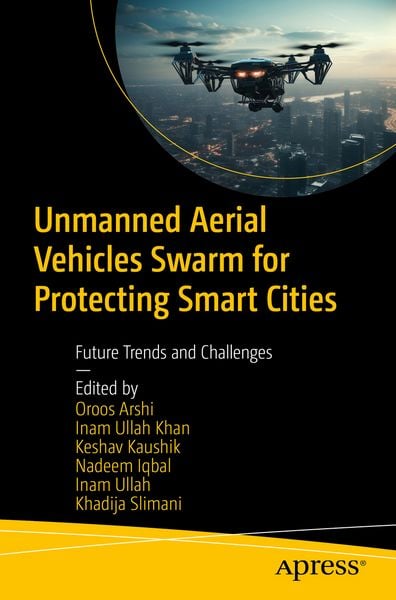
Unmanned Aerial Vehicles Swarm for Protecting Smart Cities Future Trends and Challenges

57,99 €

inkl. gesetzl. MwSt., Versandkostenfrei


Beschreibung

Produktdetails

Einband

Taschenbuch

Erscheinungsdatum

01.03.2025

Abbildungen

XLVI, 821 p. 110 illus.

Herausgeber

Oroos Arshi + weitere

Verlag

Apress

Seitenzahl

821

Maße (L/B/H)

23,5/15,5/4,7 cm

Gewicht

1288 g

Auflage

1. Auflage

Sprache

Englisch

EAN

9798868810466

Beschreibung

Portrait


Oroos Arshi
is a Research Scientist at AI-EYS and was awarded the Young Researcher award at the International Conference on Emerging Trends and Innovations (ICETI) 2024 held in Pakistan. She is a dedicated Research Scholar at the University of Petroleum and Energy Studies in Dehradun, India. She was the speaker at the International Conference on Emerging Trends and Innovations held in Pakistan. She has contributed significantly to the technological discourse with some Scopus, SCI, and a noteworthy publication with Springer. Since then, Oroos has embarked on an intricate exploration of diverse technological realms, displaying a profound interest in the Natural Processing Language (NLP), Computer Vision, Internet of Things (IoT), Artificial Intelligence (AI), Cybersecurity, and Cloud Computing. 


Dr. Inam Ullah Khan
is the Founder of AI-EYS. He was a visiting researcher at King’s College London, UK and was a faculty member at different universities in Pakistan including the Center for Emerging Sciences Engineering & Technology (CESET), Islamabad, Abdul Wali Khan University, Garden Campus, Timergara Campus, University of Swat & Shaheed Zulfikar Ali Bhutto Institute of Science and Technology (SZABIST), Islamabad Campus. He has authored/co-authored more than 30 research articles in reputable journals, conferences, and book chapters. His research interests include Network System Security, Intrusion Detection, Intrusion Prevention, cryptography, Optimisation techniques, WSN, IoT, Mobile Ad Hoc Networks (MANETS), Flying Ad Hoc Networks, and Machine Learning. He was a technical program committee member at an international workshop on intelligent systems for sustainable smart cities, New Delhi, India, February 19–20, 2022. 


Keshav Kaushik
is an experienced educator with around ten years of teaching and research experience in Cybersecurity, Digital Forensics, and the Internet of Things. He is working as an Assistant Professor (Senior Scale) in the systemic cluster under the School of Computer Science at the University of Petroleum and Energy Studies, Dehradun, India. He has published 100+ research papers in International Journals and has presented at reputed International Conferences. Currently, he is also serving as à Vice Chairperson of the Meerut ACM Professional Chapter and is also a brand ambassador for Bentham Science. 


Nadeem Iqbal
(Senior Member IEEE) received a Ph.D. degree in bio and brain engineering from the Korea Advanced Institute of Science and Technology (KAIST), Daejeon, South Korea, in 2013. He has completed a Fulbright Fellowship at St. John’s University in New York, USA. Dr. Iqbal was a postdoctoral fellow at the School of Mechanical Engineering, University of Leeds, UK. He is currently working as an Associate Professor with the Department of Computer Science, Abdul Wali Khan University Mardan, Pakistan. His research interests include biological information processing mechanisms in the brain, Natural Language Processing, the Internet of Things, and Pattern recognition. 


Inam Ullah
received a B.Sc. degree in Electrical Engineering (Telecommunication) from the Department of Electrical Engineering, University of Science and Technology Bannu (USTB), KPK, Pakistan, in 2016 and a Master's and Ph.D. degree in Information and Communication Engineering from the College of Internet of Things (IoT) Engineering, Hohai University (HHU), China, in 2018 and 2022, respectively. He is currently an Assistant Professor at the Department of Computer Engineering, Gachon University, S Korea. His research interests include Robotics, Internet of Things (IoT), Wireless Sensor Networks (WSNs), Underwater Communication and Localization, Underwater Sensor Networks (USNs), Artificial Intelligence (AI), Big data, Deep learning, etc. He has authored more than 70 peer-reviewed articles on various research topics. 


Dr. Khadija Slimani
completed her PhD, which was jointly supervised by the University of Ibn Tofail in Morocco and the University of Technology of Belfort Montbeliard (UTBM) in France. This collaborative international effort showcased her commitment to academic excellence and cross-cultural research. For her doctoral studies, Dr. Slimani delved into the realms of machine learning, deep learning, pattern recognition, and computer vision, with a specific focus on academic emotion recognition. This interdisciplinary approach, spanning both Moroccan and French academic environments, enriched her research experience and contributed to the global perspective of her work. Dr. Slimani's academic contributions extended to various engineering schools in Paris, France, where she took on teaching responsibilities across multiple modules, including data science, deep learning, machine learning, data bases, and computer vision. She currently holds the title of Associate Professor at the Graduate School of Automatic Electronic Computing in Paris, France. Through her diverse roles, Dr. Slimani consistently inspires and contributes to shaping the next generation of researchers.

Produktdetails

Einband

Taschenbuch

Erscheinungsdatum

01.03.2025

Abbildungen

XLVI, 821 p. 110 illus.

Herausgeber

Verlag

Apress

Seitenzahl

821

Maße (L/B/H)

23,5/15,5/4,7 cm

Gewicht

1288 g

Auflage

1. Auflage

Sprache

Englisch

EAN

9798868810466

Herstelleradresse

Springer-Verlag GmbH
Tiergartenstr. 17
69121 Heidelberg
DE

Email: ProductSafety@springernature.com

Noch keine Bewertungen vorhanden

Verfassen Sie die erste Bewertung zu diesem Artikel

Helfen Sie anderen Kundinnen und Kunden durch Ihre Meinung.

Kundinnen und Kunden meinen

Bewertungen (0)

  • Produktbild: Unmanned Aerial Vehicles Swarm for Protecting Smart Cities
  • Produktbild: Unmanned Aerial Vehicles Swarm for Protecting Smart Cities

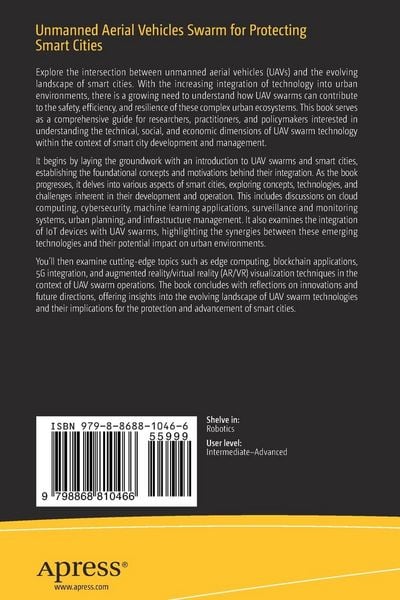
  • Chapter 1:  Introduction to UAV Swarms and Smart Cities.- Chapter 2:  Fundamentals of UAV Swarms.- Chapter 3: Smart Cities: Concepts and Technologies.- Chapter 4: Cloud Computing for UAV Swarms.- Chapter 5: Cybersecurity in UAV Swarm Operations.- Chapter 6: Machine Learning Applications in UAV Swarms.- Chapter 7: Surveillance and Monitoring in Smart Cities.- Chapter 8: Urban Planning and Infrastructure Management.- Chapter 9: Public Perception and Acceptance.- Chapter 10: Infrastructure Resilience and Disaster Management.- Chapter 11: International Perspectives on UAV Swarms.- Chapter 12: Real-world Deployments of UAV Swarms.- Chapter 13: Integration of IoT Devices with UAV Swarms.- Chapter 14: Smart Infrastructure for IoT and UAV Swarms.- Chapter 15: Economic Analysis of IoT and UAV Swarm Integration.- Chapter 16: Edge Computing for UAV Swarm Operations.- Chapter 17: Blockchain Applications in UAV Swarm Security.- Chapter 18: 5G Integration for Enhanced UAV Swarm Connectivity.- Chapter 19: Augmented Reality (AR) and Virtual Reality (VR) for UAV Swarm Visualization.- Chapter 20: Innovations and Future Directions in UAV Swarm for Protecting Smart Cities.