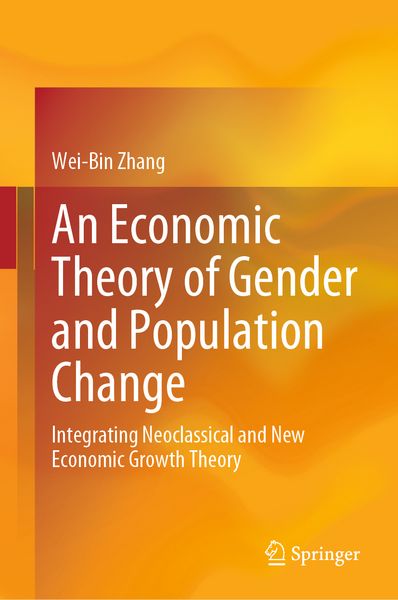
An Economic Theory of Gender and Population Change Integrating Neoclassical and New Economic Growth Theory
-
- Hardcover ausgewählt
- Taschenbuch
- eBook
-
Sprache:Englisch
126,99 €
inkl. gesetzl. MwSt.,
Beschreibung
Produktdetails
Einband
Gebundene Ausgabe
Erscheinungsdatum
11.01.2025
Verlag
Springer SingaporeSeitenzahl
333
Maße (L/B/H)
24,1/16/2,4 cm
Gewicht
755 g
Auflage
1. Auflage
Sprache
Englisch
ISBN
978-981-9796-04-5
This book proposes an economic theory of gender and population change by integrating neoclassical and new economic theories. Modern economies are characterized by complicated dynamic interdependence between many variables such as population growth, human capital accumulation, wealth accumulation, gender division of labor, children caring, environmental changes, various types of conflicts, wars, and so on. However modern dynamic economic theories deal with simplified interdependence between a few variables. Any genuine modeling of economic dynamics result in high-dimensional nonlinear dynamics. Nevertheless, it is only in recent years that it is possible to examine the behavior of highly dimensional dynamics. This partly explains why economic theory has been dominated by modeling dynamic economic systems with a few variables with linear (linearized) relations. Since Malthus published his An Essay on the Principle of Population in 1798, economists have made great efforts to reveal the dynamic complexity of population change. Modern economies have experienced unprecedented population dynamics. No one in human history could even have rationally predicted the natural declination of the national population in modern times. These failures in predicting family structural changes and life expectancy lead to many socioeconomic problems, such as health costs in association with aging and pension systems, that many societies fail to be prepared for. This book contributes to the literature on macroeconomics based on microeconomics, neoclassical growth theory, new growth theory, and family economics by integrating some important ideas in neoclassical growth theory and family economics. This book extensively applies the ideas in the literature to deal with the complexity of population change.
Noch keine Bewertungen vorhanden
Verfassen Sie die erste Bewertung zu diesem Artikel
Helfen Sie anderen Kundinnen und Kunden durch Ihre Meinung.
Kurze Frage zu unserer Seite
Vielen Dank für Ihr Feedback
Wir nutzen Ihr Feedback, um unsere Produktseiten zu verbessern. Bitte haben Sie Verständnis, dass wir Ihnen keine Rückmeldung geben können. Falls Sie Kontakt mit uns aufnehmen möchten, können Sie sich aber gerne an unseren Kund*innenservice wenden.
zum Kundenservice