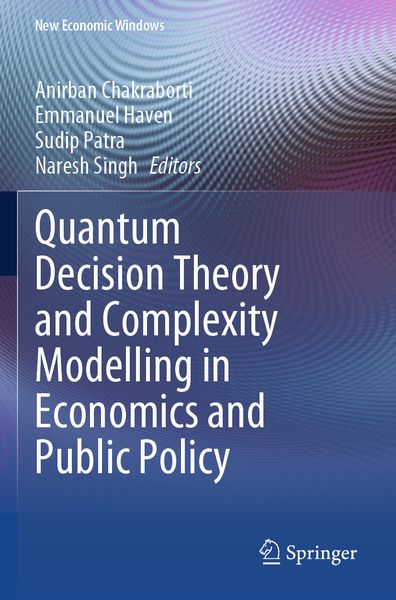
Produktbild: Quantum Decision Theory and Complexity Modelling in Economics and Public Policy
- 10%

Quantum Decision Theory and Complexity Modelling in Economics and Public Policy

Aus der Reihe New Economic Windows
10% sparen

133,99 € UVP 149,79 €

inkl. gesetzl. MwSt., Versandkostenfrei


Beschreibung

Produktdetails

Einband

Taschenbuch

Erscheinungsdatum

23.09.2024

Herausgeber

Anirban Chakraborti + weitere

Verlag

Springer

Seitenzahl

251

Maße (L/B/H)

23,5/15,5/1,5 cm

Gewicht

400 g

Sprache

Englisch

ISBN

978-3-031-38835-4

Beschreibung

Portrait

Anirban Chakraborti  is the Dean-Research and Development, BML Munjal University, Gurugram, and Professor at the School of Computational and Integrative Sciences, Jawaharlal Nehru University, New Delhi. He had been a faculty at École Centrale Paris, France, and Banaras Hindu University, India. He  obtained a Ph.D. in Physics from Saha Institute of Nuclear Physics, India and then the Habilitation in Physics from the Université Pierre et Marie Curie (Paris VI), France. He has  experience  working as a scientist at many reputed universities and educational institutions in India, the USA, Europe, and Japan. He was awarded the prestigious Young Scientist Medal by the Indian National Science Academy in 2009 for pioneering work in Econophysics. He has been elected as the Fellow, The World Academy of Sciences (TWAS). He has published fourteen books and edited volumes, and more than eighty-five research and review articles in internationally renowned publishing houses. His main research interests lie in the areas of Econophysics, Sociophysics, Data Science, Complex Systems, Statistical Physics, Quantum Physics and Nanomaterial Science.

Emmanuel Haven has been a pioneer in the emerging paradigm of quantum like modeling in social science. He is the Dr. Alex Faseruk Chair in Financial Management and Director of the Interdisciplinary Ph.D. programme at the Memorial University, Canada. He earned a Bachelor of Arts and Master of Arts in economics from McGill University and a Ph.D. in finance from Concordia University. He is the former head of the finance division at the School of Business, University of Leicester (United Kingdom). His research applies concepts from physics to social science. He has published in social science journals such as the Journal of Mathematical Economics, Economic Theory, the Journal of Mathematical Psychology, the European Journal of Operational Research, the Journal of Economic Dynamics and Control, and the International Review of Financial Analysis, Theory and Decision and Frontiers in Psychology. He  has also published in science journals such as Philosophical Transactions of the Royal Society A, Foundations of Physics, the Journal of Mathematical Analysis and Applications, Physica Scripta, the International Journal of Theoretical Physics, Acta Applicandae Mathematicae, Progress in Biophysics and Molecular Biology, Annalen der Physik and other journals. Haven has been the recipient of a 'super star award' from the Students' Union (University of Leicester) for his teaching on several occasions.

Dr Sudip Patra (PhD University of Glasgow, Scotland) is associate professor at OP Jindal Global University, India, and a research fellow at the Laszlo Institute of new paradigm research, Argentina. He is also a founding member of an interdisciplinary research group: CEASP at OP Jindal Global University. Dr Patra’s works are in the field of quantum-like framework or modelling, which is an interface between mathematical and philosophical concepts of quantum science (particularly quantum information theory) and decision science, with potential contributions in social sciences. Dr Patra’s research interest also lies in philosophy of science and quantum foundations.  

Naresh Singh  has more than three decades of post Ph.D. international development experience in more than fifty countries. He holds a Ph.D. in Environmental Sciences from the University of West Indies, Mona, and a M.Sc. in Agriculture from the Indian Agricultural Research Institute (IARI), New Delhi, India. Currently, he is the Professor and Professor & Executive Dean,  Jindal School of Government and Public Policy, and Director of the Centre for Complexity Economics, Applied Spirituality and Public Policy (CEASP) at O.P. Jindal Global University. He was a Director General and acting Vice President at CIDA; Program Director at the  International Institute for Sustainable Development (IISD); Principal Adviser on Poverty and Sustainable Livelihoods at UNDP; and Executive Director of the UN Commission on Legal Empowerment of the Poor, among several other high-profile positions. He has also been a visiting scholar/professor at several Universities in North America, India and the Caribbean and is widely published.


Produktdetails

Einband

Taschenbuch

Erscheinungsdatum

23.09.2024

Herausgeber

Verlag

Springer

Seitenzahl

251

Maße (L/B/H)

23,5/15,5/1,5 cm

Gewicht

400 g

Sprache

Englisch

ISBN

978-3-031-38835-4

Herstelleradresse

Springer-Verlag GmbH
Tiergartenstr. 17
69121 Heidelberg
DE

Email: ProductSafety@springernature.com

Kundinnen und Kunden meinen

0 Bewertungen

Informationen zu Bewertungen

Zur Abgabe einer Bewertung ist eine Anmeldung im Konto notwendig. Die Authentizität der Bewertungen wird von uns nicht überprüft. Wir behalten uns vor, Bewertungstexte, die unseren Richtlinien widersprechen, entsprechend zu kürzen oder zu löschen.

Die Bewertungen sind nach Format, Anzahl Sterne und Datum sortiert.

Verfassen Sie die erste Bewertung zu diesem Artikel

Helfen Sie anderen Kund*innen durch Ihre Meinung

Kundinnen und Kunden meinen

0 Bewertungen filtern

  • Produktbild: Quantum Decision Theory and Complexity Modelling in Economics and Public Policy
  • A brief overview of the quantum-like formalism in social science.- Cooperative functioning of unconscious and consciousness from theory of open quantum systems.- Hilbert Space Modelling With Applications in classical optics, human cognition, and game theory.- Remodeling Leadership: Quantum modeling of Wise Leadership.- Quantum financial entanglement: The case of strategic default.- Quantum-like Contextual utility framework: Application in economic theory And wider implications.