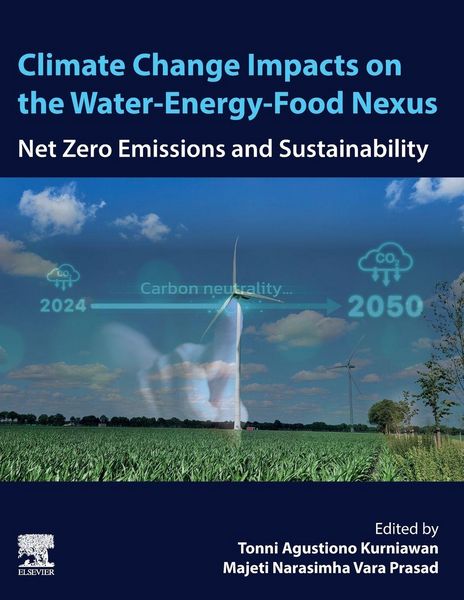
Produktbild: Climate Change Impacts on the Water-Energy-Food Nexus

Climate Change Impacts on the Water-Energy-Food Nexus Net Zero Emissions and Sustainability

197,99 €

inkl. gesetzl. MwSt., Versandkostenfrei


Beschreibung

Produktdetails

Einband

Taschenbuch

Erscheinungsdatum

31.10.2025

Herausgeber

Tonni Agustiono Kurniawan + weitere

Verlag

Elsevier Science & Technology

Seitenzahl

626

Maße (L/B/H)

27,9/21,6/3,2 cm

Gewicht

1430 g

Sprache

Englisch

ISBN

978-0-443-22320-4

Beschreibung

Portrait

Dr. Tonni Agustiono Kurniawan's degrees include a B.Sc. in chemistry from the Bogor Agricultural University (Indonesia), a M.Sc. in environmental technology from the Thammasat University (Thailand), and a Ph.D. in applied chemical technology from the Hong Kong Polytechnic University (China). He is the author of over 130 peer-reviewed publications in ISI-rated journals, 26 conference proceedings, including 9 book chapters and 6 monographs on waste to energy and wastewater treatment. He received the 2010 Green Talent Award from German Federal Ministry of Education and Research (BMBF), the 2013 Young Scientist Award from the World Economy Forum (WEF) (Switzerland), and the 2014 Scope-Zhongyu (France) for his outstanding research contribution to the fields of study. Elsevier and Stanford University (US) listed him among the top 2% of highly cited scientists in the field of Environmental Sciences.
Dr. Prasad is Emeritus Professor, School of Life Sciences, University of Hyderabad (India). He has made outstanding contributions to the fields of bioremediation, bioresources, biomass energy sources, bioeconomy, and to the broad field of environmental biotechnology, all of which are his main areas of expertise. Dr. Prasad has served the Government of India's Ministry of Environment, Forests and Climate Change as a member of various advisory committees on biodiversity conservation, ecosystem services, pollution control and abatement, environmental information systems and bioremediation of contaminated sites. He is an active visiting scientist for several international universities.

Produktdetails

Einband

Taschenbuch

Erscheinungsdatum

31.10.2025

Herausgeber

Verlag

Elsevier Science & Technology

Seitenzahl

626

Maße (L/B/H)

27,9/21,6/3,2 cm

Gewicht

1430 g

Sprache

Englisch

ISBN

978-0-443-22320-4

EU-Ansprechpartner

Zeitfracht Medien GmbH
Ferdinand-Jühlke-Straße 7
99095 Erfurt
DE
produktsicherheit@zeitfracht.de

Herstelleradresse

Elsevier Science & Technology
London Wall 125
EC2Y 5AS London
GB
tradeorders@elsevier.com

Noch keine Bewertungen vorhanden

Verfassen Sie die erste Bewertung zu diesem Artikel

Helfen Sie anderen Kundinnen und Kunden durch Ihre Meinung.

Kundinnen und Kunden meinen

Bewertungen (0)

Die Leseprobe wird geladen.
  • Produktbild: Climate Change Impacts on the Water-Energy-Food Nexus

    1. An Interrelationship of Water, Energy, and Food Nexus to Deal With Climate Mitigation and Adaptation: An Introduction

    2. Impact of Geopolitical Conflicts on Food Supply Chain, Droughts, and Water Scarcity

    3. Climate Change and Cities: Impacts and Sustainable Solutions

    4. Decoding the Water-Energy-Food Nexus for Carbon Neutrality

    5. Promoting Sustainable Production and Consumption in Water, Energy, and Food Nexus to Contribute to Carbon Neutrality

    6. Promoting Sustainability Transition in the Nexus of Water, Energy, and Food

    7. Societal Transition in the Nexus of Water, Energy, and Food Toward Decarbonization

    8. Dealing With Climate Change Implications on the Nexus of Water, Energy, and Food

    9. Strengthening Urban Resilience in the Nexus of Water, Energy, and Food

    10. Water Shortage Due to Urban Climate Imbalance in Water, Food, and Energy Nexus and the Role of Their Respective Resource Recovery

    11. Urban Forests: Nexus Between Energy Demand and Climate Change Mitigation

    12. Management of Water, Energy, and Food Nexus for Cleaner Production in Arable Lands

    13. Food Waste Upcycling via Livestock to Address Sustainability Objectives

    14. Technological Innovation and Its Role in Waste Management and Carbon Neutrality

    15. Biogas and Compressed Biogas Landscape in India: Opportunities and Challenges Considering the Advancements and Future Prospects of Biogas¿based Power Production in Europe

    16. Advances in Energy Systems, Water Processing and Food Technologies

    17. Technöeconomic Analysis of Waste Valorization in the Nexus of Energy and Food Using Digital Technologies

    18. Nexus and Connections of Waste Management, Energy Conservation, and Economic Development

    19. Sustaining Global Food Security Through Digitalization

    20. Industry 4.0, Innovation for Climate Change Mitigation and Sustainability

    21. Challenges and Technological Opportunities in the Energy Digitalization Era: Identifying Pathways Toward Sustainability

    22. Innovative Solutions to Climate Change: A Case Study of Green Hydrogen for Sustainable Energy Path

    23. How Do Low¿carbon Technologies Work in the Nexus of Water, Energy, and Food?

    24. Nanotechnologies in the Nexus of Water, Energy, and Food

    25. Impact of Resource Recovery Efforts in Protecting Water-Energy-Food Nexus

    26. Applying Life Cycle Assessment for Sustainable Manufacturing and Net Zero Carbon Goal

    27. Biochar From Biomass Wastes: Advancing Sustainable Circular Agriculture and the Water-Energy-Food Nexus

    28. Circularity of Water, Energy, Food Nexus Toward Decarbonization

    29. Decarbonization in the Nexus of Waste-Food and Energy Using Digital Technologies

    30. Toward Net Zero Emissions in Nexus of Water-Food-Energy Through Hydrogen Economy

    31. Biogas to Electricity Development in West Asia and the Middle East and North Africa Region: Challenges and Opportunities

    32. Artificial Intelligence Application on Food to Water to Energy Nexus

    33. Nanoinnovations at the Heart of the Water-Energy-Food Nexus

    34. Navigating Challenges and Unlocking Opportunities in Energy Digitalization: Paving the Way to a Sustainable Future

    35. Integrating Technology, Governance, and Social Justice in Sustainable Decarbonization: Resilient Strategies for Water-Energy-Food Nexus Transition