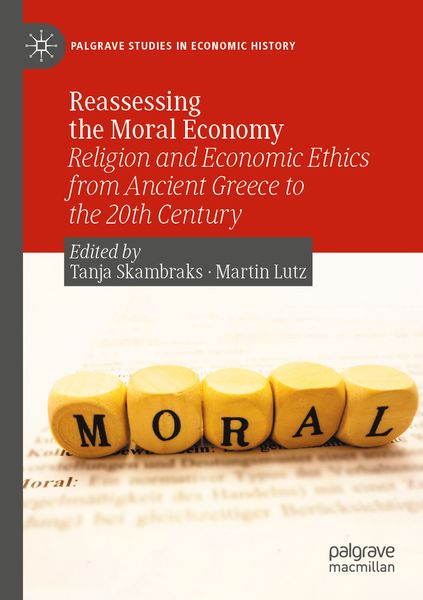
Reassessing the Moral Economy Religion and Economic Ethics from Ancient Greece to the 20th Century
-
- Hardcover
- Taschenbuch ausgewählt
- eBook
-
Sprache:Englisch
161,99 €
UVP
192,59 €
inkl. gesetzl. MwSt.,
Beschreibung
Produktdetails
Einband
Taschenbuch
Erscheinungsdatum
24.10.2024
Abbildungen
XIII, 298 p. 4 illus., 3 illus. in color.
Herausgeber
Tanja Skambraks + weitereVerlag
SpringerSeitenzahl
298
Maße (L/B/H)
21/14,8/1,7 cm
Gewicht
406 g
Sprache
Englisch
ISBN
978-3-031-29836-3
This book examines the concept of moral economy originally established by E.P. Thompson, focusing on the impact of religious norms on economic practice. With each chapter discussing a different empirical case study, the interrelations of the economy and religion are explored from antiquity through to the 20th century. The long-term trajectory and comparative perspective allows for moral economy to be seen in relation to ancient Greek commerce, medieval pawn-broking, Christian and Jewish economic ethics, urban social politics during the Plague, the Jesuit mission in Paraguay, the Ottoman Empire, religion in modern American capitalism, and Catholic attitudes toward taxation.
This book aims to provide insight into how moral thinking about the economy and economic practicehas evolved from a long historic perspective. It will be relevant to students and researchers interested in economic history and cultural economics.
Noch keine Bewertungen vorhanden
Verfassen Sie die erste Bewertung zu diesem Artikel
Helfen Sie anderen Kundinnen und Kunden durch Ihre Meinung.
Kurze Frage zu unserer Seite
Vielen Dank für Ihr Feedback
Wir nutzen Ihr Feedback, um unsere Produktseiten zu verbessern. Bitte haben Sie Verständnis, dass wir Ihnen keine Rückmeldung geben können. Falls Sie Kontakt mit uns aufnehmen möchten, können Sie sich aber gerne an unseren Kund*innenservice wenden.
zum Kundenservice