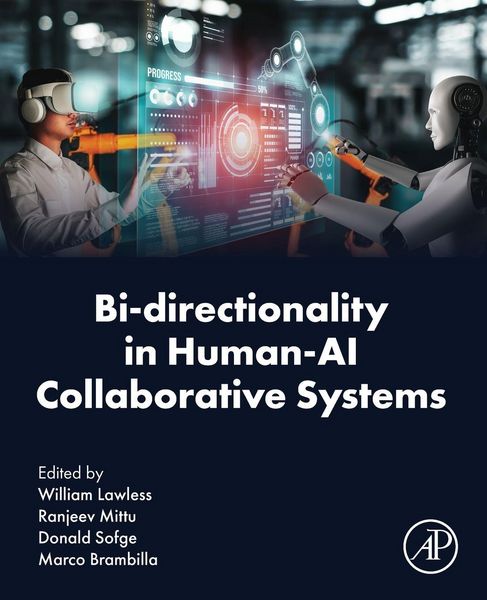
Bi-directionality in Human-AI Collaborative Systems
-
- Taschenbuch ausgewählt
- eBook
-
Sprache:Englisch
145,99 €
UVP
192,50 €
inkl. gesetzl. MwSt.,
Beschreibung
Produktdetails
Einband
Taschenbuch
Erscheinungsdatum
10.07.2025
Herausgeber
William Lawless + weitereVerlag
Elsevier Science & TechnologySeitenzahl
508
Maße (L/B/H)
23,5/19,1/2,6 cm
Gewicht
865 g
Sprache
Englisch
ISBN
978-0-443-40553-2
Bi-directionality in Human-AI Collaborative Systems investigates the foundations, metrics, and applications of human-machine systems, along with the legal ramifications of autonomy, including standards, trust by the public, and bidirectional trust by users and AI systems. The book addresses the challenges in creating synergistic human and AI-based autonomous system-of-systems by focusing on the underlying challenges associated with bi-directionality. Chapters cover advances in LLMs, logic, machine learning choices, the development of standards, as well as human-centered approaches to autonomous human-machine teams. This is a valuable resource for world-class researchers and engineers who are theorizing on, designing, and developing autonomous systems.
It will also be useful for government scientists, business leaders, social scientists, philosophers, regulators and legal experts interested in the impact of autonomous human-machine teams and systems.
Noch keine Bewertungen vorhanden
Verfassen Sie die erste Bewertung zu diesem Artikel
Helfen Sie anderen Kundinnen und Kunden durch Ihre Meinung.
Kurze Frage zu unserer Seite
Vielen Dank für Ihr Feedback
Wir nutzen Ihr Feedback, um unsere Produktseiten zu verbessern. Bitte haben Sie Verständnis, dass wir Ihnen keine Rückmeldung geben können. Falls Sie Kontakt mit uns aufnehmen möchten, können Sie sich aber gerne an unseren Kund*innenservice wenden.
zum Kundenservice