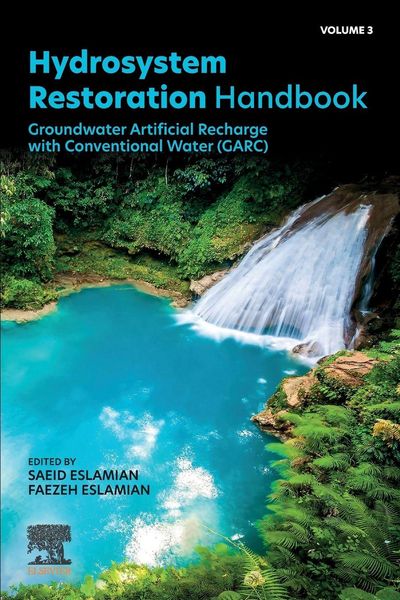
Produktbild: Hydrosystem Restoration Handbook

Hydrosystem Restoration Handbook Groundwater Artificial Recharge with Conventional Water (GARC)

164,99 €

inkl. gesetzl. MwSt., Versandkostenfrei


Beschreibung

Produktdetails

Einband

Taschenbuch

Erscheinungsdatum

28.11.2025

Herausgeber

Saei Eslamian

Verlag

Elsevier

Seitenzahl

526

Maße (L/B/H)

22,9/15,2/2,7 cm

Gewicht

697 g

Sprache

Englisch

ISBN

978-0-443-29104-3

Beschreibung

Portrait

Saeid Eslamian received his PhD in Civil and Environmental Engineering from University of New South Wales, Australia in 1998. Saeid was Visiting Professor in Princeton University and ETH Zurich in 2005 and 2008 respectively. He has contributed to more than 1K publications in journals, conferences, books. Eslamian has been appointed as 2-Percent Top Researcher by Stanford University for several years. Currently, he is full professor of Hydrology and Water Resources and Director of Excellence Center in Risk Management and Natural Hazards. Isfahan University of Technology, His scientific interests are Floods, Droughts, Water Reuse, Climate Change Adaptation, Sustainability and Resilience

Faezeh Eslamian is a PhD holder of bioresource engineering from McGill University. Her research focuses on the development of a novel lime-based product to mitigate phosphorus loss from agricultural fields. Faezeh completed her bachelor’s and master’s degrees in civil and environmental engineering from Isfahan University of Technology, Iran, where she evaluated natural and low-cost absorb bents for the removal of pollutants such as textile dyes and heavy metals. Furthermore, she has conducted research on the worldwide water quality standards and wastewater reuse guidelines. Faezeh is an experienced multidisciplinary researcher with research interests in soil and water quality, environmental remediation, water reuse, and drought management.

Produktdetails

Einband

Taschenbuch

Erscheinungsdatum

28.11.2025

Herausgeber

Saei Eslamian

Verlag

Elsevier

Seitenzahl

526

Maße (L/B/H)

22,9/15,2/2,7 cm

Gewicht

697 g

Sprache

Englisch

ISBN

978-0-443-29104-3

Herstelleradresse

Libri GmbH
Europaallee 1
36244 Bad Hersfeld
DE

Email: gpsr@libri.de

Noch keine Bewertungen vorhanden

Verfassen Sie die erste Bewertung zu diesem Artikel

Helfen Sie anderen Kundinnen und Kunden durch Ihre Meinung.

Kundinnen und Kunden meinen

Bewertungen (0)

  • Produktbild: Hydrosystem Restoration Handbook
  • Part I: Foundational Concepts and Traditional Techniques
    1. Water Harvesting Systems and Groundwater Artificial Recharge with Conventional Water
    2. Three-R: Recharge, Retention and Reuse of Water
    3. Comparison of Water and Flood Spreading Area Against Non-Spreading and Control Area using Remote Sensing, GIS and Statistical Analysis

    Part II: Case Studies and Regional Applications
    4. Identification and Assessment of Artificial Groundwater Recharge Potential Zones-A Case Study in the Mitidja Plain, North Algeria
    5. The Long-Term Variability of Hydrological Characteristics of Lake Baikal and Its Tributaries Under Climate Change and Anthropogenic Impact
    6. Understanding the Water Scenario in India
    7. Traditional Groundwater Recharge Techniques in India
    8. The Role of Non-State actors in Groundwater Artificial Recharge with Conventional Water-Based Watershed Development Programmes in India: A case study

    Part III: Planning and Management Strategies
    9. Groundwater Artificial Recharge with Conventional Water Management and Sustainability
    10. Planning Various Groundwater Artificial Recharge with Conventional Water Schemes
    11. Water Resources Restoration as a Robust Tool for Poverty Reduction and Promoting Welfare
    12. Groundwater Resources Restoration: A Green Technology Approach
    13. Artificial Groundwater Recharge for Water Banking
    14. Rainwater Harvesting and Groundwater Recharge

    Part IV: Methodological Innovations and Advanced Techniques
    15. Methodological Survey for the Estimation of Groundwater Artificial Recharge
    16. Conceptual Modeling of Groundwater Artificial Recharge with Conventional Water
    17. Machine Learning Techniques for the Estimation of Groundwater Artificial Recharge by Conventional Water
    18. Water Productivity Enhancement using Groundwater Artificial Recharge with Conventional Water
    19. Classification Methods for Ranking the Appropriate Locations for Groundwater Artificial Recharge with Conventional Water

    Part V: Future Trends and Emerging Technologies
    20. Underground Dam Theory and Application
    21. Future Trends in Groundwater Artificial Recharge with Conventional Water