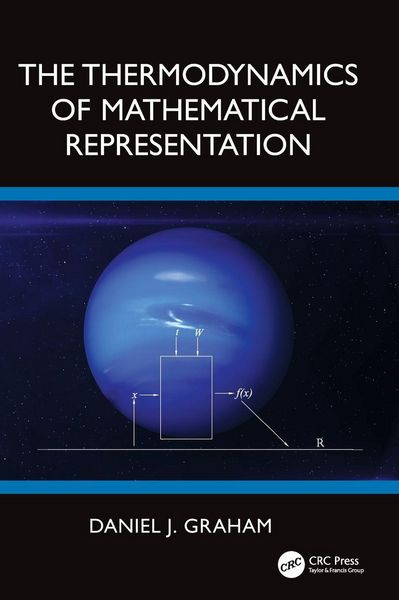
The Thermodynamics of Mathematical Representation
219,99 €
UVP
272,60 €
inkl. gesetzl. MwSt.,
Beschreibung
Produktdetails
Einband
Gebundene Ausgabe
Erscheinungsdatum
04.07.2025
Abbildungen
schwarz-weiss Illustrationen, Zeichnungen, schwarz-weiss
Verlag
Taylor & FrancisSeitenzahl
314
Maße (L/B/H)
26/18,3/2,2 cm
Gewicht
740 g
Sprache
Englisch
ISBN
978-1-03-298150-5
Thermodynamics is the physical science surrounding work, heat, and relationships across fundamental quantities, and situates itself near the center of multiple disciplines through its generality and timelessness. Its laws required no rewriting after the twentieth century revolutions of quantum mechanics, relativity, and solid state physics, just to name three subjects. The nine chapters of this book make appeal to thermodynamic notions and laws to get under the hood of mathematics-the language of the physical sciences-without just echoing things best said and written in math books. It takes a system to learn about another system-we all need thermometers, voltmeters, and other gadgets to get to know objects of interest. But just as critical are the numbers and functions we put to the task, however relegated they are to computers in the modern day for the heavy lifting. To be sure, mathematical representations like x = ½, 5.2, pi, e, etc., and f(x) = x2, sin(x), etc., are never in physical contact with the solids, liquids, and gases that draw our attention, but they are as impacted by the same natural laws as the lab apparatus itself.
This book shows how the thermodynamic laws impact our number systems. The laws affirm that we have direct access to a vanishingly small fraction of the real numbers. They further establish that the real numbers present a maximum-evolved system impacting all matters of computation, graphing, differentiation, and integration. For completeness, one of the chapters includes cases where the thermodynamic laws have little, if anything, constructive to say about representations in mathematics.
This book presents a novel perspective to students and teachers in the physical sciences, biology, and mathematics, with the goal of enriching classroom and seminar hours. The chapters are self-contained and written informally, and readers with rudimentary knowledge of energy, numbers, and functions should handle the material well.
Noch keine Bewertungen vorhanden
Verfassen Sie die erste Bewertung zu diesem Artikel
Helfen Sie anderen Kundinnen und Kunden durch Ihre Meinung.
Kurze Frage zu unserer Seite
Vielen Dank für Ihr Feedback
Wir nutzen Ihr Feedback, um unsere Produktseiten zu verbessern. Bitte haben Sie Verständnis, dass wir Ihnen keine Rückmeldung geben können. Falls Sie Kontakt mit uns aufnehmen möchten, können Sie sich aber gerne an unseren Kund*innenservice wenden.
zum Kundenservice