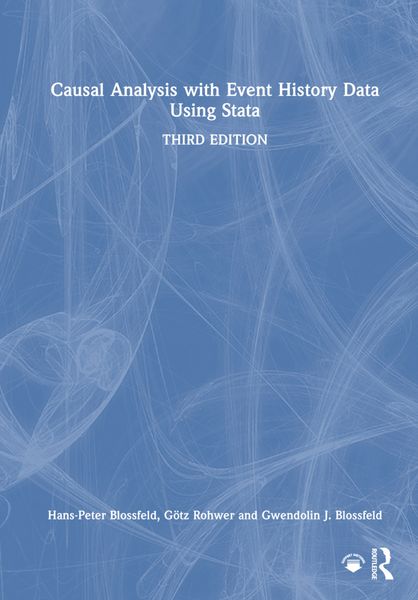
Rohwer, G: Causal Analysis with Event History Data Using Sta
-
- Hardcover ausgewählt
- Taschenbuch
- eBook
-
Sprache:Englisch
168,99 €
inkl. gesetzl. MwSt.,
Beschreibung
Produktdetails
Einband
Gebundene Ausgabe
Erscheinungsdatum
28.07.2025
Abbildungen
62 SW-Abb., 62 SW-Zeichn.
Verlag
Taylor & FrancisSeitenzahl
248
Maße (L/B/H)
29,7/21/1,6 cm
Gewicht
820 g
Auflage
3. Auflage
Sprache
Englisch
ISBN
978-1-03-270809-6
This third edition of Causal Analysis with Event History Data Using Stata provides an updated introduction to event history modeling along with many instructive Stata examples. Using the latest Stata software, each of these practical examples develops a research question, points to useful contextual background information, gives a brief account of the underlying statistical concepts, describes the organization of input data and the application of Stata statistical procedures, and assists the reader in interpreting the content of the results obtained.
Emphasizing the strengths and limitations of continuous-time event history analysis in different fields of social science applications, this book demonstrates that event history models provide a useful approach to uncover causal relation- ships or to map a system of causal relationships. In particular, this book demonstrates how long-term processes can be studied, how different forms of duration dependencies can be estimated using nonparametric, parametric and semiparametric models, and how parallel and interdependent dynamic systems can be analyzed from a causal-analytical point of view using the method of episode splitting. The book also shows how changing contextual information at the micro, meso and macro levels can be easily integrated into a dynamic analysis of longitudinal data. Finally, the book addresses the problem of unobserved heterogeneity of time-constant and time-dependent omitted variables and makes suggestions for dealing with these sometimes difficult methodological problems.
Causal Analysis with Event History Data Using Stata is an invaluable resource for both novice and experienced researchers from a variety of fields (e.g. sociology, economics, political science, education, psychology, demography, epidemiology, management research and organizational studies, as well as medicine and clinical applications) who need an introductory textbook on continuous-time event history analysis and who are looking for a practical handbook for their longitudinal research.
Noch keine Bewertungen vorhanden
Verfassen Sie die erste Bewertung zu diesem Artikel
Helfen Sie anderen Kundinnen und Kunden durch Ihre Meinung.
Kurze Frage zu unserer Seite
Vielen Dank für Ihr Feedback
Wir nutzen Ihr Feedback, um unsere Produktseiten zu verbessern. Bitte haben Sie Verständnis, dass wir Ihnen keine Rückmeldung geben können. Falls Sie Kontakt mit uns aufnehmen möchten, können Sie sich aber gerne an unseren Kund*innenservice wenden.
zum Kundenservice