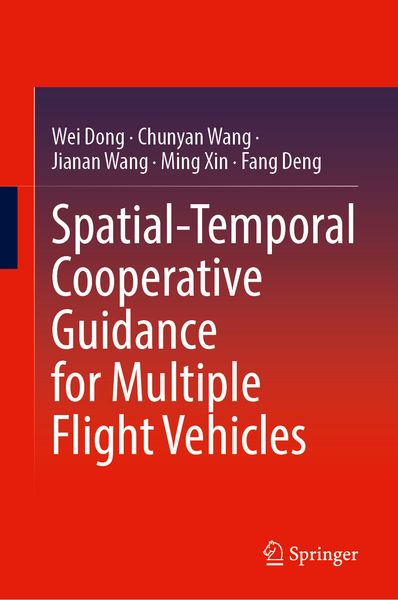
Spatial-Temporal Cooperative Guidance for Multiple Flight Vehicles
-
- Hardcover ausgewählt
- Taschenbuch
- eBook
-
Sprache:Englisch
149,99 €
UVP
181,89 €
inkl. gesetzl. MwSt.,
Beschreibung
Produktdetails
Einband
Gebundene Ausgabe
Erscheinungsdatum
01.06.2025
Verlag
Springer SingaporeSeitenzahl
209
Maße (L/B/H)
24,1/16/1,8 cm
Gewicht
504 g
Auflage
1. Auflage
Sprache
Englisch
ISBN
978-981-9651-37-5
The spatial-temporal cooperative guidance problem for multiple flight vehicles has garnered significant attention in recent years due to its potential benefits in both military and civil fields. This book provides a concise but holistic introduction to this practical problem and presents a summative collection of the latest solutions to the concerned challenges, thereby providing some theoretical support for enhancing the synergism and applicability of cooperative guidance for multiple flight vehicles. This book consists of nine chapters. In Chapter 1, recent works on cooperative guidance are systematically recalled. Chapter 2 introduces the common formulation and unique challenges of the cooperative guidance problem from a practical viewpoint. In Chapter 3, a varying-gain proportional navigation guidance law with accurate time-to-go prediction is developed to realize precise control of the impact time. In Chapter 4, in response to the inherent finite-time property of the cooperative guidance problem, a fixed-time convergent error dynamic is proposed to design a 3D distributed cooperative guidance law with enhanced convergence. In Chapter 5, a command-decoupled design strategy is proposed to address the challenging spatial-temporal cooperative guidance problem through the derivation and combination of the coplanar cooperative guidance and planar pursuit guidance commands. In Chapter 6, an integrated design strategy based on rotational operations on spatial vectors is proposed to simultaneously satisfy the impact angle and time constraints. In Chapter 7, a multiple-stage cooperative guidance strategy is developed to satisfy the spatial-temporal constraints without relying on time-to-go information. In Chapter 8, a unified command augmentation method is proposed to prevent the seeker's FOV from exceeding the boundary throughout the cooperative guidance. Finally, Chapter 9 concludes this book and offers an instructive opinion on the future directions of the cooperative guidance problem in both academic and engineering investigations. Therefore, this book can not only serve as a reference for researchers who are interested in this field with systematic and inspirational perspectives, but also be a useful handbook for engineers engaged in cooperative guidance and control of multiple flight vehicles.
Noch keine Bewertungen vorhanden
Verfassen Sie die erste Bewertung zu diesem Artikel
Helfen Sie anderen Kundinnen und Kunden durch Ihre Meinung.
Kurze Frage zu unserer Seite
Vielen Dank für Ihr Feedback
Wir nutzen Ihr Feedback, um unsere Produktseiten zu verbessern. Bitte haben Sie Verständnis, dass wir Ihnen keine Rückmeldung geben können. Falls Sie Kontakt mit uns aufnehmen möchten, können Sie sich aber gerne an unseren Kund*innenservice wenden.
zum Kundenservice