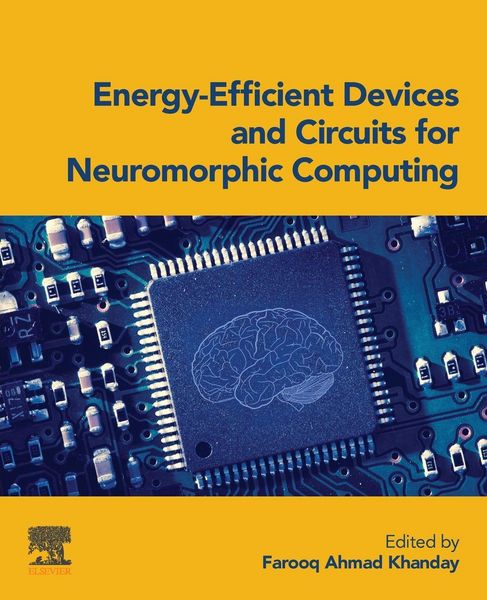
Produktbild: Energy-Efficient Devices and Circuits for Neuromorphic Computing
- 20%

Energy-Efficient Devices and Circuits for Neuromorphic Computing

20% sparen

81,99 € UVP 102,50 €

inkl. gesetzl. MwSt., Versandkostenfrei


Beschreibung

Produktdetails

Einband

Taschenbuch

Erscheinungsdatum

29.10.2025

Herausgeber

Farooq Ahmad Khanday

Verlag

Elsevier Science & Technology

Seitenzahl

508

Maße (L/B/H)

23,5/19,1/2,6 cm

Gewicht

1040 g

Sprache

Englisch

ISBN

978-0-443-29981-0

Beschreibung

Portrait

Dr. Farooq Ahmad Khanday (M’15, SM’19) received M.Sc. (Gold Medalist), M. Phil. and Ph.D. Degrees from University of Kashmir in 2004 2010 and 2013 respectively. From June 2005 to Jan. 2009, he served as Assistant Professor on contractual basis at University of Kashmir, Department of Electronics and Instrumentation Technology. In 2009, he joined to Department of Higher Education J&K and Department of Electronics and Vocational Studies, Islamia College of Science and Commerce Srinagar, as Assistant Professor. From May 2010 to May 2022, he served as Assistant Professor in the Department of Electronics and Instrumentation Technology, University of Kashmir. From May 2022, he is associate professor in the Department of Electronics and Instrumentation Technology, University of Kashmir. His research interests include Neuromorphic Computing, Fractional-order Circuits, Low-power circuit Design, Nano-Electronics and Stochastic Computing. He is author or co-author of more than 150 publications in peer reviewed indexed International and National journals/conferences of repute including IEEE Transactions and Eleven book chapters. Besides he has authored a book on “Nanoscale Electronic Devices and Their Applications” in CRC Press (Taylor and Francis) and has Edited one book on “Neuromorphic Computing” and three books on “Fractional-order Systems” in Elsevier. In addition he has one patent on “Portable Microcontroller-Based Impedance Meter For Biological Tissue Analysis (563600)”. He is featuring in Stanford University list of top 2% cited Scientists in the world. He is also listed among the world top 0.25% researchers in the field of Nanoelectronic Devices for the year 2024, according to ScholarGPS, California, USA. He has been the Management Committee (MC) Observer of the COST Action CA15225 (Fractional-order systems - analysis, synthesis and their importance for future design) of European Union and INSA visiting scientist fellow 2020-21. He is the Editor of PLOS ONE journal. He is the senior member of IEEE and member of other professional societies. He is serving as a reviewer for many International and National scientific journals in Electronics. He has successfully guided many Ph.D., M. Phil scholars, and M. Tech thesis. Dr. Khanday also has completed/ongoing funded research projects to his credit and has established laboratories with state of the art facilities for pursuing research in the fields of IC design, Nanoelectronics, fractional-order systems, etc.

Produktdetails

Einband

Taschenbuch

Erscheinungsdatum

29.10.2025

Herausgeber

Farooq Ahmad Khanday

Verlag

Elsevier Science & Technology

Seitenzahl

508

Maße (L/B/H)

23,5/19,1/2,6 cm

Gewicht

1040 g

Sprache

Englisch

ISBN

978-0-443-29981-0

EU-Ansprechpartner

Zeitfracht Medien GmbH
Ferdinand-Jühlke-Straße 7
99095 Erfurt
DE
produktsicherheit@zeitfracht.de

Herstelleradresse

Elsevier Science & Technology
London Wall 125
EC2Y 5AS London
GB
tradeorders@elsevier.com

Noch keine Bewertungen vorhanden

Verfassen Sie die erste Bewertung zu diesem Artikel

Helfen Sie anderen Kundinnen und Kunden durch Ihre Meinung.

Kundinnen und Kunden meinen

Bewertungen (0)

Die Leseprobe wird geladen.
  • Produktbild: Energy-Efficient Devices and Circuits for Neuromorphic Computing
  • 1. Biological neural systems NEW
    2. Fundamentals of neuron dynamics and Neural Networks NEW
    3. Foundations, recent developments and applications of spiking neural networks (SNNs)
    4. Training and learning processes of SNNs
    5. Introduction to Neuromorphic Computing
    6. The Need for Energy Efficiency in Neuromorphic Computing v Review of Neuromorphic devices and Circuits
    7. Energy-efficient devices for Neuromorphic computing
    8. Novel biomimetic devices for energy efficient synapses and neurons OLD
    9. Analog and Digital CMOS circuits for Energy Efficient Neuromorphic Computing
    10. Energy-efficient Neuromorphic computing systems with emerging post-CMOS devices
    11. Energy Efficient Neuromorphic Computing Architectures and Processing
    12. Nonvolatile memory crossbar arrays for energy efficient neuromorphic computing
    13. Energy Efficient Neuromorphic Vision Systems
    14. Neuromorphic sensors and in-sensor computing
    15. Practical Applications of Energy-Efficient Neuromorphic Computing
    16. Current and future challenges of Neuromorphic Computing