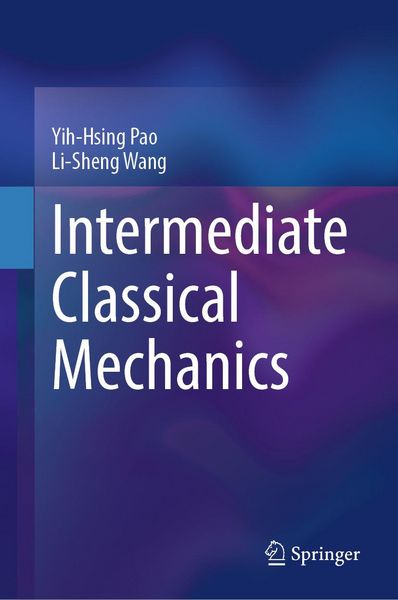
Intermediate Classical Mechanics
-
- Hardcover
- Taschenbuch
- eBook ausgewählt
-
Form:Einzelkauf Download
-
Sprache:Englisch
85,59 €
inkl. gesetzl. MwSt.Beschreibung
Produktdetails
Format
Kopierschutz
Nein
Family Sharing
Nein
Text-to-Speech
Nein
Erscheinungsdatum
28.03.2025
Verlag
Springer Nature SingaporeSeitenzahl
430 (Printausgabe)
Dateigröße
5241 KB
Sprache
Englisch
EAN
9789819791361
This book describes the basic concepts and principles of classical mechanics in the intermediate level. Given the perspective that different mechanical problems require an appropriate approach drawn from various methods or principles, a textbook discussing multiple methods or principles in mechanics is highly desirable. Additionally, a good textbook should include historical context on the motivation and the development of the methods or principles, allowing students to gain insights that may help them discover new theories. However, after many years of teaching Dynamics in the graduate school, the authors were unable to find a suitable intermediate-level textbook on classical mechanics, which motivated them to begin writing this book. For the aforementioned reasons, this book includes the descriptions of various methods or principles in mechanics, such as the Newton-Euler Principle, the d'Alembert Principle, Lagrangian methods, Gauss's Principle of Least Constraint, the Gibbs-Appell equation, Jourdain's equation, the Principle of Virtual Power, the Appell-Kane method, the Hamilton Principle, and the Hamiltonian mechanics, among others. Moreover, many historical remarks on the motivation and the development of the methods or principles are given in this book, as well as numerous applications. The authors also believe that in studying the motion of a material body, different models may be used depending on the application. If the position of the body is of interest, a particle model may be chosen. If the orientation or attitude of the body is under consideration, a rigid body model should be adopted. If deformation is a concern, a model of deformable body should be applied. Consequently, a book in mechanics for engineers should encompass a variety of models of the body, ranging from particles to continua such as solids or fluids. This book also meets that need.
Noch keine Bewertungen vorhanden
Verfassen Sie die erste Bewertung zu diesem Artikel
Helfen Sie anderen Kundinnen und Kunden durch Ihre Meinung.
Kurze Frage zu unserer Seite
Vielen Dank für Ihr Feedback
Wir nutzen Ihr Feedback, um unsere Produktseiten zu verbessern. Bitte haben Sie Verständnis, dass wir Ihnen keine Rückmeldung geben können. Falls Sie Kontakt mit uns aufnehmen möchten, können Sie sich aber gerne an unseren Kund*innenservice wenden.
zum Kundenservice