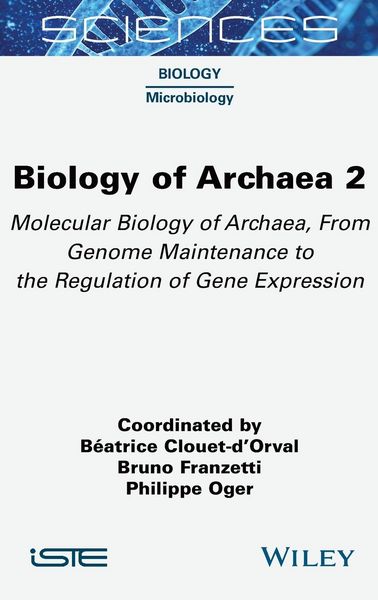
Produktbild: Biology of Archaea 2

Biology of Archaea 2 Molecular Biology of Archaea, from Genome Maintenance to the Regulation of Gene Expression

176,99 €

inkl. gesetzl. MwSt., Versandkostenfrei


Beschreibung

Produktdetails

Einband

Gebundene Ausgabe

Erscheinungsdatum

20.05.2025

Herausgeber

Béatrice Clouet-d'Orval + weitere

Verlag

Wiley

Seitenzahl

256

Maße (L/B/H)

23,4/15,6/1,6 cm

Gewicht

531 g

Sprache

Englisch

ISBN

978-1-78945-169-6

Beschreibung

Portrait

Béatrice Clouet-d'Orval is Research Director at the CNRS and works at the Center for Integrative Biology, Toulouse, France. Her main research areas focus on the post-transcriptional regulation of gene expression.

Bruno Franzetti is Research Director at the CNRS, France, where he specializes in the structural biology of archaea. His research areas include biophysical and cellular mechanisms that maintain proteome integrity under extreme conditions.

Philippe Oger is Research Director at the CNRS, France. His research areas include understanding the adaptations of prokaryotes in response to extreme conditions, using a multidisciplinary approach combining the methods derived from atomic physics and cutting-edge molecular biology and modeling.

Produktdetails

Einband

Gebundene Ausgabe

Erscheinungsdatum

20.05.2025

Herausgeber

Verlag

Wiley

Seitenzahl

256

Maße (L/B/H)

23,4/15,6/1,6 cm

Gewicht

531 g

Sprache

Englisch

ISBN

978-1-78945-169-6

Herstelleradresse

Libri GmbH
Europaallee 1
36244 Bad Hersfeld
DE

Email: gpsr@libri.de

Noch keine Bewertungen vorhanden

Verfassen Sie die erste Bewertung zu diesem Artikel

Helfen Sie anderen Kundinnen und Kunden durch Ihre Meinung.

Kundinnen und Kunden meinen

Bewertungen (0)

Die Leseprobe wird geladen.
  • Produktbild: Biology of Archaea 2
  • Preface xi
    Béatrice CLOUET-D'ORVAL, Bruno FRANZETTI and Philippe OGER

    Chapter 1. Replication of Archaeal Chromosomes 1
    Ghislaine HENNEKE, Roxane LESTINI, Marc NADAL and Didier FLAMENT

    1.1. Replication initiation 2

    1.2. The elongation phase of replication 8

    1.3. Okazaki fragment maturation 10

    1.4. Restarting replication forks 15

    1.5. Replication termination 18

    1.6. Chromosome segregation and decatenation 18

    1.7. References 19

    Chapter 2. Archaeal DNA Repair 25
    Caroline L'HERMITTE-STEAD, Anaïs BAYARD, Alexey ALEKSANDROV, Roxane LESTINI and Hannu MYLLYKALLIO

    2.1. General introduction 25

    2.2. Several different types of DNA damages occur in archaea 28

    2.3. Different archaeal DNA repair pathways 31

    2.4. Coordination of the different pathways by the replication clamp 40

    2.5. Summary and conclusion 42

    2.6. References 43

    Chapter 3. Transcription in Archaea 45
    Thomas FOUQUEAU, Duy KHANH PHUNG and Ludovic SAUGUET

    3.1. RNA polymerase 47

    3.2. The three stages of transcription 51

    3.3. Transcription regulation 64

    3.4. References 66

    Chapter 4. RNA Classes and Their Maturation and Degradation Enzymes 77
    Manon BATISTA, Béatrice CLOUET-D'ORVAL and Marie BOUVIER

    4.1. Introduction 77

    4.2. RNA classes in archaea 79

    4.3. Ribonuclease families in archaea 84

    4.4. Ubiquitous RNA-binding proteins in archaea 95

    4.5. Conclusion 100

    4.6. References 100

    Chapter 5. Ribosome and Transfer RNA Biogenesis 115
    Tamara BASTA and Sébastien FERREIRA-CERCA

    5.1. Ribosome biogenesis 116

    5.2. Synthesis and maturation of tRNAs 133

    5.3. Methodical toolboxes 156

    5.4. References 158

    Chapter 6. The Diversity and Function of Noncoding RNAs in Archaea 167
    Hubert F. BECKER and Christine GASPIN

    6.1. Introduction 167

    6.2. Noncoding RNA diversity 168

    6.3. ncRNA identification 178

    6.4. Circularization of noncoding RNAs 182

    6.5. Conclusion 185

    6.6. References 186

    Chapter 7. Translation in Archaea 193
    Emmanuelle SCHMITT and Yves MECHULAM

    7.1. Initiating the translation 195

    7.2. Elongation peptide synthesis 206

    7.3. Translation termination and ribosome recycling 214

    7.4. Conclusion 219

    7.5. References 220

    List of Authors 233

    Index 237