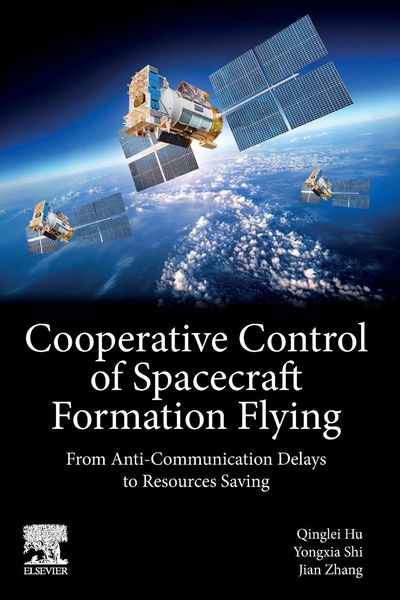
Cooperative Control of Spacecraft Formation Flying From Anti-Communication Delays to Resources Saving
-
- Taschenbuch ausgewählt
- eBook
-
Sprache:Englisch
156,99 €
UVP
199,50 €
inkl. gesetzl. MwSt.,
Beschreibung
Produktdetails
Einband
Taschenbuch
Erscheinungsdatum
30.10.2025
Verlag
Elsevier Science & TechnologySeitenzahl
364
Maße (L/B/H)
22,9/15,2/1,9 cm
Gewicht
450 g
Sprache
Englisch
ISBN
978-0-443-43948-3
Cooperative Control of Spacecraft Formation Flying: From Anti-Communication Delays to Resources Saving provides an in-depth, practically focused, exploration of secure cooperative control for spacecraft formation flying that addresses real-world challenges including communication latency, resource constraints, and information security, balancing foundational theory with actionable solutions, tailored to complex, resource-limited environments A comprehensive reference source for aerospace engineers and researchers covering anti-communication delays and resource-saving coordination strategies in spacecraft formation flying. For professionals and researchers in space systems, robotics and control engineering, the book provides detailed descriptions of robust security measures and practical application insights. The integration of secure communication protocols with control methods makes the book particularly relevant for professionals in high-stakes environments, where cyber threats and resource limitations are critical. For space agency mission planners and aerospace cybersecurity experts, the project addresses critical issues in secure, delay-tolerant communication and resource optimization for coordinated spacecraft missions. This enhances the development of secure and resilient communication protocols, which are critical to prevent data breaches and ensure reliable inter-spacecraft coordination in adversarial environments. The integration of advanced algorithms and the emphasis on real-world challenges, particularly the communication security issue, provides readers with a unique perspective that is missing in existing literature. The book equips readers with detailed information on advanced control strategies for multi-spacecraft coordination, particularly methods that address communication delays and optimize resource use.
Noch keine Bewertungen vorhanden
Verfassen Sie die erste Bewertung zu diesem Artikel
Helfen Sie anderen Kundinnen und Kunden durch Ihre Meinung.
Kurze Frage zu unserer Seite
Vielen Dank für Ihr Feedback
Wir nutzen Ihr Feedback, um unsere Produktseiten zu verbessern. Bitte haben Sie Verständnis, dass wir Ihnen keine Rückmeldung geben können. Falls Sie Kontakt mit uns aufnehmen möchten, können Sie sich aber gerne an unseren Kund*innenservice wenden.
zum Kundenservice