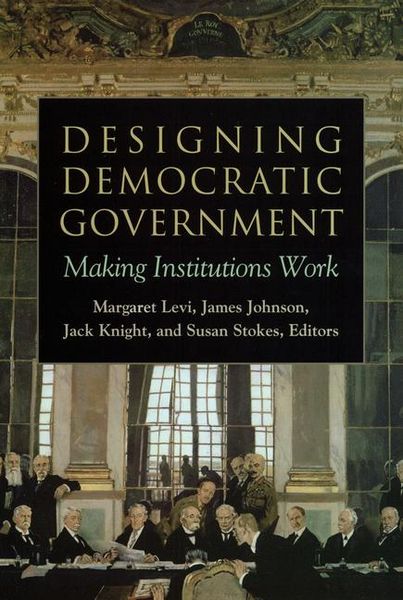
Designing Democratic Government Making Institutions Work
-
- Englisch ausgewählt
41,99 €
inkl. gesetzl. MwSt.,
Beschreibung
Produktdetails
Einband
Taschenbuch
Erscheinungsdatum
01.09.2011
Herausgeber
Margaret Levi + weitereVerlag
Russell Sage FoundationSeitenzahl
334
Maße (L/B/H)
22,4/14,7/2,5 cm
Gewicht
476 g
Sprache
Englisch
ISBN
978-0-87154-459-9
What are the essential elements of a democracy? How can nations ensure a political voice for all citizens, and design a government that will respond to those varied voices? These perennial questions resonate strongly in the midst of ongoing struggles to defend democratic institutions around the world and here at home. In Designing Democratic Government, a group of distinguished political scientists provides a landmark cross-national analysis of the institutions that either facilitate or constrain the healthy development of democracy. The contributors to Designing Democratic Government use the democratic ideals of fairness, competitiveness, and accountability as benchmarks to assess a wide variety of institutions and practices. John Leighly and Jonathan Nagler find that in the U.S., the ability to mobilize voters across socioeconomic lines largely hinges on the work of non-party groups such as civic associations and unions, which are far less likely than political parties to engage in class-biased outreach efforts. Michael McDonald assesses congressional redistricting methods and finds that court-ordered plans and close adherence to the Voting Rights Act effectively increase the number of competitive electoral districts, while politically-drawn maps reduce the number of competitive districts. John Carey and John Polga-Hecimovich challenge the widespread belief that primary elections produce inferior candidates. Analyzing three decades worth of comprehensive data on Latin American presidential campaigns, they find that primaries impart a stamp of legitimacy on candidates, helping to engage voters and mitigate distrust in the democratic process. And Kanchan Chandra proposes a paradigm shift in the way we think about ethnic inclusion in democracies: nations should design institutions that actively promote--rather than merely accommodate--diversity. At a moment when democracy seems vulnerable both at home and abroad, Designing Democratic Government sorts through a complex array of practices and institutions to outline what works and what doesn't in new and established democracies alike. The result is a volume that promises to change the way we look at the ideals of democracy worldwide.
Noch keine Bewertungen vorhanden
Verfassen Sie die erste Bewertung zu diesem Artikel
Helfen Sie anderen Kundinnen und Kunden durch Ihre Meinung.
Kurze Frage zu unserer Seite
Vielen Dank für Ihr Feedback
Wir nutzen Ihr Feedback, um unsere Produktseiten zu verbessern. Bitte haben Sie Verständnis, dass wir Ihnen keine Rückmeldung geben können. Falls Sie Kontakt mit uns aufnehmen möchten, können Sie sich aber gerne an unseren Kund*innenservice wenden.
zum Kundenservice