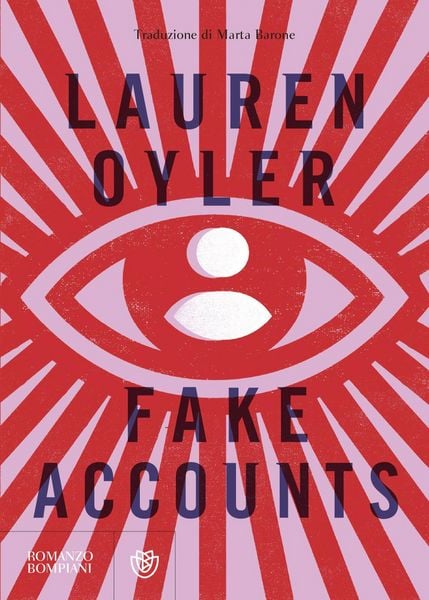
Produktbild: Fake accounts

Fake accounts

Aus der Reihe Narrativa straniera
3

32,99 €

inkl. gesetzl. MwSt., Versandkostenfrei


Beschreibung

Produktdetails

Einband

Taschenbuch

Erscheinungsdatum

07.09.2022

Verlag

Bompiani

Seitenzahl

288

Maße (L/B)

21/15 cm

Übersetzt von

Marta Barone

Sprache

Italienisch

EAN

9788830109216

Beschreibung

Produktdetails

Einband

Taschenbuch

Erscheinungsdatum

07.09.2022

Verlag

Bompiani

Seitenzahl

288

Maße (L/B)

21/15 cm

Übersetzt von

Marta Barone

Sprache

Italienisch

EAN

9788830109216

Herstelleradresse

Fastbook
Via Volta 4
20090 Buccinasco (MI)
IT

Email: carlo.capellano@fastbookspa.it

Kundinnen und Kunden meinen

Informationen zu Bewertungen

Zur Abgabe einer Bewertung ist eine Anmeldung im Konto notwendig. Die Authentizität der Bewertungen wird von uns nicht überprüft. Wir behalten uns vor, Bewertungstexte, die unseren Richtlinien widersprechen, entsprechend zu kürzen oder zu löschen.

Die Bewertungen sind nach Format, Anzahl Sterne und Datum sortiert.

  • Bewertung

    aus Breitenfurt

    5/5

    20.07.2023

    eBook (ePUB 3)

    Interessanter spannender Einblick in eine mir fremde Welt

    Als 'alter Mann' ist mir die Welt der Social Media ziemlich fremd. Die Protagonistin 'lebt' dort und ihre Welt ist komplex, vielfältig und fremd für mich. Den Rahmen bildet eine spannende Geschichte rund um das Ende einer komplexen Beziehung und die Welt der US Expats in Berlin. Lesenswert für alle, die sich für die Welt von jungen Menschen interessieren, der Welt von Social Media geprägt wird.

  • Miss.mesmerized

    4/5

    08.03.2021

    eBook (ePUB 3)

    Lauren Oyler - Fake Accounts

    When the unnamed narrator seizes the chance to snoop through her boyfriend’s phone – which he normally does not let out of his sight – she discovers that he has a large Instagram account on which he spreads conspiracy theories. She is confused but admittedly, she was already thinking about splitting up and now she’s got a good reason. However, her plan – telling him after returning from the women’s march against Trump – fails totally because when she’s still in Washington, his mother informs her of his fatal bike accident. Even though she already was detached emotionally, this hits her hard and literally throws her out of her life. She quits her job and travels to Berlin, the city where they first met and where she hopes to find out what she expects from life and what she actually wants to do professionally. Lauren Oyler’s novel is a portrait of a somehow lost generation who lives a double life: one in the real world, where many of them are lost and orbiting around aimlessly, and one in the online world, where they can create an idea of themselves, a person they would like to be and play a role according to their likes. Yet, the more followers they generate, the more narcissistic they become and inevitably, the fake life in the world-wide web has an impact on reality, too. Slowly, they also start to create fake personalities there and increasingly lack the necessary authenticity and sincerity it needs to have serious relationship with others. The narrator lives such a life in both spheres at the same time, her job involves roaming the net for good stories she can re-use and pimp for the magazine she works at. After leaving her old life behind and moving to Europe, she does not even start to create a new life in Berlin, neither does she try to learn German nor does she really make acquaintances. She dates people she gets to know online simply to tell each one a different story about who she is – she successfully transfers the possibility of a fake online account into real life. However, this does not make her any happier. In a certain way, this is funny and ironic since it is so much over the top that it cannot be real. But is it really? Are people still able to make a distinction between the two? And which consequences does this have for us? We are all aware of how photos can be photoshopped, how information online can be embellished or simply wrong and we pay attention when we are approached by someone online whom we don’t know. In real life however, don’t we expect that people tell us the truth at least to a certain extent? And especially in a relationship, aren’t sincerity and truthfulness necessary foundations to build trust in each other? An interesting study in how far our online behaviour may fire back – not something we can really wish for. Even though the tone is light and often funny, is leaves you somehow with a bad aftertaste.

  • Bewertung

    aus Mainz

    4/5

    23.02.2021

    eBook (ePUB 3)

    When the unnamed narrator…

    When the unnamed narrator seizes the chance to snoop through her boyfriend’s phone – which he normally does not let out of his sight – she discovers that he has a large Instagram account on which he spreads conspiracy theories. She is confused but admittedly, she was already thinking about splitting up and now she’s got a good reason. However, her plan – telling him after returning from the women’s march against Trump – fails totally because when she’s still in Washington, his mother informs her of his fatal bike accident. Even though she already was detached emotionally, this hits her hard and literally throws her out of her life. She quits her job and travels to Berlin, the city where they first met and where she hopes to find out what she expects from life and what she actually wants to do professionally. Lauren Oyler’s novel is a portrait of a somehow lost generation who lives a double life: one in the real world, where many of them are lost and orbiting around aimlessly, and one in the online world, where they can create an idea of themselves, a person they would like to be and play a role according to their likes. Yet, the more followers they generate, the more narcissistic they become and inevitably, the fake life in the world-wide web has an impact on reality, too. Slowly, they also start to create fake personalities there and increasingly lack the necessary authenticity and sincerity it needs to have serious relationship with others. The narrator lives such a life in both spheres at the same time, her job involves roaming the net for good stories she can re-use and pimp for the magazine she works at. After leaving her old life behind and moving to Europe, she does not even start to create a new life in Berlin, neither does she try to learn German nor does she really make acquaintances. She dates people she gets to know online simply to tell each one a different story about who she is – she successfully transfers the possibility of a fake online account into real life. However, this does not make her any happier. In a certain way, this is funny and ironic since it is so much over the top that it cannot be real. But is it really? Are people still able to make a distinction between the two? And which consequences does this have for us? We are all aware of how photos can be photoshopped, how information online can be embellished or simply wrong and we pay attention when we are approached by someone online whom we don’t know. In real life however, don’t we expect that people tell us the truth at least to a certain extent? And especially in a relationship, aren’t sincerity and truthfulness necessary foundations to build trust in each other? An interesting study in how far our online behaviour may fire back – not something we can really wish for. Even though the tone is light and often funny, is leaves you somehow with a bad aftertaste.

Kundinnen und Kunden meinen

5

1

4

2

3

0

2

0

1

0

Bewertungen (3)

Die Leseprobe wird geladen.
  • Produktbild: Fake accounts