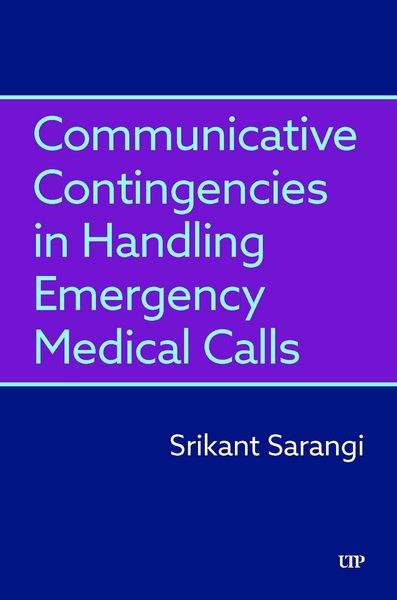
Communicative Contingencies in Handling Emergency Medical Calls
-
- Englisch ausgewählt
26,99 €
inkl. gesetzl. MwSt.,
Beschreibung
Produktdetails
Einband
Taschenbuch
Erscheinungsdatum
30.06.2026
Verlag
University of Toronto PressSeitenzahl
180
Maße (L/B/H)
22,9/15,2/2,5 cm
Gewicht
1 g
Sprache
Englisch
ISBN
978-1-4875-8701-7
Calls to emergency medical services are primarily a telephone-mediated communicative activity, where detailed critical information is exchanged through an elaborate series of questions and answers. Although, on the surface, it may seem a routine information-exchange activity, the framing of questions and how they are responded to and followed up in the absence of any visible cues are filled with communicative contingencies, requiring fast-thinking professional judgment. The core focus of humanities and medicine scholar Srikant Sarangi's work is to unpack these nuanced communicative contingencies underpinning decision-making from a language/interaction perspective. In adopting the activity-type analytical framework to identify the various linguistic and interactional features of telephone-mediated emergency medical calls and their rhetorical potential, the book explores how the different elicited and volunteered information trajectories vis-à-vis instruction and advice formats constitute the basis of risk assessments and decisions regarding dispatch of help.
Drawing on a comprehensive database of telephone calls about breathlessness (comprising 400 call transcripts from two regions in Denmark), the book highlights caller type as a significant variable in the communication process. In essence, during the emergency medical calls, the call-taker handles not only factual information in an algorithmic, scripted manner against established criteria but also the caller type as part of the emergent communicative contingencies. In addition to delineating the general interaction trajectories across the dataset, of the six caller types identified, the analysis focuses on three types - patient, spouse/partner, and professional carer - and each type receives case-study length treatment. The key findings of Communicative Contingencies in Handling Emergency Medical Calls lead to the formulation of a set of practical guidelines for the training of professional practitioners and for raising awareness among caller types.
Kundinnen und Kunden meinen
Verfassen Sie die erste Bewertung zu diesem Artikel
Helfen Sie anderen Kund*innen durch Ihre Meinung
Kurze Frage zu unserer Seite
Vielen Dank für Ihr Feedback
Wir nutzen Ihr Feedback, um unsere Produktseiten zu verbessern. Bitte haben Sie Verständnis, dass wir Ihnen keine Rückmeldung geben können. Falls Sie Kontakt mit uns aufnehmen möchten, können Sie sich aber gerne an unseren Kund*innenservice wenden.
zum Kundenservice