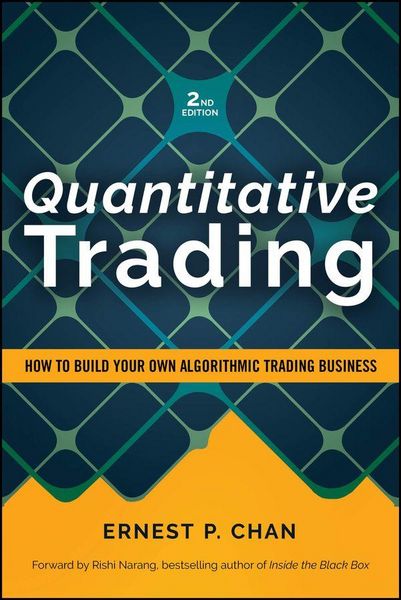
Quantitative Trading How to Build Your Own Algorithmic Trading Business
24,99 €
inkl. gesetzl. MwSt.,
Beschreibung
Produktdetails
Einband
Gebundene Ausgabe
Erscheinungsdatum
13.04.2026
Verlag
John Wiley & Sons IncSeitenzahl
256
Maße (L/B/H)
22,5/15,6/2,2 cm
Gewicht
312 g
Farbe
Anthrazit / Karamell
Auflage
2. Auflage
Sprache
Englisch
ISBN
978-1-394-37804-3
PRAISE FOR Quantitative Trading 2ND EDITION
"Ernie's timely update to his classic Quantitative Trading is extraordinary in that, despite the modernization of the content, all the fundamentals remain unchanged and have clearly stood the test of time since the first edition. If you want to be a competitive swimmer, you need to learn the fundamentals of swimming first. Trading is no different; Ernie makes the fundamentals as simple as possible, but no simpler (as Einstein would say) and strikes the perfect balance between intuition and technical depth. Those specifically interested in trading, and anyone generally interested in understanding how modern financial markets work, will benefit from reading the Second Edition of Quantitative Trading."
-CRAIG BETTS, mathematician and Founder, Solace
"As technology has evolved, so has the ease in developing trading strategies. Ernest Chan does all traders, current and prospective, a real service by succinctly outlining the tremendous benefits, but also some of the pitfalls, in utilizing many of the recently implemented quantitative trading techniques."
-PETER BORISH, Chairman and CEO, Computer Trading Corporation; Founding Partner, Tudor Investment Corporation
"Out of the many books and articles on quantitative trading that I've read over the years, very few have been of much use at all. In most instances, the authors have no real knowledge of the subject matter or do have something important to say but are unwilling to do so because of fears of having trade secrets stolen. Ernie subscribes to a different credo: Share meaningful information and have meaningful interactions with the quantitative community at large. Ernie successfully distills a large amount of detailed and difficult subject matter down to a very clear and comprehensive resource for novice and pro alike."
-STEVE HALPERN, Founder, HCC Capital, LLC
"Often the hardest part of getting started is simply knowing what questions to ask. This holds especially true for fields like quantitative trading, which are shrouded in mystery and protected by impenetrable jargon. Readers of this book will not only learn the foundations of research and strategy development, but also gain pragmatic insight into the operational sides of the business. Ernie has written the ideal guide for those looking to go from zero-to-one in their quantitative trading journey."
-COREY HOFFSTEIN, Co-founder and CIO, Newfound Research
Kundinnen und Kunden meinen
Verfassen Sie die erste Bewertung zu diesem Artikel
Helfen Sie anderen Kund*innen durch Ihre Meinung
Kurze Frage zu unserer Seite
Vielen Dank für Ihr Feedback
Wir nutzen Ihr Feedback, um unsere Produktseiten zu verbessern. Bitte haben Sie Verständnis, dass wir Ihnen keine Rückmeldung geben können. Falls Sie Kontakt mit uns aufnehmen möchten, können Sie sich aber gerne an unseren Kund*innenservice wenden.
zum Kundenservice