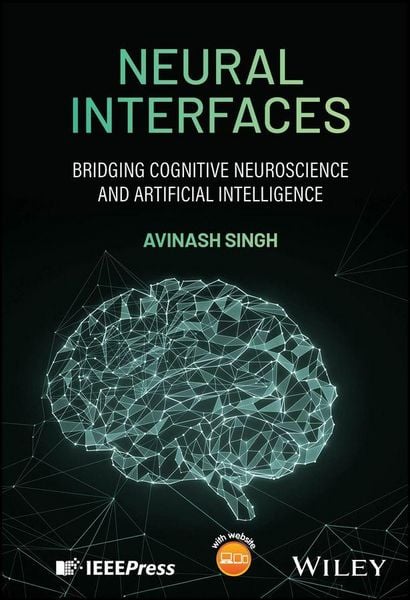
Neural Interfaces: Bridging Cognitive Neuroscience and Artificial Intelligence for Brain-Computer In teraction Bridging Cognitive Neuroscience and Artificial Intelligence
131,99 €
inkl. gesetzl. MwSt.,
Beschreibung
Produktdetails
Einband
Gebundene Ausgabe
Erscheinungsdatum
23.06.2026
Verlag
WileySeitenzahl
272
Maße (L/B/H)
23,7/15,8/2,1 cm
Gewicht
525 g
Sprache
Englisch
ISBN
978-1-394-33181-9
Interdisciplinary resource on the current state of brain-computer interfaces (BCIs), covering research, technology, ethics, and practical applications
Neural Interfaces offers key insights from an interdisciplinary angle into cognitive neuroscience and artificial intelligence to create sophisticated brain-computer interfaces (BCIs). This book explores and informs on how fundamental cognitive neuroscience knowledge takes shape into real-world BCI applications, leading readers through the entire process from experimentation to implementation. It also delves into the technical understanding of mobile experimentation, machine learning, and other tools and technologies that are accelerating the development of BCIs.
Readers will find essential information on the historical evolution of BCIs, exploring the first neural experiments roughly 100 years ago all the way to today's cutting-edge advancements and key milestones that have shaped the field. The book also details different BCI technologies publicly available today and their effectiveness and provides case studies of applications in fields of medical, entertainment, and industry that show how BCIs are being used to restore lost functions from neuroprosthetics to rehabilitation, diagnose mental disorders, create new gaming and personalization experiences, and augment psychological functions used to improve workplace performance.
This book discusses sample topics including:
- Neuroethics, covering the current societal perception of BCIs as well as key considerations as the technology evolves in complexity and scope
- How AI and machine learning are enhancing the capabilities of BCIs, such as thorough decoding neural signals and translating them into actionable commands
- Experimental setups and tools crucial for BCI research, and how to turn research into real-world applications
- Integration of multiple sensory inputs to enhance BCI functionality
- Innovations and challenges related to data, technology, ethics, and design that will shape the future of BCI research
This book is an essential up-to-date resource on the subject for engineers, neuroscentists, and entrepreneurs, as well as all individuals interested in this transformative technology, regardless of background.
Noch keine Bewertungen vorhanden
Verfassen Sie die erste Bewertung zu diesem Artikel
Helfen Sie anderen Kundinnen und Kunden durch Ihre Meinung.
Kurze Frage zu unserer Seite
Vielen Dank für Ihr Feedback
Wir nutzen Ihr Feedback, um unsere Produktseiten zu verbessern. Bitte haben Sie Verständnis, dass wir Ihnen keine Rückmeldung geben können. Falls Sie Kontakt mit uns aufnehmen möchten, können Sie sich aber gerne an unseren Kund*innenservice wenden.
zum Kundenservice