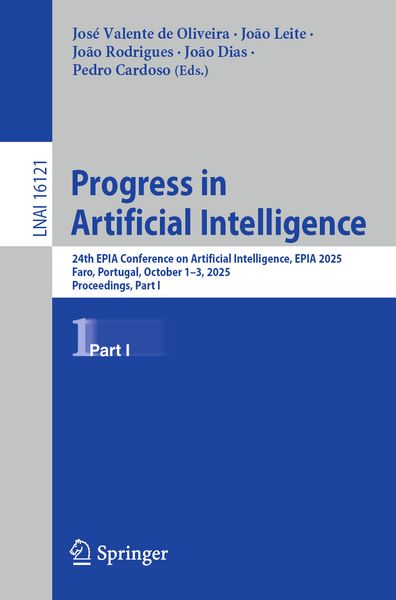
Produktbild: Progress in Artificial Intelligence
Band 16121

Progress in Artificial Intelligence 24th EPIA Conference on Artificial Intelligence, EPIA 2025, Faro, Portugal, October 1–3, 2025, Proceedings, Part I

72,99 €

inkl. gesetzl. MwSt., Versandkostenfrei


Beschreibung

Produktdetails

Einband

Taschenbuch

Erscheinungsdatum

16.09.2025

Abbildungen

XXXVIII, 522 p. 159 illus., 131 illus. in color.

Herausgeber

José Valente de Oliveira + weitere

Verlag

Springer

Seitenzahl

522

Maße (L/B/H)

23,5/15,5/3,1 cm

Gewicht

844 g

Sprache

Englisch

ISBN

978-3-032-05175-2

Beschreibung

Produktdetails

Einband

Taschenbuch

Erscheinungsdatum

16.09.2025

Abbildungen

XXXVIII, 522 p. 159 illus., 131 illus. in color.

Herausgeber

Verlag

Springer

Seitenzahl

522

Maße (L/B/H)

23,5/15,5/3,1 cm

Gewicht

844 g

Sprache

Englisch

ISBN

978-3-032-05175-2

Herstelleradresse

Springer-Verlag GmbH
Tiergartenstr. 17
69121 Heidelberg
DE

Email: ProductSafety@springernature.com

Noch keine Bewertungen vorhanden

Verfassen Sie die erste Bewertung zu diesem Artikel

Helfen Sie anderen Kundinnen und Kunden durch Ihre Meinung.

Kundinnen und Kunden meinen

Bewertungen (0)

  • Produktbild: Progress in Artificial Intelligence

  • .-
    Artificial Intelligence in Medicine (AIM)
    .


    .- AI-Driven Mobile Solution for Early Detection and Management of


    Diabetic Foot Ulcers.


    .- Deep neural networks to the detection of lumbar hernias: methodology


    and preliminary results .


    .- Knowledge-aware Clinical Narrative Extraction using Ontologies and


    Knowledge Graphs.


    .- Deep Learning-Based Microbial Colony Detection on Agar Plates.


    .- Towards Intelligent Low-Code Systems: A systematic review.


    .- Unveiling microRNA biomarkers for Breast Cancer Sub-typing using


    Discriminative Models.


    .- Smartphone Keyboard Typing for Rheumatic Disease Identification: A


    Machine Learning Approach.


    .- Dual Watermarking with Deep Learning for Enhancing Security of


    Medical Images.


    .-
    AI for Architecture, Engineering and Conservation (AI4AEC)
    .


    .- AI-driven adaptive photogrammetry for Built Heritage information


    modelling.


    .- From synthetic data to deep learning enhancements in muon


    tomography for cultural heritage.


    .- Crack Detection in Pavement Imagery: Evaluating U-Net Variants.


    .- Coral and Fish Segmentation Enhanced by Image Restoration and


    Assisted Labeling via a Foundation Model.


    .- Multimodal Pipeline for Underwater Artifact Detection and 3D


    Reconstruction with VLM and Gaussian Splatting.


    .- From Facades to 3D Models: Automating Building Reconstruction with


    Deep Learning and Texture Analysis.


    .- Challenging Fortification Attribution Through AI-Assisted Geometric


    Analysis.


    .- Experimental LINCS Dam for Low-Cost Monitoring & Synthetic Data.


    .-
    Knowledge Discovery and Business Intelligence (KDBI)
    .


    .- Online Data Augmentation for Forecasting with Deep Learning.


    .- Time Series Modeling for Smart Energy Consumption in Industry 4.0.


    .- Towards Smarter Property Recommendations in Complex Housing Market.


    .- Feature-tokeniser transformer autoencoders for interpretable tabular


    anomaly detection.


    .- Benchmarking Time Series Feature Extraction for Algorithm Selection.


    .- Managing Missing Data and Predictions in Short Time Series.


    .- Learning Coastal Upwelling Patterns from Wind Velocity via


    Interpretable Tree Models.


    .-
    Generative AI: Foundations and Applications (GenAI)
    .


    .- SynDocDis: A Metadata-Driven Framework for Generating Synthetic


    Physician Discussions Using Large Language Models.


    .- Large Language Model Framework for Log Sequence Anomaly Detection.


    .- LLM–Based Framework for Synthetic Data Generation in Portuguese


    Clinical NER.


    .- RAG-EVO: Increasing the Reliability and Autonomy of LLMs via


    Iterative Recovery.


    .- Generating Synthetic Medical Dialogues in European Portuguese:


    Preliminary Results with GPT models.


    .-
    Artificial Intelligence: Theory, Methods, and Applications (AITMA)
    .


    .- Convolutional Spiking Neural Networks with Molecular Fingerprints


    for Drug Discovery.


    .- Enhancing privacy: using blurred images with MobileNet SSD.


    .- From Homeostatic Principles to Discrete Emotions in an Agent


    Architecture - the HOmeostatic Regulation Architecture (HORA).


    .- Multi-Objective Reinforcement Learning Algorithm for Irregular


    Spatial Clusters Detection.


    .- Exploring the Early Universe with Deep Learning.


    .- Improved Complex-Valued Kolmogorov–Arnold Networks with


    Theoretical Support.


    .- From Execution to Representation: Capturing Metaheuristic Behaviour


    via Graph-Derived Meta-Features.


    .- A New Proposal of Layer Insertion in Stacked Autoencoder Neural


    Networks.


    .-
    Ethics and Responsibility in AI (ERAI)
    .


    .- Evaluating Coreset Selection with Coverage and Density: A Data


    Quality Perspective.


    .- Invisible Citizens, Visible Futures: Rethinking Inclusivity in Urban


    Digital Twins.


    .- Subgroup Discovery Using Model Uncertainty: A Feasibility Study.