Beschreibung
Produktdetails
Einband
Taschenbuch
Erscheinungsdatum
28.07.2026
Abbildungen
schwarz-weiss Illustrationen, schwarz-weiss Illustrationen
Verlag
Johns Hopkins University PressSeitenzahl
256
Maße (L/B/H)
22,9/15,2/1,5 cm
Gewicht
408 g
Sprache
Englisch
ISBN
978-1-4214-5448-1
An essential guide to understanding tensors through physics.
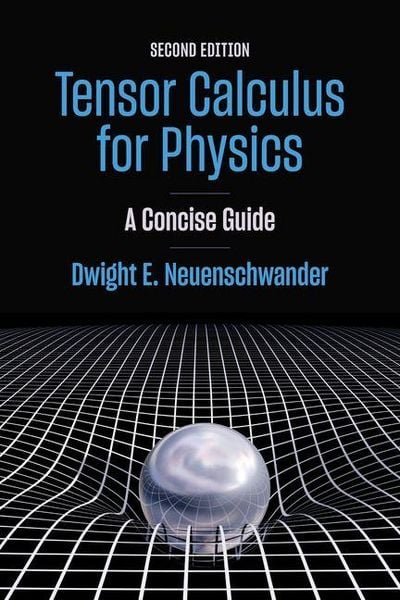
Understanding tensors is essential for physics students who encounter phenomena where direction matters. A jet stream rushing overhead can trigger vertical convection that leads to thunderstorms. An unbalanced car wheel spinning around a horizontal axis produces a wobble in the vertical plane. Astronauts orbiting Earth observe an electrostatic field as a magnetic one. In all these cases, tensors offer a language that captures directional relationships with precision. In the second edition of Tensor Calculus for Physics, Dwight E. Neuenschwander provides an accessible guide that shows how tensor logic arises naturally from physical problems.
Tensors' true elegance lies in how they transform: when coordinates change from one system to another, tensors follow the same rules, allowing physical laws to retain their form across perspectives. Students are often introduced to tensors piecemeal through the inertia tensor in classical mechanics or the polarization tensor in electricity and magnetism. While useful, this fragmented approach does not prepare the student for tensor features such as affine connections, dual basis vectors, and covariant derivatives they will encounter in advanced studies such as general relativity, continuum mechanics, or non-Euclidean geometry. This concise guide builds from the ground up, providing a clear, step-by-step progression that embeds tensors in contexts where their power becomes self-evident.
This extensively revised second edition incorporates more illustrative examples and carefully designed homework problems to strengthen understanding. Now accompanied by a solutions manual, this edition is an ideal resource for courses in general relativity, covariant electrodynamics, continuum mechanics, fluid dynamics, materials science, and any discipline where tensors illuminate the structure of physical reality.
Kundinnen und Kunden meinen
Verfassen Sie die erste Bewertung zu diesem Artikel
Helfen Sie anderen Kund*innen durch Ihre Meinung
Kurze Frage zu unserer Seite
Vielen Dank für Ihr Feedback
Wir nutzen Ihr Feedback, um unsere Produktseiten zu verbessern. Bitte haben Sie Verständnis, dass wir Ihnen keine Rückmeldung geben können. Falls Sie Kontakt mit uns aufnehmen möchten, können Sie sich aber gerne an unseren Kund*innenservice wenden.
zum Kundenservice