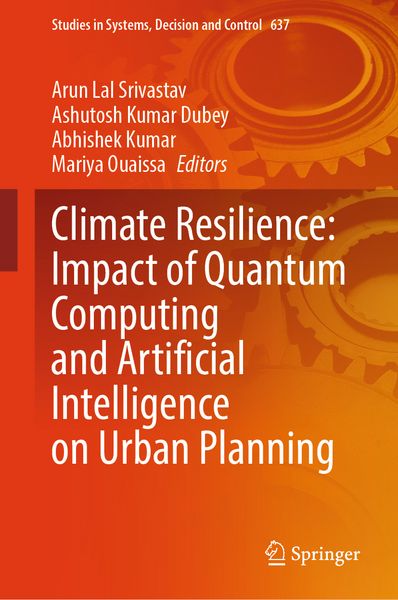
Climate Resilience: Impact of Quantum Computing and Artificial Intelligence on Urban Planning
176,99 €
inkl. gesetzl. MwSt.,
Beschreibung
Produktdetails
Einband
Gebundene Ausgabe
Erscheinungsdatum
18.11.2025
Abbildungen
VII, 49 illus., 46 illus. in color., farbige Illustrationen, schwarz-weiss Illustrationen
Herausgeber
Arun Lal Srivastav + weitereVerlag
SpringerSeitenzahl
385
Maße (L/B/H)
24,1/16/2,7 cm
Gewicht
701 g
Sprache
Englisch
ISBN
978-3-032-06790-6
This book discusses how changes in climate can affect biodiversity, the natural world, and human society. The exploitation of natural resources, improperly managed development projects, human activities, and other factors are causing regular changes in the global environmental circumstances. Because of its severe effects on living things, climate change is one of the main problems that has attracted the attention of scientists, policy officials, academics, businesses, and other stakeholders worldwide. The main adverse implications of climate change are human health problems, changes in mean sea level, lower agricultural output, the spread of vectors, and degradation of the ecosystem. Utilizing cutting-edge techniques such as robotics, deep learning, machine learning, and artificial intelligence help construct greener, more intelligent energy systems or boost energy efficiency to mitigate the harmful consequences of climate change. Furthermore, by using real-time data analysis, these strategies might be useful in monitoring and anticipating climate challenges. It helps in developing novel approaches to quantifying the effects of climate change by taking into account the infrastructure that is currently in place, plant growth, power use, and emissions from vehicles and industries. In order to reduce the consequences, recent techniques are helpful in the research and management of climate-related concerns are also thoroughly explored. This is also helpful for future projections of weather phenomena along with climate extremes, etc. These methods are rapidly growing and widely applied in engineering and research. Therefore, it is anticipated that a large number of researchers are able to provide excellent reviews, case studies, and research findings regarding how these strategies might assist the globe to cope with climate variability. Additionally, this book also includes other strategies for lowering the risks associated with climate change as well as various forecasting techniques for climate uncertainty. Additionally, this book contributes to the accomplishment sustainable development goals (SDGs).
Noch keine Bewertungen vorhanden
Verfassen Sie die erste Bewertung zu diesem Artikel
Helfen Sie anderen Kundinnen und Kunden durch Ihre Meinung.
Kurze Frage zu unserer Seite
Vielen Dank für Ihr Feedback
Wir nutzen Ihr Feedback, um unsere Produktseiten zu verbessern. Bitte haben Sie Verständnis, dass wir Ihnen keine Rückmeldung geben können. Falls Sie Kontakt mit uns aufnehmen möchten, können Sie sich aber gerne an unseren Kund*innenservice wenden.
zum Kundenservice