Beschreibung
Produktdetails
Format
Kopierschutz
Nein
Family Sharing
Nein
Text-to-Speech
Nein
Erscheinungsdatum
21.08.2025
Verlag
Springer Nature SingaporeSeitenzahl
201 (Printausgabe)
Dateigröße
22477 KB
Sprache
Englisch
EAN
9789819507764
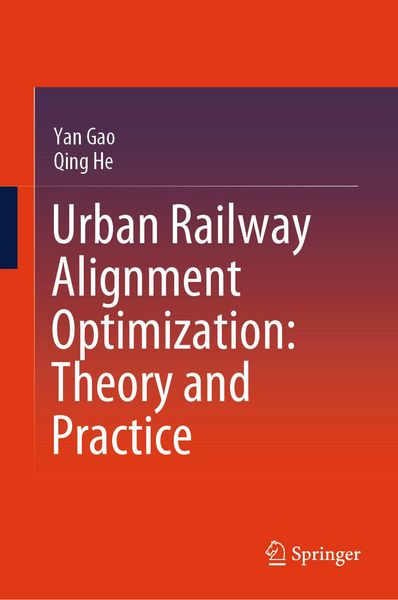
This book falls within the field of urban transportation planning and design, with a particular focus on urban railway alignment optimization. It delves into the background, challenges, and objective functions and constraints (including cost, environmental impact, and risk) of urban railway alignment design. Furthermore, it presents system reliability modeling approaches for assessing the reliability of parallel railway lines. Additionally, the book emphasizes GIS-based methods for land use analysis and automatic demolition area calculation, as well as the Bayesian Sustainable Intelligent Framework for Enhancing Parallel Railway Reliability, which integrates system reliability analysis, the two-dimensional finite element method, and the Bayesian neural network surrogate model. Lastly, it covers the optimization of railway alignment using approximate dynamic programming, introducing a bi-objective approximate fine-grained optimization model that considers both construction cost and construction risk adjacent to existing operating railways.
This book encompasses not only the theoretical foundations of urban railway alignment optimization but also provide detailed case studies of practical applications. These methods and techniques are significant for enhancing the efficiency, sustainability, and economy of urban railway systems, making them highly valuable to professionals involved in urban transportation planning, design, and construction. Combining theoretical analysis with practical applications, it provides abundant illustrations and tables to elucidate complex concepts and methods, employs novel presentation styles, such as case studies to demonstrate the practical application of theories, and may include instructional elements like step-by-step guides or practical suggestions to help readers better understand and apply the knowledge.
By reading this book, readers can gain insights into the latest methods and techniques in urban railway alignment optimization and learn how to apply them in their work, thereby improving the overall performance and sustainability of urban railway systems. The primary target audience of this book is researchers, practitioners, and students involved in urban transportation planning, design, and construction. Whether for beginners seeking to delve into the field of urban railway alignment optimization or for professionals looking to update their knowledge base, this book is an invaluable resource.
Noch keine Bewertungen vorhanden
Verfassen Sie die erste Bewertung zu diesem Artikel
Helfen Sie anderen Kundinnen und Kunden durch Ihre Meinung.
Kurze Frage zu unserer Seite
Vielen Dank für Ihr Feedback
Wir nutzen Ihr Feedback, um unsere Produktseiten zu verbessern. Bitte haben Sie Verständnis, dass wir Ihnen keine Rückmeldung geben können. Falls Sie Kontakt mit uns aufnehmen möchten, können Sie sich aber gerne an unseren Kund*innenservice wenden.
zum Kundenservice