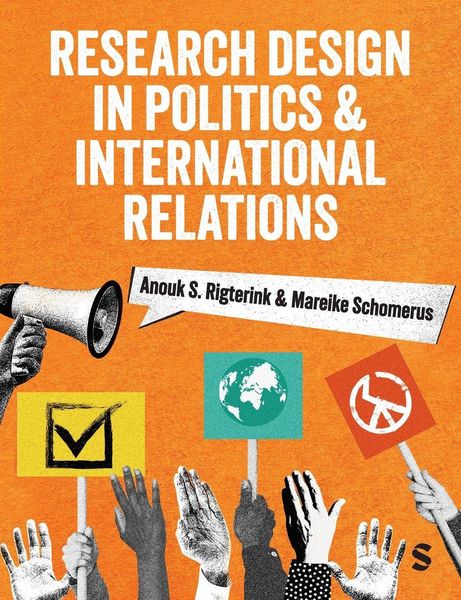
Research Design in Politics and International Relations
-
- Hardcover
- Taschenbuch ausgewählt
- eBook
-
Sprache:Englisch
46,99 €
inkl. gesetzl. MwSt.,
Beschreibung
Produktdetails
Einband
Taschenbuch
Erscheinungsdatum
27.02.2026
Verlag
Sage PublicationsSeitenzahl
480
Maße (L/B/H)
24,6/18,9/2,6 cm
Gewicht
924 g
Sprache
Englisch
ISBN
978-1-5296-8530-5
Rigterink and Schomerus introduce seven core research designs spanning discourse analysis and ethnography to quasi-experiments and process tracing through contemporary political topics such as violent conflict, the environment and political protests.
What sets this book apart is starting with topics rather than methods, so you ll learn how to research real-world issues like climate change, inequality, or war, and see how different research designs can help you understand them. It s also honest about the challenges of research, offering practical strategies to overcome distractions, doubts, and demotivation.
Ideal for undergraduate and postgraduate students, this book is as much a practical manual as a conceptual map for navigating the terrain of political research that makes doing research manageable and enjoyable.
Anouk S. Rigterink is Associate Professor in Quantitative Comparative Politics, at Durham University, UK.
Mareike Schomerus is VP at Busara, a research institute headquartered in Kenya, and a Visiting Lecturer at the University of Chicago Harris School of Public Policy, USA.
Noch keine Bewertungen vorhanden
Verfassen Sie die erste Bewertung zu diesem Artikel
Helfen Sie anderen Kundinnen und Kunden durch Ihre Meinung.
Kurze Frage zu unserer Seite
Vielen Dank für Ihr Feedback
Wir nutzen Ihr Feedback, um unsere Produktseiten zu verbessern. Bitte haben Sie Verständnis, dass wir Ihnen keine Rückmeldung geben können. Falls Sie Kontakt mit uns aufnehmen möchten, können Sie sich aber gerne an unseren Kund*innenservice wenden.
zum Kundenservice