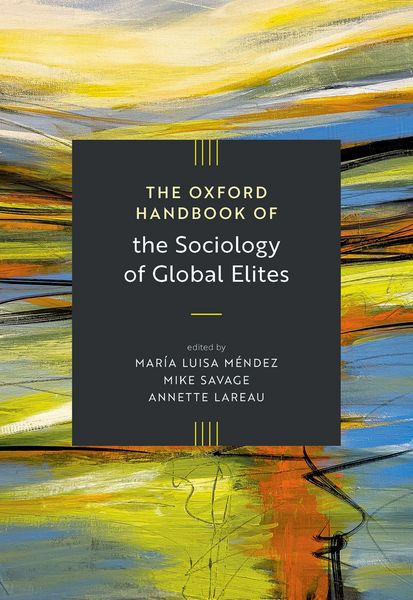
Produktbild: The Oxford Handbook of the Sociology of Global Elites

The Oxford Handbook of the Sociology of Global Elites

242,99 €

inkl. gesetzl. MwSt., Versandkostenfrei


Beschreibung

Produktdetails

Einband

Gebundene Ausgabe

Erscheinungsdatum

12.06.2026

Herausgeber

María Luisa Méndez + weitere

Verlag

Oxford Academic

Seitenzahl

714

Maße (L/B/H)

25,4/17,7/4,7 cm

Gewicht

1338 g

Sprache

Englisch

ISBN

978-0-19-778031-2

Beschreibung

Portrait

María Luisa Méndez is Professor at the Pontifical Catholic University of Chile and Director of the Centre for Social Conflict and Cohesion Studies (COES). She previously served as Director of the Department of Sociology at Diego Portales University (UDP). Her research explores social mobility, urban inequality, and elite reproduction in Latin America. She is the author of Upper Middle Class Social Reproduction and The Politics of the Elite. Her work has appeared in leading journals including Urban Studies, Urban Geography, and The Sociological Review.

Mike Savage has written extensively on the sociology of class and inequality. He has been Professor at the Universities of Manchester and York and was founding co-Director of the LSE's International Inequalities Institute, one of the world's premier interdisciplinary centres for the study of inequality. His best-selling (co-authored) book Social Class in the 21st Century made a major impact in insisting on social class

as a key contemporary divide. The Return of Inequality: Social Change and the Weight of the Past has been translated into three languages.

Annette Lareau is the author of the award-winning books Unequal Childhoods, Home Advantage, and Listening to People. With Blair Sackett, she authored We Thought It Would be Heaven: Refugees in an Unequal America. She is currently writing a book, to be published with the University of California Press, on the blessings and challenges of wealth for family life. Lareau is Professor (emeritus) in the Department of Sociology at the University of Pennsylvania. She is the Past President of the American Sociological Association.

Produktdetails

Einband

Gebundene Ausgabe

Erscheinungsdatum

12.06.2026

Herausgeber

Verlag

Oxford Academic

Seitenzahl

714

Maße (L/B/H)

25,4/17,7/4,7 cm

Gewicht

1338 g

Sprache

Englisch

ISBN

978-0-19-778031-2

Herstelleradresse

Libri GmbH
Europaallee 1
36244 Bad Hersfeld
DE

Email: gpsr@libri.de

Noch keine Bewertungen vorhanden

Verfassen Sie die erste Bewertung zu diesem Artikel

Helfen Sie anderen Kundinnen und Kunden durch Ihre Meinung.

Kundinnen und Kunden meinen

Bewertungen (0)

  • Produktbild: The Oxford Handbook of the Sociology of Global Elites
    • Part I. Introductory Section

    • Chapter 1: Mike Savage and María Luisa Méndez: The Renaissance of the Sociology of Elites: An Introductory Review

    • Chapter 2: Mike Savage: The Power of Wealth: A New Analytical Frame for the Sociology of Elites

    • Part I. Wealth, Power, and Elite Formation

    • Chapter 3: Aaron Reeves and Sam Friedman: Family Fortunes: Family Wealth and Elite Recruitment in Britain 1895 to 1995

    • Chapter 4: Alice Krozer and Diego Castañeda Garza: Casta Dorada: The Making of a Mexican Elite and Their Henequen Empire

    • Chapter 5: Jules Naudet and Surinder S. Jodhka: India's Elite Power: Structures and Fluidities

    • Chapter 6: Rebecca Simson: Elite Continuities in Africa: Historical Perspectives, State of Knowledge, and the Path Forward

    • Chapter 7: Shay O'Brien: Rethinking New and Old Money

    • Chapter 8: John Osburg: Banquets, Bribes, and Brotherhood: Elite Networks in Post-Mao China

    • Chapter 9: Shamus Khan: Trajectories of Capital: The Building of the Astor Fortune

    • Chapter 10: Annette Lareau: Conflicts in Wealthy Families in the United States: A Qualitative Study

    • Part II. Race and Gender in the Intersectional Sociology of Elites

    • Section 1. Gender and Household Dynamics

    • Chapter 11: Parul Bhandari: Being a Good Rich Housewife: Religion, Family, and the Indian Business Elites

    • Chapter 12: Céline Bessière: On Women's Ignorance of Wealth in Elite Families of the Global North

    • Chapter 13: Rachel Théodore, Isabel Castillo, and Catherine Reyes-Housholder: Women Economic Elites as "Insiders and Outsiders" in Chile

    • Chapter 14: The World Elite Database (WED) Collective: Gender and Age Divisions Among the Economic Power Elite: A Comparative Analysis of 16 Countries from the World Elite Database (WED)

    • Section 2. Racial Divides

    • Chapter 15: Mike Savage: The British Imperial Elite: Whiteness and the Meaning of 'Home'

    • Chapter 16: Kevin L. Young: Racial Diversity Among Global Elite Populations

    • Chapter 17: Patricia A. Banks: Not Just High Culture, But Black Culture: Ethnoracial Distinction and African American Cultural Consumption

    • Chapter 18: Jody Agius Vallejo: Minoritized Economic Elites in Racially Stratified Systems: The Case of Latino Elites in the United States

    • Section 3. Conspicuous or Ordinary Consumption

    • Part III. Culture, Consumption, and Social Closure

    • Chapter 19: Irmak Karademir and Alan Warde: The Consumption Patterns of Contemporary Elites

    • Chapter 20: Ashley Mears: Varieties of Conspicuity: The Logic of Capital in Elite Consumption

    • Section 4. Education and Social Closure

    • Chapter 21: Pere Ayling: Beyond an Instrumental Analysis of Elite Nigerian Parents' Consumption of Overseas Schooling: Parental Love, Responsibility, and Sacrifice

    • Chapter 22: Emma Taylor: Selling and Silencing: Imperial Logics and the Franchising of Elite British Schools Overseas

    • Chapter 23: Yi-Lin Chiang: When Fields Collide: Chinese High Schools as Global Elite Training Grounds

    • Section 5. Worth, Wealth, and Cultural Legitimacy

    • Chapter 24: Katharina Hecht: Richness and Its Legitimacy

    • Chapter 25: Rachel Sherman: Moral Modes of the Liberal Wealthy in the United States: Meritocratic Accumulation and Systemic Redistribution

    • Chapter 26: Ana Y. Ramos-Zayas: Shrinking Wealth: Therapeutic Cultural Workers, Dynastic Families, and "Psychological Wealth Laundering" in the Americas

    • Chapter 27: Hanna Kuusela: Elites and Today's Neo-Accumulationist Culture: Studying the Cultural Underpinnings of Inequality in Finland

    • Section 6. Elites and Urban Spaces

    • Part IV. Transnationalism and Urban Dynamics

    • Chapter 28: Ilan Wiesel: Elite Neighbourhoods as Sites for Accumulation of Economic, Social, and Cultural Capital

    • Chapter 29: María Luisa Méndez: Elites and the Production of Space: The New Centripetal Points in Contemporary Cities of the Global South

    • Chapter 30: Eva-Maria Gajek and Isabell Stamm: City Conquerors: A Case Study of How Families in Germany's Wealth Elites Occupy Urban Spaces

    • Chapter 31: Pablo Fuentenebro and Bas van Heur: Urban Elites and Cultural Patronage: How private culture is shaping cities

    • Section 7. Cosmopolitanism and Transnational Elites

    • Chapter 32: Bruno Cousin and Sébastien Chauvin: Coaching the Global Super-Bourgeoisie: Physical Lifestyle Intermediaries and the Management of Elite Social Capital

    • Chapter 33: Sarah Kunz: Citizenship and the Making of a Global Elite

    • Chapter 34: Brooke Harrington: Transformers: Elites and Capital Conversions

    • Chapter 35: Kimberly Kay Hoang: Spiderweb Capitalism: Uncovering Secret Offshore Financial Webs

    • Chapter 36: Mariana Heredia: Who's global and how? Socio-economic elites seen from Argentina

    • Part V. Elites and Power

    • Chapter 37: Jenny Pearce and Hobeth Martínez Carrillo: Bringing Violence into the Study of Elites: Resetting the Global Debate from Latin America

    • Chapter 38: Peng Lu, Xiaoguang Fan, Fan Fu, and Chao Ling: Economic and Political Elites in China: Formation and Transformation of Power

    • Chapter 39: Mark S. Mizruchi and Galen Hall: The American Corporate Elite in the Twenty-First Century: Cohesive or Fragmented?

    • Chapter 40: Alejandro Pelfini and Claudio Riveros: From Legitimation to Extortion? Latin American Hierarchical Capitalism Reloaded

    • Chapter 41: Fabien Accominotti: Elites as Status Groups in Democratic Societies