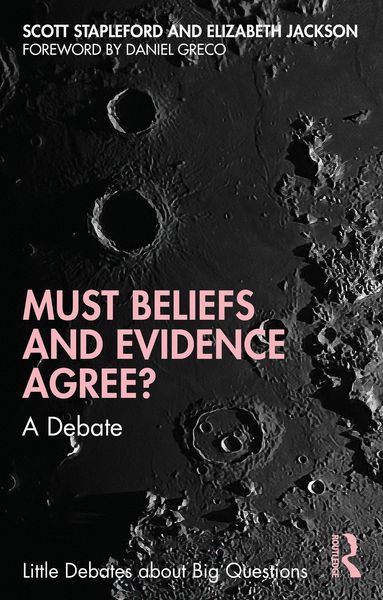
Must Beliefs and Evidence Agree? A Debate
-
- Hardcover
- Taschenbuch
- eBook ausgewählt
-
Form:Einzelkauf Download
-
Sprache:Englisch
58,49 €
inkl. gesetzl. MwSt.Beschreibung
Produktdetails
Format
Kopierschutz
Ja
Family Sharing
Nein
Text-to-Speech
Nein
Erscheinungsdatum
04.12.2025
Verlag
Taylor & Francis eBooksSeitenzahl
238 (Printausgabe)
Dateigröße
1761 KB
Sprache
Englisch
EAN
9781040474532
Should our beliefs be proportioned to our evidence? Are we doing something wrong in believing with little or no evidence? And may our beliefs be based partly or wholly on moral or practical considerations? These questions are harder than you think. Scott Stapleford and Elizabeth Jackson agree on the priority of evidence, but they differ on the degree of permissible slack and the relevance of other considerations.
In this lively epistemological debate, Stapleford takes a hard line, defending the extremist view that any discrepancy between what we believe and what our evidence supports is an error that should be corrected. In the economy of our beliefs, evidence alone has a normative grip. Jackson is more forgiving. While evidence regulates belief, its authority is not complete. She takes a more liberal perspective that accords non-evidential factors a lawful role in delimiting the class of permissible beliefs.
With echoes of the famous 19th century dispute between the mathematician William Clifford and the psychologist William James, the Stapleford-Jackson debate feels particularly relevant in a time when disagreement runs uncomfortably hot and evidence is treated with contempt. This debate will tempt-and gently instruct-anyone who has ever asked themselves: Can't I just believe what I want?
Key Features
- Includes accessible discussions of evidence, evidentialism, transparency, epistemic value monism, the aim of belief, permissivism, encroachment, practical reasons for belief, epistemic obligations, Pascal's wager, and much more.
- Is highly readable, with clear language and an easy-to-follow format.
- Includes boxed summaries at the end of each section and partitioned expansions of key ideas that supplement the main lines of reasoning.
Noch keine Bewertungen vorhanden
Verfassen Sie die erste Bewertung zu diesem Artikel
Helfen Sie anderen Kundinnen und Kunden durch Ihre Meinung.
Kurze Frage zu unserer Seite
Vielen Dank für Ihr Feedback
Wir nutzen Ihr Feedback, um unsere Produktseiten zu verbessern. Bitte haben Sie Verständnis, dass wir Ihnen keine Rückmeldung geben können. Falls Sie Kontakt mit uns aufnehmen möchten, können Sie sich aber gerne an unseren Kund*innenservice wenden.
zum Kundenservice