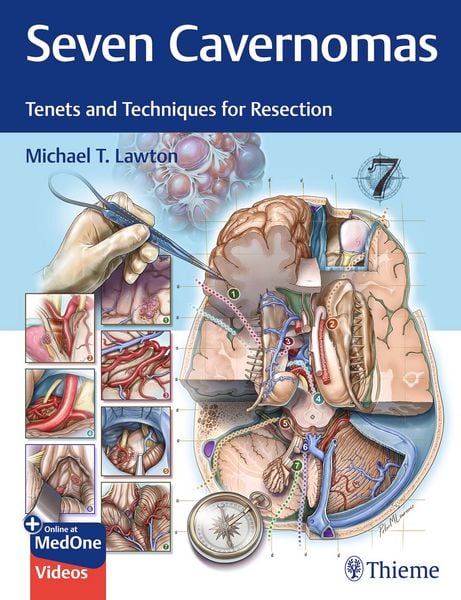
Produktbild: Seven Cavernomas

Seven Cavernomas Tenets and Techniques for Resection

153,99 €

inkl. gesetzl. MwSt., Versandkostenfrei


Beschreibung

Produktdetails

Verkaufsrang

36799

Einband

Gebundene Ausgabe

Erscheinungsdatum

18.02.2026

Abbildungen

Beilage: Videos, Illustrationen, nicht spezifiziert

Verlag

Thieme Medical Publishers

Seitenzahl

452

Maße (L/B/H)

28,4/22,2/2,8 cm

Gewicht

1840 g

Auflage

1

Sprache

Englisch

ISBN

978-1-68420-494-6

Beschreibung

Produktdetails

Verkaufsrang

36799

Einband

Gebundene Ausgabe

Erscheinungsdatum

18.02.2026

Abbildungen

Beilage: Videos, Illustrationen, nicht spezifiziert

Verlag

Thieme Medical Publishers

Seitenzahl

452

Maße (L/B/H)

28,4/22,2/2,8 cm

Gewicht

1840 g

Auflage

1

Sprache

Englisch

ISBN

978-1-68420-494-6

EU-Ansprechpartner

Georg Thieme Verlag KG
Oswald-Hesse-Straße 50
70469 Stuttgart
DE
info@thieme.de

Herstelleradresse

Thieme Medical Publishers
333 Seventh Avenue, 18th Floor
10001 New York
US
customerservice@thieme.com

Kundinnen und Kunden meinen

0 Bewertungen

Informationen zu Bewertungen

Zur Abgabe einer Bewertung ist eine Anmeldung im Konto notwendig. Die Authentizität der Bewertungen wird von uns nicht überprüft. Wir behalten uns vor, Bewertungstexte, die unseren Richtlinien widersprechen, entsprechend zu kürzen oder zu löschen.

Die Bewertungen sind nach Format, Anzahl Sterne und Datum sortiert.

Verfassen Sie die erste Bewertung zu diesem Artikel

Helfen Sie anderen Kund*innen durch Ihre Meinung

Kundinnen und Kunden meinen

0 Bewertungen filtern

Die Leseprobe wird geladen.
  • Produktbild: Seven Cavernomas
  • - Section I The Tenets - 1 Taxonomy - 1.1 Classifying Surgical Pathology - 1.2 Informing Surgical Strategy - 1.3 Neuroanatomy - 1.4 Neuroradiology - 1.5 Neurology - 1.6 Neurosurgery - 1.7 Seven Cavernomas Framework - 2 Subarachnoid Dissection - 2.1 Seven Surgical Corridors - 2.1.1 Cerebral Sulci - 2.1.2 Sylvian Fissure - 2.1.3 Interhemispheric Fissure - 2.1.4 Ventricular System - 2.1.5 Tentorial Fissure - 2.1.6 Cerebellopontine Cistern - 2.1.7 Cisterna Magna - 2.2 Conclusion - 3 Triangle Concept - 3.1 The Triangle Concept - 3.2 A System of Anatomical Triangles - 3.3 Midbrain Triangles - 3.3.1 Carotid-Oculomotor Triangle - 3.3.2 Oculomotor-Tentorial Triangle - 3.3.3 Supracerebellar-Supratrochlear and Supracerebellar-Infratrochlear Triangles - 3.3.4 Infragalenic Triangle - 3.4 Pontine Triangles - 3.4.1 Posteromedial (Kawase) Triangle - 3.4.2 Glossopharyngeal-Cochlear Triangle - 3.4.3 Supra- and Infratrigeminal Triangles - 3.4.4 Interlobular Triangle - 3.5 Medullary Triangles - 3.5.1 Vertebrobasilar Junctional Triangle - 3.5.2 Subtonsillar Triangle - 3.5.3 Vagoaccessory Triangle - 3.5.4 Cerebellar Vallecular Triangle - 3.6 Thalamic and Basal Ganglial Triangles - 3.6.1 Supracarotid-Infrafrontal Triangle - 3.6.2 Caudate-Thalamostriate Triangle - 3.6.3 Septocaudate Triangle - 3.6.4 Infragalenic Triangle - 3.7 Cerebral and Cerebellar Triangles - 3.7.1 Vallecular Triangle - 3.7.2 Interlobular Triangle - 3.8 Clinical Evidence - 3.9 Conclusion - 4 Arterial Landmarks - 4.1 Rivers of the Brain - 4.2 Middle Cerebral Arteries - 4.3 Anterior Cerebral Arteries - 4.4 Internal Carotid Artery - 4.5 Posterior Cerebral Arteries - 4.6 Superior Cerebellar Artery - 4.7 Anterior Inferior Cerebellar Artery - 4.8 Posterior Inferior Cerebellar Artery - 4.9 Arterial Dissection Codes - 5 Safe Entry Zones - 5.1 From Inoperable to Operable - 5.2 Clinical Evidence - 5.3 The Safety of Safe Entry Zones - 5.4 The 21 Brainstem Safe Entry Zones - 5.5 Midbrain Safe Entry Zones - 5.5.1 Interpeduncular Zone - 5.5.2 Anterior Mesencephalic Zone - 5.5.3 Lateral Mesencephalic Sulcus Zone - 5.5.4 Intercollicular Zone - 5.5.5 Supracollicular and Infracollicular Zones - 5.6 Pontine Safe Entry Zones - 5.6.1 Supratrigeminal and Infratrigeminal - 5.6.2 Middle Cerebellar Peduncle or Lateral Pontine - 5.6.3 Area Acustica - 5.6.4 Median Sulcus (Pons) - 5.6.5 Suprafacial Collicular - 5.6.6 Superior Foveal - 5.6.7 Pontomedullary Sulcus - 5.7 Medullary Safe Entry Zones - 5.7.1 Anterolateral Sulcus - 5.7.2 Olive - 5.7.3 Posterolateral Sulcus and Lateral Medullary - 5.7.4 Median Sulcus (Medulla) - 5.7.5 Infrafacial Collicular - 5.7.6 Posterior Median Sulcus - 5.7.7 Posterior Intermediate Sulcus - 5.8 Accuracy of Preoperative MRI in Determining Surface Proximity - 5.9 Neuronavigation, Hemosiderin Stain, and Neuromonitoring - 5.10 Brainstem CM Taxonomy and Associated SEZs - 6 Resection Technique - 6.1 The Mulberry - 6.2 Extracapsular Resection Technique - 6.3 Intracapsular Resection Technique - 6.4 Brain Transgression - 6.5 Technical Overview of the Trans-MCP Approach - 6.6 Superomedial Trajectory Beyond the SEZ: Superior Cerebellar Peduncle - 6.7 Posteromedial Trajectory Beyond the SEZ: Pontine Tegmentum - 6.8 Invisible Triangles - 6.9 Orienteering Beyond - 7 Eloquent Noneloquence - 7.1 Ten Percent Myth - 7.2 Eloquent Noneloquence - 7.3 Clinical Evidence - 7.4 Eloquent Cortex - 7.5 Large-Scale Brain Networks - 7.6 Seven Hotspots of Cerebral Eloquence - 7.7 Expanding the Concept of Cerebral Eloquence - 8 Residual and Recurrent Cavernous Malformations - 8.1 Problem of Recurrence - 8.2 Clinical Evidence - 8.3 Detection - 8.4 Surgical Blind Spots - 8.5 Right-Angle Method - 8.6 Fine Line - 9 Patient Selection - 9.1 Rationale for a Brainstem Cavernous Malformation Grading Scale - 9.2 Lawton Brainstem CM Grading Scale - 9.3 Elements of the Brainstem CM Grading System - 9.3.1 Size - 9.3.2 Crossing the Axial Midpoint - 9.3.3 Developmental Venous Anomaly - 9.3.4 Age - 9.3.5 Hemorrhage - 9.4 Validation of the Brainstem CM Grading System - 9.5 Clinical Application - 9.6 Giant Cavernomas - 9.7 Hannegan's Sign - 10 Neurosurgical Cartography - 10.1 Jackson Hole - 10.2 Cartography - 10.3 Maps as Metaphors for the Seven Cavernomas - 10.4 Seven Cavernomas Maps - 10.5 Maps for Safe Passage - 10.6 Maps for Education - 10.7 Maps for Exploration - 10.8 The Metaphor - Section II The Seven Cavernomas - 11 Superficial Cerebral Cavernous Malformations - 11.1 Introduction - 11.2 Neuroanatomy of Superficial Cerebral Cavernous Malformation Subtypes - 11.2.1 Convexity - 11.2.2 Medial - 11.2.3 Basal - 11.2.4 Sylvian - 11.3 Clinical Evidence - 11.4 Resection Strategies for Superficial Cerebral Cavernous Malformations - 11.4.1 Convexity Subtype - 11.4.2 Medial Subtype - 11.4.3 Basal Subtype - 11.4.4 Sylvian Subtype - 11.5 Superficial Cerebral Cavernous Malformations and Approach Selection - 11.6 Approach Technique - 11.7 Presenting Symptom - 11.8 Clinical Syndromes - 11.9 Conclusion - 12 Basal Ganglia Cavernous Malformations - 12.1 Introduction - 12.2 Neuroanatomy of Three Basal Ganglia Cavernous Malformation Subtypes - 12.2.1 Caudate - 12.2.2 Putaminal - 12.2.3 Pallidal - 12.3 Clinical Evidence - 12.4 Basal Ganglia Cavernous Malformation Subtypes - 12.4.1 Caudate - 12.4.2 Putaminal - 12.4.3 Pallidal - 12.5 Conclusion - 13 Thalamic Cavernous Malformations - 13.1 Introduction - 13.2 Neuroanatomy of Thalamic Cavernous Malformation Subtypes - 13.2.1 Anterior - 13.2.2 Medial - 13.2.3 Lateral - 13.2.4 Choroidal - 13.2.5 Pulvinar - 13.2.6 Geniculate - 13.3 Clinical Evidence - 13.4 Resection Strategies for Thalamic Cavernous Malformation Subtypes - 13.4.1 Anterior - 13.4.2 Medial - 13.4.3 Lateral - 13.4.4 Choroidal - 13.4.5 Pulvinar - 13.4.6 Geniculate - 13.5 Iterative Advances - 13.6 Conclusion - 14 Midbrain Cavernous Malformations - 14.1 Introduction - 14.2 Neuroanatomy of the Five Midbrain Cavernous Malformation Subtypes - 14.2.1 Interpeduncular - 14.2.2 Peduncular - 14.2.3 Tegmental - 14.2.4 Quadrigeminal - 14.2.5 Periaqueductal - 14.3 Clinical Evidence - 14.4 Resection Strategies for Midbrain Cavernous Malformations - 14.4.1 Interpeduncular - 14.4.2 Peduncular - 14.4.3 Tegmental - 14.4.4 Quadrigeminal - 14.4.5 Periaqueductal - 14.5 Conclusion - 15 Pontine Cavernous Malformations - 15.1 Introduction - 15.2 Neuroanatomy of the Six Pontine Cavernous Malformation Subtypes - 15.2.1 Basilar - 15.2.2 Peritrigeminal - 15.2.3 Middle Peduncular - 15.2.4 Inferior Peduncular - 15.2.5 Rhomboid - 15.2.6 Supraolivary - 15.3 Clinical Evidence - 15.4 Resection Strategies for Pontine Cavernous Malformations - 15.4.1 Basilar Subtype - 15.4.2 Peritrigeminal Subtype - 15.4.3 Middle Peduncular Subtype - 15.4.4 Inferior Peduncular Subtype - 15.4.5 Rhomboid Subtype - 15.4.6 Supraolivary Subtype - 15.5 Signs and Syndromes - 16 Medullary Cavernous Malformations - 16.1 Introduction - 16.2 Neuroanatomy of the Five Medullary Cavernous Malformation Subtypes - 16.2.1 Pyramidal - 16.2.2 Olivary - 16.2.3 Cuneate - 16.2.4 Gracile - 16.2.5 Trigonal - 16.3 Clinical Evidence - 16.4 Resection Strategies for Medullary Cavernous Malformations - 16.4.1 Pyramidal Subtype - 16.4.2 Olivary Subtype - 16.4.3 Cuneate Subtype - 16.4.4 Gracile Subtype - 16.4.5 Trigonal Subtype - 16.5 Conclusion - 17 Cerebellar Cavernous Malformations - 17.1 Introduction - 17.2 Neuroanatomy of the Six Cerebellar Cavernous Malformation Subtypes - 17.2.1 Suboccipital - 17.2.2 Tentorial - 17.2.3 Petrosal - 17.2.4 Vermian - 17.2.5 Tonsillar - 17.2.6 Deep Nuclear - 17.3 Clinical Evidence - 17.4 Resection Strategies for Cerebellar Cavernous Malformations - 17.4.1 Suboccipital, Vermian, and Tonsillar - 17.4.2 Tentorial - 17.4.3 Petrosal - 17.4.4 Deep Nuclear - 17.5 Conclusion - 18 Seven Cavernomas: Project Connectomunculus and the Mind - 18.1 Seven Cavernomas Cartography - 18.2 The Connectomunculus - 18.3 The Mind - 18.4 Gallery of Functional Networks - 19 Suggested Readings - Contributors - Index