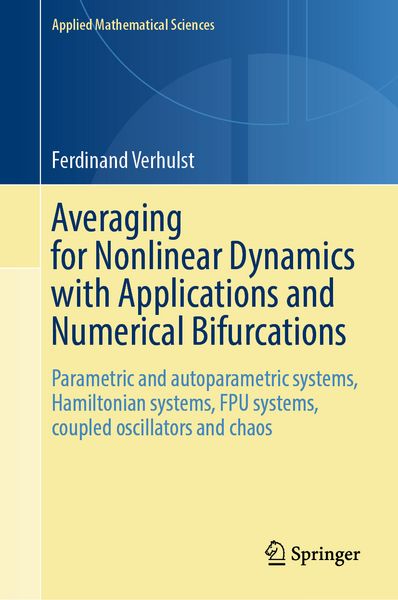
Averaging for Nonlinear Dynamics with Applications and Numerical Bifurcations Parametric and autoparametric systems, Hamiltonian systems, FPU systems, coupled oscillators and chaos
143,99 €
UVP
160,49 €
inkl. gesetzl. MwSt.,
Beschreibung
Produktdetails
Einband
Gebundene Ausgabe
Erscheinungsdatum
08.02.2026
Abbildungen
XIII, 276 p. 82 illus., 58 illus. in color.
Verlag
SpringerSeitenzahl
276
Maße (L/B/H)
24,1/16/2,2 cm
Gewicht
604 g
Sprache
Englisch
ISBN
978-3-032-12744-0
This book presents a comprehensive and practical survey of averaging methods for differential equations. Combining rigorous theory with applied perspectives, this book serves as both a study text and a reference for mathematicians and scientists in fields such as engineering, physics, and biology.
Divided into two complementary parts, the book begins with Part I , the Toolbox of Averaging Theorems, providing clear definitions, theorem formulations, and foundational results. While mathematicians may be content with existence proofs and qualitative analyses, applied scientists require tools that link theory to real-world problems—an essential motivation for Part II .
Part II explores applications in physics and engineering, blending theory with practice and incorporating numerical bifurcation analysis using tools such as AUTO , Mathematica , and MatCont . Interspersed theoretical interludes provide the background necessary for understanding and applying these methods.
Highlights include:
-
Hamiltonian systems (Ch. 9), examining resonance phenomena in physics and engineering.
-
Fermi-Pasta-Ulam chains (Ch. 10), extending fundamental theory.
-
Parametric excitation (Ch. 11) and dissipation-induced instability (Ch. 13), showcasing classical but lesser-known engineering results.
-
Coupled oscillators and chaos (Ch. 12), a detailed exploration of complex nonlinear dynamics.
-
Diffusion and waves (Ch. 14), providing essential guidance while pointing to broader material for further study.
Whether as a reference, teaching aid, or bridge between theory and application, Averaging for Nonlinear Dynamics equips readers with the tools to analyze, approximate, and apply nonlinear systems across a wide range of scientific disciplines.
Noch keine Bewertungen vorhanden
Verfassen Sie die erste Bewertung zu diesem Artikel
Helfen Sie anderen Kundinnen und Kunden durch Ihre Meinung.
Kurze Frage zu unserer Seite
Vielen Dank für Ihr Feedback
Wir nutzen Ihr Feedback, um unsere Produktseiten zu verbessern. Bitte haben Sie Verständnis, dass wir Ihnen keine Rückmeldung geben können. Falls Sie Kontakt mit uns aufnehmen möchten, können Sie sich aber gerne an unseren Kund*innenservice wenden.
zum Kundenservice