Produktbild: Psychology and Climate Change

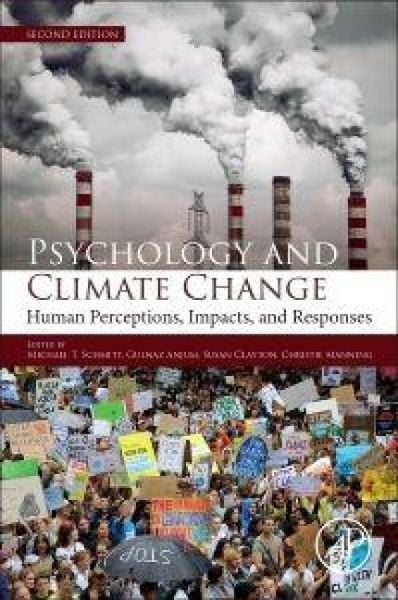
Psychology and Climate Change Human Perceptions, Impacts, and Responses

159,99 €

inkl. gesetzl. MwSt., Versandkostenfrei


Beschreibung

Produktdetails

Einband

Taschenbuch

Erscheinungsdatum

01.07.2026

Herausgeber

Schmitt Michael T. + weitere

Verlag

Elsevier

Seitenzahl

325

Maße (L/B)

22,9/15,2 cm

Gewicht

450 g

Auflage

2. Auflage

Sprache

Englisch

ISBN

978-0-443-34162-5

Beschreibung

Portrait

Dr. Michael T. Schmitt received his MA and PhD from the University of Kansas, where worked with Nyla Branscombe on the psychological implications of group-based privilege and disadvantage. After two years at Purdue University, Michael has worked at Simon Fraser University where he is now a professor of social psychology. He is a White settler grateful to live and work on the unceded territories of the Tsleil-Waututh (səl̓ilw̓ətaʔɬ), Kwikwetlem (kʷikʷəƛ̓əm), Squamish (Sḵwx̱wú7mesh Úxwumixw) and Musqueam (xʷməθkʷəy̓əm) Nations. Michael’s current work applies critical psychology perspectives and a social identity lens to climate change and environmental activism.

Dr. Gulnaz Anjum (she/her) is a Researcher in the Department of Psychology at the University of Oslo (Norway). Her research and teaching focus on climate justice and Global South perspectives. Dr. Anjum examines how climate change, gendered vulnerability, and displacement intersect to shape health and psychosocial wellbeing in marginalised communities across South Asia, Africa, Latin America, and migrant contexts in the Global North. Drawing on feminist, decolonial, and community-based approaches, she investigates how structural inequalities and environmental stressors constrain agency, repair, and adaptive capacity, while also advancing frameworks for equitable climate governance. Dr. Anjum’s research and collaborations have been supported by major international funders, including the International Development Research Centre (IDRC, Canada), UK Research and Innovation (UKRI), and the Higher Education Commission of Pakistan (HEC).

Dr. Susan Clayton is the Whitmore-Williams Professor of Psychology at the College of Wooster in Ohio. Her PhD, in social psychology, is from Yale University. Dr. Clayton’s research examines people’s relationship with the natural environment, how it is socially constructed, and how it is affected by changing environmental conditions; she is co-author of the widely used Climate Change Anxiety Scale. A fellow of the American Psychological Association and the International Association of Applied Psychology, she was a lead author on the Sixth Assessment Report of the Intergovernmental Panel on Climate Change. She continues to research the ways in which climate change is affecting people’s lives and well-being.

Dr. Christie Manning, PhD, is a cognitive and biological psychologist who teaches in the interdisciplinary Environmental Studies Department at Macalester College in Minnesota. Her research explores how climate storytelling influences the psychological antecedents of community-level climate action, and how climate injustice impacts human well-being. Her recent co-authored books include Fostering Sustainability in Higher Education, and the academic textbook, Psychology for Sustainability, 6e. Dr Manning is a Fellow of the American Psychological Association.

Produktdetails

Einband

Taschenbuch

Erscheinungsdatum

01.07.2026

Herausgeber

Verlag

Elsevier

Seitenzahl

325

Maße (L/B)

22,9/15,2 cm

Gewicht

450 g

Auflage

2. Auflage

Sprache

Englisch

ISBN

978-0-443-34162-5

Herstelleradresse

Libri GmbH
Europaallee 1
36244 Bad Hersfeld
DE

Email: GPSR Kontakt

Noch keine Bewertungen vorhanden

Verfassen Sie die erste Bewertung zu diesem Artikel

Helfen Sie anderen Kundinnen und Kunden durch Ihre Meinung.

Kundinnen und Kunden meinen

Bewertungen (0)

Die Leseprobe wird geladen.
  • Produktbild: Psychology and Climate Change
  • 1. Introduction: Psychology and Climate Change

    Part I: Perceptions and Communication
    2. Perceptions of Climate Change
    3. Climate Change Communication: Challenges, Insights, and Opportunities

    Part II: Responding to Climate Change
    4. Unrealized Potential: Leveraging Psychology to Advance High-Impact Consumer Behaviors for Climate Change Behavior
    5. The Emotional Drivers of Climate Action: Anticipatory, Moral, and Self-Transcendent Emotions
    6. Mobilizing Collective Identity: Harnessing Group Processes to Drive Climate Action
    7. The Psychology of Effective Climate Activism: Building Movements, Influencing Change, and Responding to Opposition
    8. Leading Organizations Toward Climate Action

    Part III: Wellbeing and Resilience
    9. Threats to Mental Health and Wellbeing Associated with Climate Change
    10. Children and youth in the climate crisis: A developmental perspective
    11. Community resilience to climate change: Advancing research, equity, and collaborative action

    Part IV: Incorporating Equity and Justice
    12. Psychological Dimensions of Climate Justice
    13. Gender Inequality and Eco-Feminist Approaches to Climate Change
    14. The Psychology of Climate Conflicts and Green Mediation
    15. Decolonizing Climate Psychology: Climate Coloniality and Pathways for Transformation
    16. Conclusions