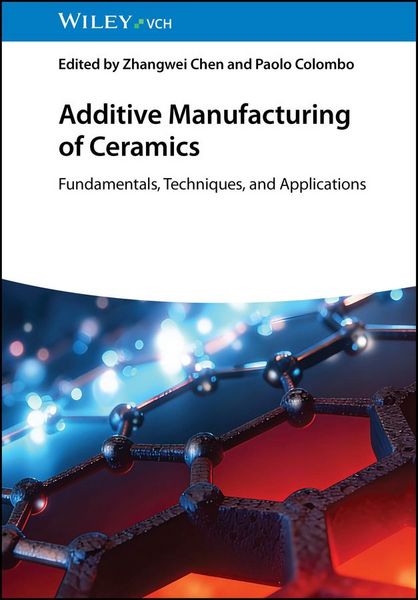
Produktbild: Additive Manufacturing of Ceramics
Neu

Additive Manufacturing of Ceramics Fundamentals, Techniques and Applications

158,99 €

inkl. gesetzl. MwSt., Versandkostenfrei


Beschreibung

Produktdetails

Einband

Gebundene Ausgabe

Erscheinungsdatum

19.08.2026

Herausgeber

Zhangwei Chen + weitere

Verlag

Wiley-VCH

Seitenzahl

368

Maße (L/B/H)

24,4/17/1,5 cm

Gewicht

666 g

Auflage

1. Auflage

Sprache

Englisch

ISBN

978-3-527-35502-0

Beschreibung

Portrait

Zhangwei Chen is currently a full professor and the director of Additive Manufacturing Institute at Shenzhen University. He is a distinguished scholar of the University. He earned his PhD from Imperial College London, and his master degree from Xi'an Jiaotong University and Ecole Centrale de Lyon. His research focuses on the additive manufacturing of high- performance materials, and he has published over 140 papers with a citation of 5700 times.

Paolo Colombo is a professor at the University of Padova, Italy and an adjunct Professor at the State University of Pennsylvania in the United States. He has long been engaged in the preparation and additive manufacturing of non-metallic materials, especially advanced ceramics, glass and oligomer materials. So far, he has published more than 350 academic papers in journals.

Produktdetails

Einband

Gebundene Ausgabe

Erscheinungsdatum

19.08.2026

Herausgeber

Verlag

Wiley-VCH

Seitenzahl

368

Maße (L/B/H)

24,4/17/1,5 cm

Gewicht

666 g

Auflage

1. Auflage

Sprache

Englisch

ISBN

978-3-527-35502-0

Herstelleradresse

Wiley-VCH GmbH
Boschstraße 12
69469 Weinheim
DE

Email: wiley-vch@kolibri360.de

Noch keine Bewertungen vorhanden

Verfassen Sie die erste Bewertung zu diesem Artikel

Helfen Sie anderen Kundinnen und Kunden durch Ihre Meinung.

Kundinnen und Kunden meinen

Bewertungen (0)

  • Produktbild: Additive Manufacturing of Ceramics


  • Preface

    1. Introduction

    1.1 Most important properties and applications of ceramics

    1.2. Typical processing routes and manufacturing techniques for ceramics

    1.3. Challenges and the need for additive manufacturing

    1.4. Brief introduction to ceramic additive manufacturing techniques

    1.5. Summary of the book

    1.6. Conclusions

    References

    2. Vat photopolymerization (VPP)

    2.1. Introduction

    2.2. Photopolymerization 3D printing processes for ceramic parts

    2.3. Process modeling and simulation

    2.4. Advantages and limits of VAT processes

    2.5. AM hybridization opportunities

    2.6. Next generation ceramic printing: Two photon photopolymerization and volumetric additive manufacturing methods

    2.7 Conclusion

    References

    3. Binder Jetting (BJT) and Material jetting (MJT)

    3.1. Inkjet printing

    3.2 Binder Jetting (BJT)

    3.3 Material Jetting (MJT)

    3.4 Post-processes

    References

    4. Material extrusion (MEX)

    4.1 Introduction

    4.2 Direct ink writing

    4.3 Fused filament fabrication

    4.4 Heat treatment and post-processing

    4.5 AM of fiber-reinforced composites

    4.6 Summary

    References

    5. Powder bed fusion (PBF)

    5.1. Short historical background of PBF

    5.2. Terminology focus

    5.3. Indirect - Powder Bed Selective Laser Processing (PBSLP)

    5.4. Direct - Powder Bed Selective Laser Processing (PBSLP)

    5.5. Process parameters PBF

    5.6. Heat treatment and post-processing

    5.7. Conclusion

    References

    6. Directed Energy Deposition (DED)

    6.1. Introduction

    6.2. Advantages and Limitations of DED

    6.3. Powder Characteristics

    6.4. DED Processing Related Challenges

    6.5. Processing via DED

    6.6. Monolithic Ceramics

    6.7. Metal Matrix Composites via DED

    6.8. Current Challenges and Future Directions

    6.9. Summary

    References


    7. Hybrid AM of ceramics and AM of ceramic-based multi-material components

    7.1. Hybrid Additive Manufacturing of ceramics

    7.2. Additive Manufacturing of ceramic-based multi-material components

    7.3. Applications

    7.4. Conclusion and Outlook for AM of ceramic multi-material components

    References

    8. Design and characterization of AM of ceramics

    8.1. Introduction

    8.2. Model design - General rules for ceramic AM

    8.3. Topological optimization and numerical simulation

    8.4. Characterization of the feedstocks prior to printing

    8.5. Characterization of the parts before and after heat processing

    8.6. Summary

    References

    9. Industrial VPP equipment for AM of functional ceramic composites

    9.1. Introduction

    9.2. Materials and Rheology

    9.3. Processing

    9.4. Reproducibility

    9.5. Quality Management, Compliance, and Performance Metrics

    9.6. Economic and Regulatory Considerations

    9.7. Industrial applications of lithography based ceramic AM

    9.8. Market considerations and selection guidance

    9.9. Multi-material additive manufacturing

    9.10. Multi-material AM of ceramic composites with LCM

    9.11. Applications for LCM multi-material printing

    9.12. Future research

    9.13. Summary

    References

    10. Applications and Impacts of AM of Ceramics

    10.1. Aerospace and defense applications

    10.2. Chemical applications

    10.3. Electronic and semiconductor applications

    10.4. Biomedical applications

    10.5. Detailed case studies of ceramic AM applications

    10.6. Cross-domain value and systemic impact of ceramic additive manufacturing

    10.7. Conclusion

    References

    11. New Developments and Perspectives

    11.1. Introduction

    11.2. Green/smart design and manufacturing

    11.3. 4D/5D Printing

    11.4. Potentials and Challenges

    References