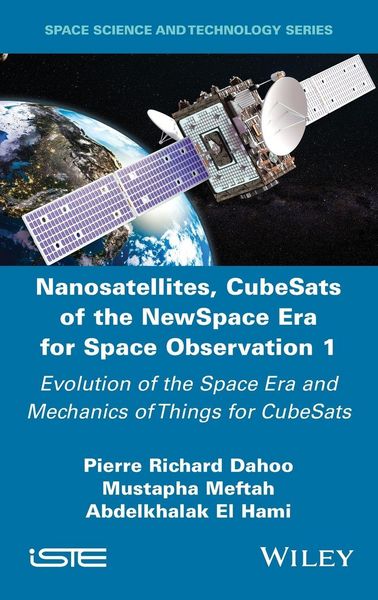
Produktbild: Nanosatellites, CubeSats of the NewSpace Era for Space Observation 1

Nanosatellites, CubeSats of the NewSpace Era for Space Observation 1

164,99 €

inkl. gesetzl. MwSt., Versandkostenfrei


Beschreibung

Produktdetails

Einband

Gebundene Ausgabe

Erscheinungsdatum

14.11.2025

Verlag

John Wiley & Sons

Seitenzahl

226

Maße (L/B/H)

23,4/15,6/1,4 cm

Gewicht

496 g

Sprache

Englisch

ISBN

978-1-83669-021-4

Beschreibung

Produktdetails

Einband

Gebundene Ausgabe

Erscheinungsdatum

14.11.2025

Verlag

John Wiley & Sons

Seitenzahl

226

Maße (L/B/H)

23,4/15,6/1,4 cm

Gewicht

496 g

Sprache

Englisch

ISBN

978-1-83669-021-4

Herstelleradresse

Libri GmbH
Europaallee 1
36244 Bad Hersfeld
DE

Email: gpsr@libri.de

Noch keine Bewertungen vorhanden

Verfassen Sie die erste Bewertung zu diesem Artikel

Helfen Sie anderen Kundinnen und Kunden durch Ihre Meinung.

Kundinnen und Kunden meinen

Bewertungen (0)

Die Leseprobe wird geladen.
  • Produktbild: Nanosatellites, CubeSats of the NewSpace Era for Space Observation 1
  • Foreword ix
    Philippe KECKHUT

    Introduction xi

    Chapter 1. The NewSpace Era 1
    1.1. The space age and its evolutions 2
    1.1.1. The first artificial satellites 2
    1.1.2. Planet Earth and its near and distant environment 5
    1.1.3. Exploring the near and distant Universe 5
    1.1.4. Space activities 7
    1.2. NewSpace in the 21st century 8
    1.2.1. Development priorities for the NewSpace era 11
    1.2.2. Research development 11
    1.3. The space system 13
    1.3.1. The system concept 14
    1.3.2. Designing a space system 16
    1.3.3. The two main sectors of a space system 16
    1.4. Implementing a space project 17
    1.4.1. The initial spatial project and management methods 17
    1.4.2. Key issues from idea to realization 19
    1.4.3. Academia and industry 20
    1.4.4. Questions and steps once the project is defined 20
    1.5. Building a spacecraft 25
    1.5.1. Spacecraft subsystems 25
    1.5.2. Example of an optical payload 26
    1.6. The digital twin of a space vehicle 30
    1.7. Conclusion 33
    1.8. Appendix 34
    1.8.1. Worldwide satellite development 34
    1.8.2. Electromagnetic theory 36
    1.8.3. Light-matter interaction 43

    Chapter 2. Orbital Parameters of a CubeSat 51
    2.1. Using conics to describe a satellite orbit 52
    2.1.1. Conics 52
    2.1.2. Observations, analyses and laws of physics 53
    2.1.3. From Babylon's Goseck to Aristotle's Ancient Greece 53
    2.1.4. Copernicus' heliocentric approach and Kepler's laws 54
    2.1.5. The Galilean frame of reference and Galileo's principle of relativity 56
    2.1.6. Newton's law of universal gravitation 58
    2.1.7. Lagrange's and Hamilton's analytical mechanics 61
    2.1.8. The principles of relativity and equivalence 64
    2.2. Selecting orbital parameters 69
    2.2.1. Keplerian parameters of a satellite's orbit around the Earth 69
    2.2.2. The different types of orbit 72
    2.2.3. Orbit parameters, beta angle and orbit eclipse duration 74
    2.3. Conclusion 77
    2.4. Appendix 78
    2.4.1. Coordinate systems and point mechanics 78
    2.4.2. Classical point mechanics 86
    2.4.3. The metric tensor in general relativity 88

    Chapter 3. Space Launchers for CubeSat Satellites 93
    3.1. Propulsion systems and launch sites 93
    3.2. Launcher selection and satellite orbiting 95
    3.3. Important parameters for launcher selection. 102
    3.4. Setting up and maintaining a satellite 106
    3.4.1. CubeSat trajectory 114
    3.5. Conclusion 115
    3.6. Appendix 116
    3.6.1. The mechanics of a solid body 116
    3.6.2. Euler angles and rotation matrix 119
    3.6.3. Quaternions 122
    3.6.4. Lagrange points 124
    3.6.5. Calculating the L1 and L2 Lagrange points of the Sun-Earth system 126
    3.6.6. Center of inertia for a two-body system 130
    3.6.7. SU(2) and SO(3) groups 133

    Chapter 4. Designing a CubeSat 137
    4.1. CubeSats, microsats, nanosats and picosats engineering systems 137
    4.1.1. Systems approach and engineering 137
    4.1.2. Key satellite design parameters 139
    4.1.3. CubeSat design requirements and constraints 140
    4.2. CubeSat structure 141
    4.3. CubeSat mission implementation 148
    4.4. Communications and ground connections 148
    4.5. CubeSat architecture 153
    4.5.1. Mechanical architecture of a CubeSat 154
    4.5.2. Materials for mechanical architecture 158
    4.5.3. The environment of mechanical architecture 160
    4.5.4. Dimensions of mechanical architecture 162
    4.6. Conclusion 169
    4.7. Appendix 169
    4.7.1. Elastic and thermal properties of a physical system 169
    4.7.2. Finite element method (FEM) 174
    4.7.3. Modal analysis of structural components 182
    4.7.4. UVSQ-SAT production phases 186

    Conclusion 189
    References 191
    Index 205