Gutscheinbedingungen

Gültig bis 13.07.2026 | Gültig für Spielzeug (außer Tonieboxen & ausgewählte Tonies), Filme, Musik, Software, Games, Schreibwaren, Hörbücher und Hörbuch-Downloads (außer Abo & Shelfies), gebrauchte Bücher, nicht preisgebundene Bücher und Kalender | Einlösbar unter osiander.de und in der Osiander App | Click & Collect nur mit Online-Zahlung (Paypal/Kreditkarte) vorab | Einzelne Artikel können ausgeschlossen sein | Nicht kombinierbar mit anderen Gutscheinen oder Preisaktionen | Nur einmal pro Einkauf einlösbar | Gutschein wird auf max. 500€ Bestellwert angerechnet | Keine Barauszahlung | Digitale Hörbücher nur für Android | Nicht gültig für preisgebundene Artikel (aufgrund der Buchpreisbindung sind Gutscheine nicht auf Bücher, eBooks, Presse einlösbar), tolino eReader & Zubehör, Elektronik, Geschenke & Trends, Abonnements & Flatrates, Geschenkkarten, Versandkosten und Services

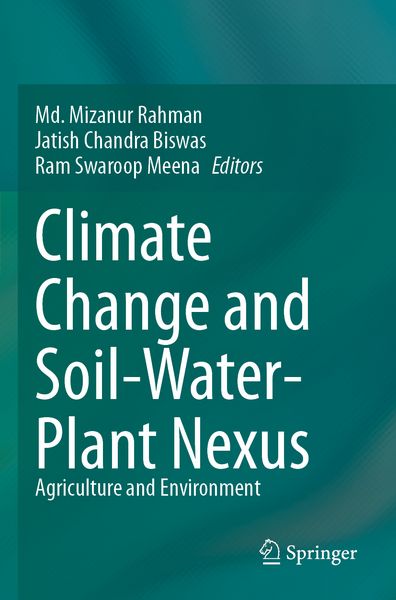
Produktbild: Climate Change and Soil-Water-Plant Nexus
- 11%

Climate Change and Soil-Water-Plant Nexus Agriculture and Environment

11% sparen

218,99 € UVP 246,09 €

inkl. gesetzl. MwSt., Versandkostenfrei


Beschreibung

Produktdetails

Einband

Taschenbuch

Erscheinungsdatum

11.11.2025

Herausgeber

Md. Mizanur Rahman + weitere

Verlag

Springer Singapore

Seitenzahl

571

Maße (L/B/H)

23,5/15,5/3 cm

Gewicht

979 g

Auflage

1. Auflage

Sprache

Englisch

ISBN

978-981-9766-37-6

Beschreibung

Portrait

Prof. Md. Mizanur Rahman of Bangabandhu Sheikh Mujibur Rahman Agricultural University completed MS and PhD from Asian Institute of Technology, Thailand. Beyond teaching, he supervised 12 PhD students and over 85 MS students in different areas of soil, environment and crop science. He has completed several national and international funded research projects as a Principal/Co-Principal Investigator. Currently, Prof. Rahman is serving as one of the Principal Investigators of the UKRI GCRF South Asian Nitrogen Hub (SANH) and SANH Lead in Bangladesh, Deputy Coordinator of Modeling Climate Change project of Krishi Gobeshona Foundation (KGF), and Focal Point of the USAID funded ‘Feed the Future Bangladesh Climate Smart Agriculture (CSA) Activity Project’. He is keen to research carbon sequestration, reactive nitrogen, global warming and climate change, waste management, nutrient recycling, soil fertility management, arsenic mitigation, soil and environmental pollution etc. Prof. Rahman is involved with different professional and social societies as a Life Member. He has published 126 research articles in renowned international and national journals and 5 book chapters.


Jatish Chandra Biswas is a researcher who worked with Bangladesh Rice Research Institute and Krishi Gobeshona Foundation. The Bangladesh Agricultural University, Mymensingh and the University of the Philippines Los Baños, Philippines shaped his career. He is the author of several books, booklets, and book chapters, and has published about 100 scientific articles in national and international journals. He is the second most cited researcher of Bangladesh Rice Research Institute.


Dr. Ram Swaroop Meena is working in the Department of Agronomy, Institute of Agricultural Sciences, BHU, Varanasi (UP). Dr. Meena has secured first division in all the classes with triple NET, JRF, and SRF from the ICAR and RGNF Awardee from the UGC, GOI. He is a Fellow of the National Academy of Agricultural Sciences (FNAAS) and the National Academy of Biological Sciences (FNABS) and Fellow Society for Rapeseed-Mustard Research. He was a visiting scientist at IRRI-ISARC under an INSA fellowship. Dr. Meena has been awarded the Raman Research Fellowship by the Ministry of Education, GOI. He has been listed in the World's Top 2% Scientists by the Stanford University, USA, and Elsevier report. He has experience with ten externally funded projects as PI/Co-PI, including running projects from IoE, BHU, SERB-DST, ICAR, MOE, GOI. He has the right to one patent on low-cost biochar preparation. Dr. Meena has published more than 120 international research and review papers in peer-reviewed reputed journals with an H-index of 63, an I-10 index of 173, citations over 12,000 and a total impact factor of 398.37, with the highest 16 and average of 3.9 impact factor. He has published 30 books and contributed 95 chapters. His research interest is to reduce soil organic carbon oxidation and enhance stability in agroecosystems for farmers' benefit through carbon credits.


Produktdetails

Einband

Taschenbuch

Erscheinungsdatum

11.11.2025

Herausgeber

Verlag

Springer Singapore

Seitenzahl

571

Maße (L/B/H)

23,5/15,5/3 cm

Gewicht

979 g

Auflage

1. Auflage

Sprache

Englisch

ISBN

978-981-9766-37-6

Herstelleradresse

Springer-Verlag KG
Sachsenplatz 4-6
1201 Wien
AT

Email: GPSR Kontakt

Noch keine Bewertungen vorhanden

Verfassen Sie die erste Bewertung zu diesem Artikel

Helfen Sie anderen Kundinnen und Kunden durch Ihre Meinung.

Kundinnen und Kunden meinen

Bewertungen (0)

  • Produktbild: Climate Change and Soil-Water-Plant Nexus
  • Chapter 1: Soil and Water: A Source of Life.- Chapter 2: Technological Intervention for Climate Change Adaptation and Mitigation.- Chapter 3: Digital Soil Mapping: A Tool for Sustainable Soil Management.- Chapter 4: Advances in the Use of Remote Sensing Techniques to Assess Crop Nitrogen Status.- Chapter 5: Nitrogen Management Options: Challenges Potentials, and Prospects.- Chapter 6:Nitrogen Use Efficiency and Agricultural Sustainability.- Chapter 7: Soil, Water and Crop Management Practices to Mitigate Greenhouse Gas Emission.- Chapter 8:Role of microorganisms in soil health management.- Chapter 9: Climate Change and its Impacts on Disease Dynamics in Major Cereal Crops.- Chapter 10: Interannual Climate Variability and its Impacts on Major Crop Productivity.- Chapter 11:Plant Nutrient Availability in Acid Soil and Management Strategies.- Chapter 12:Nutrient and Soil Moisture Dynamics under Changing Climate.- Chapter 13:Soil Management and Crop Adaptation in The Saline Areas.- Chapter 14:Current Scenario and Challenges for Agricultural Sustainability.- Chapter 15: Carbon Sequestration and Climate Change Mitigation.- Chapter 16: Agricultural Abiotic Stresses in the Tropical and Sub-Tropical Agroecosystem.- Chapter 17: Consumption of Biologically Fixed Green Nitrogen and Agricultural Sustainability.- Chapter 18: Land Use Change and Soil Erosion: Way Forward to Management.