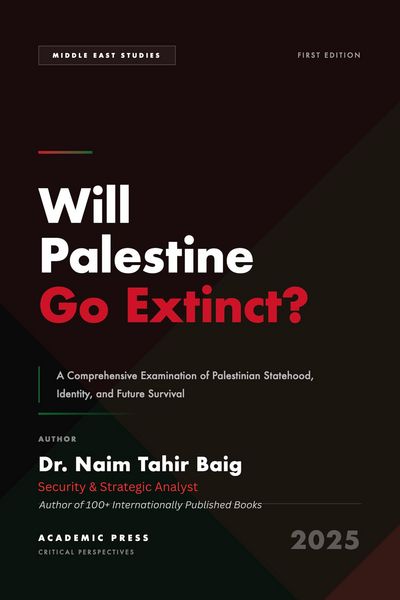
Will Palestine Go Extinct?
-
- Einzelkauf Download ausgewählt
-
Sprache:Englisch
3,99 €
inkl. gesetzl. MwSt.Beschreibung
Produktdetails
Format
ePUB
Kopierschutz
Ja
Family Sharing
Ja
Text-to-Speech
Ja
Erscheinungsdatum
03.12.2025
Verlag
Dr Naim Tahir BaigSeitenzahl
(Printausgabe)
Dateigröße
527 KB
Sprache
Englisch
EAN
9798232066673
BOOK DESCRIPTION
Will Palestine Go Extinct?
A Comprehensive Examination of Palestinian Statehood, Identity, and Future Survival
In July 2024, the International Court of Justice delivered a landmark advisory opinion declaring Israel's occupation of Palestinian territorythe West Bank, East Jerusalem, and Gazaunlawful under international law. The Court mandated Israel to cease all settlement activities, evacuate settlers, and provide full reparations to Palestinian victims. Yet as this ruling was being delivered, the Palestinian population in Gaza was enduring what the United Nations has described as an unprecedented humanitarian catastrophe, with over 45,000 lives lost since October 2023 and 96% of the population facing acute food insecurity.
Will Palestine Go Extinct? confronts one of the most pressing and provocative questions of our time: Can a nation survive without a state? At approximately 14.9 million people worldwidewith 5.5 million in the Palestinian territories, 1.8 million in Israel, and 7.6 million in diasporaPalestinians constitute a demographically robust population. Yet they remain stateless, fragmented across continents, and subject to an occupation now entering its sixth decade. This meticulously researched work examines whether Palestinian national existence is threatened with extinction across multiple dimensions: territorial, political, cultural, and demographic.
Drawing on data from the Palestinian Central Bureau of Statistics, UNRWA (which serves 5.9 million registered Palestinian refugees), the International Court of Justice, and leading human rights organizations including Amnesty International, Human Rights Watch, and B'Tselem, Dr. Baig presents a comprehensive analysis grounded in verifiable sources. The book examines the expansion of Israeli settlementsnow exceeding 700,000 settlers in the West Bank and East Jerusalemand the systematic fragmentation of Palestinian territory that has led major human rights organizations to designate the situation as one of apartheid.
The work traces the historical trajectory from the Nakba of 1948, when 750,000 Palestinians became refugees, through the 1967 occupation, the Oslo Accords, and the current crisis. It analyzes the death of the two-state solution as settlement blocs have rendered territorial contiguity increasingly impossible, while also exploring alternative futures including confederation models, one democratic state scenarios, and the grim possibility of permanent occupation.
Yet Will Palestine Go Extinct? is not merely a chronicle of dispossession. It documents Palestinian resiliencethe concept of sumud (steadfastness)that has preserved identity across generations and geography. It examines the growing international recognition of Palestine by over 146 countries, the impact of the BDS movement, and the shifting global opinion that has seen major powers including the United Kingdom, Canada, and Australia formally recognize Palestinian statehood in 2024-2025.
Comparative analysis places the Palestinian case alongside other nations that survived existential threatsthe Jewish people before 1948, the Kurds, the Armenians after genocideas well as cautionary tales of national extinction from Native American nations to Tibet. This framework provides crucial context for assessing Palestinian futures.
Written for general readers, policymakers, students, and scholars alike, Will Palestine Go Extinct? combines scholarly rigor with accessible prose. It presents multiple perspectives on contested issues while grounding analysis in international law, verifiable statistics, and documented facts. The conclusion is both sobering and significant: while the Palestinian people and their identity will almost certainly survive, Palestinian political sovereignty may never be achievedand the next decade will be critical in determining which future prevails.
Noch keine Bewertungen vorhanden
Verfassen Sie die erste Bewertung zu diesem Artikel
Helfen Sie anderen Kundinnen und Kunden durch Ihre Meinung.
Kurze Frage zu unserer Seite
Vielen Dank für Ihr Feedback
Wir nutzen Ihr Feedback, um unsere Produktseiten zu verbessern. Bitte haben Sie Verständnis, dass wir Ihnen keine Rückmeldung geben können. Falls Sie Kontakt mit uns aufnehmen möchten, können Sie sich aber gerne an unseren Kund*innenservice wenden.
zum Kundenservice