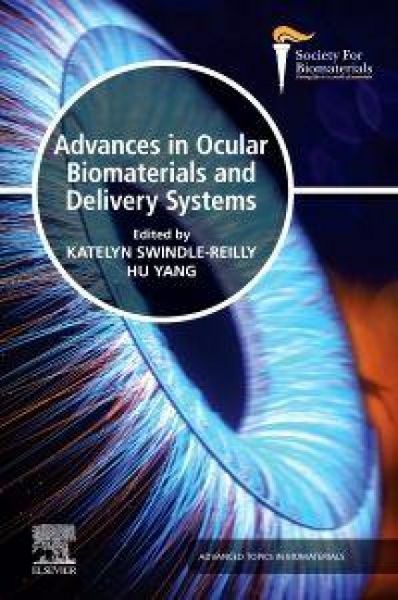
Produktbild: Advances in Ocular Biomaterials and Delivery Systems
Vorbesteller Neu

Advances in Ocular Biomaterials and Delivery Systems

229,99 €

inkl. gesetzl. MwSt., Versandkostenfrei


Beschreibung

Produktdetails

Einband

Taschenbuch

Erscheinungsdatum

02.11.2026

Herausgeber

Katelyn Swindle-Reilly + weitere

Verlag

Elsevier

Seitenzahl

320

Maße (L/B)

22,9/15,2 cm

Gewicht

450 g

Sprache

Englisch

ISBN

978-0-443-33194-7

Beschreibung

Portrait

Dr Katelyn Swindle-Reilly is an Associate Professor and College of Engineering Innovation Scholar, The Ohio State University, Ohio, USA. She is tenured faculty with appointments in Biomedical Engineering, Chemical and Biomolecular Engineering, and Ophthalmology and Visual Sciences at The Ohio State University. She has degrees in Chemical Engineering, with a B.S. from Georgia Institute of Technology, and M.S. and Ph.D. from Washington University in St. Louis. She has managed multiple research projects from initial research phase through manufacturing and regulatory approval, including serving as Chief Technology Officer of an ophthalmic startup company. Dr. Swindle-Reilly’s research lab focuses on the design of polymeric biomaterials for soft tissue repair and drug delivery with focused applications in ophthalmology.

Dr. Hu Yang is the Department Chair and Professor in the Linda and Bipin Doshi Department of Chemical and Biochemical Engineering at Missouri University of Science and Technology, Rolla, Missouri (Missouri S&T), USA, where he also holds the Linda and Bipin Doshi Endowed Chair position. Prior to joining Missouri S&T in 2020, he was a professor at Virginia Commonwealth University and held the Qimonda Endowed Chair Professorship with appointments with chemical and life science engineering, biomedical engineering, and pharmaceutics since 2005. Dr. Yang earned his Ph.D. in Chemical Engineering from the University of Akron in 2004, followed by postdoctoral training in pharmaceutical sciences at the University of Wisconsin-Madison from 2004 to 2005. Dr. Yang’s research is dedicated to developing advanced drug and gene delivery systems that enhance therapeutic effectiveness and improve patient compliance while also promoting translational and convergent research and education. His research has attracted substantial funding from agencies like the NIH, NSF, and USDA, totaling $24 million in roles as PI or Co-PI/I. Dr. Yang has published 110 peer-reviewed articles (h-index 43), received five patents, and he has been recognized in the Stanford Report (Elsevier) as one of the top 2% most-cited scientists in biomedical engineering for his career impact.

Produktdetails

Einband

Taschenbuch

Erscheinungsdatum

02.11.2026

Herausgeber

Verlag

Elsevier

Seitenzahl

320

Maße (L/B)

22,9/15,2 cm

Gewicht

450 g

Sprache

Englisch

ISBN

978-0-443-33194-7

Herstelleradresse

Libri GmbH
Europaallee 1
36244 Bad Hersfeld
DE

Email: GPSR Kontakt

Noch keine Bewertungen vorhanden

Verfassen Sie die erste Bewertung zu diesem Artikel

Helfen Sie anderen Kundinnen und Kunden durch Ihre Meinung.

Kundinnen und Kunden meinen

Bewertungen (0)

  • Produktbild: Advances in Ocular Biomaterials and Delivery Systems
  • 1. Introduction
    2. Innovation Milestones in the History of Biomaterials in Ophthalmology (1789 to 1991)
    3. Polymeric materials for ophthalmic applications
    4. Evolution of ophthalmic drug delivery by contact lenses
    5. Biomaterials approaches for vitreous substitutes and implants
    6. Outline: Biomaterials Approaches to Ocular Gene Delivery
    7. Microneedle-based drug delivery systems for the treatment of ocular diseases
    8. Novel delivery for diabetic retinopathy and macular degeneration
    9. Nanomedicine for posterior degenerative, neovascular, and inflammatory ocular disorders
    10. Supramolecular assembly of nanomedicine in the diagnosis and treatment of ocular diseases: from drug design to applied research
    11. Drug delivery systems for glaucoma
    12. Ocular Hypertension Glaucoma Model and Normal Tension Glaucoma Model
    13. New glaucoma model for testing drug delivery systems
    14. Future perspectives and clinical translation